
- Top Pick: Ski Goggles, Snowboard Goggles with 2 UV400 Anti-Fog Detachable Magnet Lenses for Men & Women Adult
- Best Value: OutdoorMaster Ski Goggles PRO, OTG Snow Goggles with Interchangeable Lens | Frameless Quick-change Magnetic Ski Goggles for Men & Women with Anti-fog, OTG Fit, UV400 Protection, Protective Case
- Premium Choice: Ski Goggles, Snowboard Goggles with 2 UV400 Anti-Fog Detachable Magnet Lenses for Men & Women Adult
The Smith I/O Mag and the Anon M-series, especially the M4 Toric and the newer M5 and M6, are the magnetic goggles reviewers return to most, with Smith favoured for smaller faces and Anon for larger frames and fast lens swaps. If your priority is optics and field of view at a premium tier, the Smith 4D Mag is the model outlets keep singling out.
As an Amazon Associate we earn from qualifying purchases at no extra cost to you.


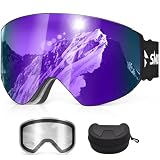

What magnetic actually means
Magnetic goggles use embedded magnets or a magnet-assisted frame to hold the lens in place, so you can change it quickly with gloves on. Different makers pair magnets with mechanical clips, so the feel of a swap varies. Reviewers say Anon’s system is among the smoothest, with the M5 rated above Smith’s Mag system in one outlet’s comparison, while Smith is praised for its lens range and optics.
At a glance
| Goggle | Best for | Reviewer notes | Limits |
|---|---|---|---|
| Smith I/O Mag | All-round use | Chosen best overall by Treeline Review; GearJunkie lists the ChromaPop version as its best overall | Fit can feel snug on larger faces |
| Smith 4D Mag | Optics and wide field of view | OutdoorGearLab names it best tested; Better Trail also praises the view | Premium tier, and a large frame |
| Anon M4 Toric | Large goggle, storm days | OutdoorGearLab calls it its top recommendation for a big-frame goggle | Bulky on small faces |
| Anon M5 | Quick lens swaps | Treeline reviewers rate its magnetic swap above Smith | Check fit against helmet |
| Anon M6 | Newest swap system | Better Trail describes it as the smoothest magnetic change | Premium tier |
| Giro Contour | Optical clarity with breathability | OutdoorGearLab places its optics near the Anon M4 | Premium tier |
Oakley’s Flight Deck is also praised for optics but, according to OutdoorGearLab, uses Oakley’s Ridgelock system rather than magnets, so it is a non-magnetic alternative.
Features to weigh
Lens swap system
Ask whether the swap works with gloves on and whether you can do it in wind without dropping the lens. Magnets help with alignment, though some designs add a mechanical lock for security. Anon has also built a balaclava attachment called MFI that snaps the face mask onto the goggle frame.
Lens tech and spare lenses
Most makers sell a flat-light lens and a bright-light lens. Smith lists ChromaPop contrast lenses, Anon offers its Perceive and other tints. Buying a second lens makes more sense than buying a second goggle, and magnetic systems make that practical.
Frame size and helmet fit
Reviewers report that testers with smaller faces tended to prefer Smith and those with larger faces preferred the Anon M4. Always try goggles with your helmet, because gaps at the brow can cause cold air, fogging and pressure points.
Ventilation and fogging
Goggle fog comes from moisture trapped between lens and face. Better venting, double lenses and anti-fog coatings all help. Giro is credited with extra breathability in one review.
Field of view
Wider frames cost more and add bulk, but the improvement in peripheral vision is what outlets cite when praising the Smith 4D Mag and the Anon M4 Toric.
Budget tiers
| Tier | Expect | Trade-off |
|---|---|---|
| Budget | Fewer magnetic models, basic lens, simpler venting | Often slower swap or a clip-based system |
| Mid-range | Magnetic swap, quality anti-fog, a spare-lens option | Lens range may be narrower |
| Premium | Top optics, large field of view, refined swap mechanism | Higher cost and bulkier frames |
The models discussed here sit mostly in the mid-to-premium tiers. Treat the budget segment with care and read maker specs closely, since some lower-tier goggles use the term magnetic loosely.
Pick X if…
| If you… | Pick |
|---|---|
| Want one goggle for everything | Smith I/O Mag |
| Care most about optics and view | Smith 4D Mag or Giro Contour |
| Have a larger face or wear a thick helmet | Anon M4 Toric |
| Swap lenses often in changing light | Anon M5 or M6 |
| Prefer a face mask that attaches to the goggle | Anon models with MFI |
| Do not need magnets | Oakley Flight Deck or a clip system |
Alternatives
- Non-magnetic goggles with spare lenses: Clip systems can be cheaper and are reported to be secure.
- Photochromic lenses: They adjust to light and reduce swapping. Speed of change varies between makers.
- Goggle plus sunglasses: For warm spring skiing, some skiers choose sunglasses on bright days and goggles in storms.
Common mistakes
- Buying without checking the helmet match.
- Carrying a spare lens loose in a pocket, where it scratches.
- Wiping the inside of the lens, which can damage the anti-fog coating. Shake off moisture and let it air dry.
- Choosing a dark lens for low-light days.
Care, storage and travel
Goggle lenses carry coatings that scratch and peel if handled roughly. Shake off water after use, let the goggle dry away from direct heat, and store it in the soft bag or hard case it came with. Keep spare lenses in their own pouches or the maker’s lens case so they do not rub together. When flying, pack goggles in a carry-on or a padded case. If a magnetic lens ever feels loose, clean the contact edges and reseat it following the manual, and contact the maker if it will not hold. Avoid leaving goggles on a dashboard in the sun, which can warp foam and frames.
Matching lenses to conditions
Light transmission is usually listed as a percentage by the maker. Lower numbers suit bright sun, higher numbers suit overcast or evening skiing. A common plan is to own one general-purpose lens for most days and one specialist lens for flat light or full sun, swapping as the weather changes. Photochromic options reduce the need to swap but adjust at a speed that varies by maker, so read the listing before relying on one for fast changes.
Frequently Asked Questions
Are magnetic ski goggles worth it?
They are convenient if you ski in changing light and want to swap lenses quickly, even with gloves on. If you only ski sunny days, a single-lens goggle may be sufficient.
Which brand has the best magnetic lens swap?
Reviewers lean toward Anon, with Better Trail calling the M6 the smoothest and Treeline rating the M5 above Smith. Smith still earns credit for optics and its overall package.
Do magnetic lenses fall out?
Makers design the systems to hold in normal use, often with a mechanical lock or tab in addition to magnets. A hard impact can still pop a lens, so follow the maker instructions for seating it.
Can I wear glasses under them?
Some frames are marked as OTG-friendly, which means they have room for glasses. Check the maker listing and try them on with your glasses.
What lens colour for flat light?
Yellow, rose or amber tints are commonly used in flat or low light, while darker mirrored lenses suit bright sun. Each maker names its tints differently, so read the light-transmission guidance.
How do I clean them?
Let moisture dry, use the microfibre bag the goggle comes with, and avoid rubbing the inner lens. Store them in a case between days.







Write Your Review
No reviews yet. Be the first to share your experience!