
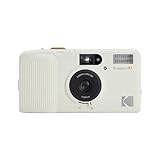
- Top Pick: RETO PANO 35mm Film Camera – 22mm Wide Lens, Panorama, Easy Switch, Cinematic Modes, Lens Cover, Built-in Flash, Reusable (Film & AAA Battery are not Included) (Sheer White)
- Best Value: KODAK EC35 35mm Film Camera 35mm, Reusable, Focus-Free, Built-in Flash, Slide Cover, Beginner Friendly (Film & AA Battery are not Included) (Single, Avocado Green)
- Premium Choice: KODAK Snapic A1 35mm Film Camera 35mm, Reusable, 2-Zone Focus, Lightweight, Compact (Rhino Grey) (Film & AAA Battery are not Included)
The cheapest way into 35mm film is the Kodak Ektar H35, a new half-frame point-and-shoot, while the best low-cost used choices are the Canon AE-1 Program for an easy SLR, the Pentax K1000 for learning manual exposure, and the Olympus Trip 35 for a pocketable compact. Which one fits depends on whether you want to learn exposure, carry something small, or simply press a button and let the lab do the rest.
As an Amazon Associate we earn from qualifying purchases at no extra cost to you.


New versus used: the first decision
A new camera comes with a warranty and no hidden faults, but new 35mm models are few, mostly simple plastic point-and-shoots. A used camera costs less per feature and gives you real optics and manual controls, but it is a gamble on light seals, shutters and meters. Reviewers note that used prices for classics such as the K1000 and AE-1 have climbed between 50 and 100 percent since 2019, yet they remain among the more affordable ways to shoot with a proper lens. Sellers list tested bodies at higher rates than untested “rescue” bodies with known faults, and a working light meter is a common dividing line.
At a glance: the cheap 35mm shortlist
| Camera | Type | Stated features | Best for | Limits |
|---|---|---|---|---|
| Kodak Ektar H35 | New half-frame compact | Half-frame format gives about 72 images from a 36-exposure roll | Beginners who want the lowest entry point | Simple fixed lens, limited control, small negatives |
| Canon AE-1 Program | Used SLR | Program and shutter-priority auto exposure, FD lens range | A balanced all-round starter SLR | Battery dependent; older bodies may need servicing |
| Pentax K1000 | Used manual SLR | Fully mechanical shutter; battery only runs the meter | Learning aperture, shutter speed and ISO | No auto modes; meters can be dead |
| Olympus Trip 35 | Used compact | Fixed lens, simple exposure system | Street shooters who want a pocket camera | Prices have risen; condition varies |
Camera by camera
Kodak Ektar H35
The H35 is a plastic half-frame camera, and the half-frame format is its main selling point: each frame uses half the standard negative area, so a roll stretches to double the number of shots. Several 2026 guides list it as the budget or beginner pick, and Expert Photography ranks it among the best overall. The trade-offs are lower resolution per frame, a fixed lens and a flash that you can use but not tune. Half-frame images are also portrait-oriented by default when you hold the camera normally, which surprises some beginners.
Canon AE-1 Program
The AE-1 Program is a long-lived SLR with automatic and manual exposure. It appears at the top of many lists because of its balance of capability, lens availability and price. The concerns are age-related: some bodies develop a squealing mirror damper often called the “Canon cough”, and the camera needs a battery to fire the shutter. A seller that offers a service history or a return window is worth choosing.
Pentax K1000
The K1000 is described as a definitive learning camera. Its shutter is fully mechanical, so a dead battery stops only the meter, not the camera. It gives you three things to master: aperture, shutter speed and film speed. It has no auto exposure, so you read the needle in the viewfinder and set everything yourself. Used listings vary widely, and some sellers sell bodies with a dead meter at lower rates; you can still use a handheld meter or a smartphone app.
Olympus Trip 35
The Trip 35 is a compact fixed-lens camera that suits street photography and daily carry. It has a simple exposure system and a reputation for sharp results with minimal fuss. Prices have risen since 2019 and sellers often list “rescue” units with faults. Its selenium-cell exposure system can fail with age, so a seller that confirms it works is worth the extra cost.
How to choose
Do you want to learn or just shoot?
If you want to understand exposure, the K1000 teaches the fundamentals. If you want results quickly, the H35 or Trip 35 handles more decisions. The AE-1 Program sits in the middle.
Lens ecosystem
An SLR is only as flexible as its lenses. Canon FD and Pentax K mounts both have large used markets. Pentax K lenses also fit later Pentax digital bodies, so lens purchases carry over if you move on.
Condition and servicing
Look for clean viewfinders, working shutter speeds, intact light seals and a working meter. Light-seal foam degrades, causing light leaks, but it can be replaced cheaply. A full service (CLA) can restore older bodies but may cost as much as the camera, so factor it in.
Film costs matter more than the camera
Film and developing are the ongoing expense. Half-frame cameras reduce cost per image. If cost matters, shoot fewer frames carefully and use a lab that scans at reasonable resolution.
Pick this if…
| Pick this if… | Choose |
|---|---|
| You want the lowest entry cost and no repair risk | Kodak Ektar H35 |
| You want one SLR with auto and manual modes | Canon AE-1 Program |
| You want to learn exposure and can accept a basic body | Pentax K1000 |
| You want a pocket camera for walking around | Olympus Trip 35 |
| You want to use the same lenses on a digital body later | Pentax K-mount |
Budget, mid-range and premium tiers
Budget. The H35 and untested “rescue” bodies sit here. Rescue bodies are a gamble and suit people who can repair or accept failure.
Mid-range. Tested and serviced AE-1 Program, K1000 and Trip 35 examples cost more but reduce risk.
Premium. New half-frame cameras such as the Pentax 17 sit above the H35 and offer more control, at a higher outlay than most used SLRs.
Alternatives
- Other classic SLRs. Minolta, Nikon and Olympus bodies from the same era are often available at similar rates.
- Disposable cameras. They remove the thinking but cost more per frame and limit control.
- Rangefinders and compacts. Fixed-lens compacts from the 1970s to 1990s can be inexpensive and sharp but vary in reliability.
Common mistakes
- Buying an untested body and expecting it to work out of the box.
- Ignoring light seals, then blaming film for streaks.
- Buying a camera but not budgeting for film and developing.
- Choosing a rare lens mount with few cheap lenses.
- Forgetting that cheap cameras still need a fresh battery.
Frequently Asked Questions
What is the cheapest 35mm film camera to start with?
The Kodak Ektar H35 is the lowest-cost new option in many 2026 lists, and used rescue-grade bodies can be cheaper but riskier. The H35 is also half-frame, so each roll yields about twice as many images.
Which is better for beginners, the AE-1 Program or the K1000?
The AE-1 Program is easier because it offers automatic exposure, while the K1000 forces you to learn manual control. Pick by how much you want the camera to decide for you.
Do I need a battery for a 35mm film camera?
The AE-1 Program needs one to fire the shutter. The K1000 uses its battery only for the light meter, so the camera still works without it. Compacts vary, so check the maker’s manual.
Is a used film camera safe to buy online?
It can be, if the seller lists tested shutter speeds, meter function and a return policy. Be cautious with listings that are for parts or unknown condition.
What does half-frame mean?
A half-frame camera exposes two pictures in the space of one standard 35mm frame. A 36-exposure roll yields about 72 images, but each negative is smaller and has less detail.
Are film cameras getting more expensive?
Reviewers report that classic bodies like the K1000 and AE-1 have risen noticeably since 2019. They remain accessible compared with many digital cameras, but prices vary by region and condition.





Write Your Review
No reviews yet. Be the first to share your experience!