
- Top Pick: HYTE Y70 Touch Infinite Modern Aesthetic Gaming PC Case – Integrated 2.5K LCD Touchscreen Screen Display – Dual Chamber ATX Desktop Chassis – 10 Fan Capacity – Luxury PCIe 4.0 Riser Cable- Pitch Black
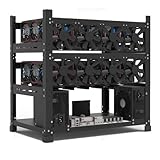
- Best Value: Mining Rig Frame for 12GPU, Steel Open Air Miner Mining Frame Rig Case, Support to Dual Power Supply for Crypto Coin Currency Bitcoin ETH ETC ZEC Mining Tools – Frame Only, Fans & GPU is not Included
- Premium Choice: HAVN HS 420 VGPU Dual-Chamber Mid Tower ATX PC Case Black | PCIe 5.0 Vertical GPU Kit, 11x 140mm Fan Slots & 2X 420mm Radiator Support, SimpliCable Cable Management, Tempered Glass, PWM Fan Hub
Modern graphics cards have outgrown the cases that were built for them. A card that reaches four hundred millimeters in length, takes three slots, and weighs as much as a small textbook does not just drop into any mid-tower. The decision behind this keyword is whether a case can really host a large GPU: clearance for length and thickness, space in front of the card for a radiator, airflow that reaches the heat sink, and a frame that does not flex under the weight.
This guide is for builders shopping around a big RTX or Radeon card, and for upgraders whose current chassis has become the limiting part. It compares five enclosures strictly from their listing titles, drawing on stated GPU clearances, radiator support, and layout notes. Open-air mining frames and a graphics card carrying bag also showed up among the candidates and were left out, because they are not desktop cases for a gaming build. Heading into 2026, dual-chamber layouts and vertical GPU kits keep spreading, which makes reading the clearance details essential.
Quick Picks
As an Amazon Associate we earn from qualifying purchases at no extra cost to you.



| Product | Best for | Key spec from the title |
|---|---|---|
| HYTE Y70 Touch Infinite | Showpiece builds | Dual chamber ATX, built-in 2.5K LCD touchscreen |
| HAVN HS 420 VGPU | Vertical GPU builds with big radiators | PCIe 5.0 vertical GPU kit, 11x 140mm fan slots, 2x 420mm radiator support |
| Cooler Master HAF II 500 | High airflow with long cards | 430mm graphics card support, 360mm AIO support |
| Lian Li A3-mATX | Compact builds with long cards | 415mm GPU, 360 AIO, M-ATX and ITX boards |
| Rosewill 4U Server Chassis | Multi-GPU rack builds | Supports up to 4 GPUs, E-ATX compatible, 8 hot-swap bays |
How to Choose
Length, thickness, and the clearance numbers that count
Start with the card, not the case. Look up the length of the exact model you plan to buy, then compare it with the maximum GPU length the case lists, and leave a margin for cables and any front radiator. A listing that says 415mm or 430mm GPU support is giving you the empty distance, not a promise that every card of that length fits with a fan in the way. Thickness matters too: large cards often take three slots or more, so confirm the case offers enough vertical room above the expansion slots and that the side panel does not bump the heat sink. If the listing does not state a clearance, check the listing or the manual before you order.
Airflow path and radiator room
Big cards dump a lot of heat, so a case with a mesh or vented front and a clear exhaust path does more than extra fans on paper. Radiator support affects how you cool the CPU and whether the front or top fans collide with a long card, since a thick radiator in the front reduces the length available to the GPU. Count fan positions, but weigh their placement: a fan slot behind a drive cage or a cable bundle contributes little. Dual-chamber layouts help by dividing the PSU and cables from the main compartment, though they can complicate routing.
Weight, support, and vertical mounts
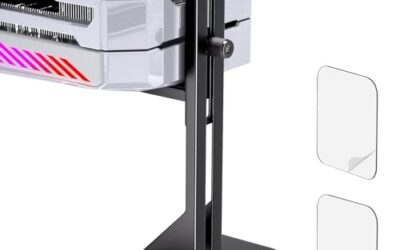
Heavy cards can sag in the slot, especially in cases where the card hangs from the PCIe connector. Look for a case with reinforced slots, a support bracket, or a vertical GPU kit that moves the load. A vertical mount, with a riser that holds the card parallel to the side glass, changes the airflow story: it needs clearance between the card and the glass, so thick cards can starve for air. Check that any riser supports the PCIe generation you need, and that your card’s fans can pull air through the gap.
What to ignore, and where budget cases cut corners
Ignore lighting counts and glass finishes when the key question is clearance. Budget cases may state a GPU length but use a drive cage or fan bracket that cuts it in practice, and thin steel panels can flex or resonate with a heavy card. Premium cases tend to offer removable cages, better dust filters, and sturdier cards support. Also consider cable routing for the 12V high power connector, which often needs extra room so the plug is not forced into a sharp bend by the side panel.
The 5 Best Options
HYTE Y70 Touch Infinite
The Y70 Touch Infinite is a dual-chamber ATX chassis with an built-in 2.5K LCD touchscreen and a modern aesthetic, according to the title. It is a statement case, and the chamber layout suits builders who want a clean window onto a large card. Putting the power supply and cable bundle in a second compartment leaves the main chamber open, which is useful when a big card needs both room and a clear view.
- Strength: the dual-chamber ATX design is stated, helping divide cables and the power supply from the card.
- Strength: the built-in touchscreen gives it a distinctive look.
- Trade-off: the visible title does not list a maximum GPU length, so confirm clearance on the listing.
Skip it if you want a plain, low-cost enclosure or if the screen is of no interest, since the display is a core part of the product. Anyone with an unusually long card should check the stated clearance before ordering.
HAVN HS 420 VGPU Dual-Chamber Mid Tower
This dual-chamber ATX mid tower lists a PCIe 5.0 vertical GPU kit, eleven 140mm fan slots, and support for two 420mm radiators, plus SimpliCable cabling. The vertical kit is aimed at showing a big card, and the radiator support suits ambitious cooling plans. With that many fan positions and two large radiator mounts, the case is aimed at people who want to build a serious liquid-cooled system around a big card.
- Strength: the vertical GPU kit is included and named as PCIe 5.0.
- Strength: eleven fan slots and two 420mm radiator mounts give extensive cooling options.
- Trade-off: a vertical mount needs clearance in front of the card, so thick cards must be checked against the listed distances.
Skip it if you want a traditional horizontal card layout or a smaller case, since the radiator support points to a big tower. Buyers should confirm the clearance numbers on the listing.
Cooler Master HAF II 500
The HAF II 500 is an ATX case with high airflow, dual 220mm and 180mm fans, 430mm graphics card support, and 360mm AIO support. The 430mm figure is the headline for anyone with a long card, and the large fans point to an airflow-first design. The 360mm AIO option means the CPU can still be liquid cooled alongside the card without giving up the fit.
- Strength: 430mm graphics card support is stated and is among the longest in this group.
- Strength: 360mm AIO support lets you pair a large card with a liquid cooler.
- Trade-off: a high-airflow design usually means vented panels, which let more fan noise out.
Skip it if you want a sealed, quiet enclosure or a compact footprint. Check how a front radiator and a long card share the space before assuming both fit at the maximum figures.
Lian Li A3-mATX (A3X-WD)
The A3-mATX lists 415mm GPU clearance, 360 AIO support, mesh panels in wood black, and a modular design for M-ATX and ITX boards. No fans are included, per the title, so it suits builders who want to choose their own cooling. The mesh panels and compact footprint make it a fit for a small desk or a LAN-style build, where the owner wants a long card but not a full tower.
- Strength: 415mm of GPU clearance in a case for smaller boards is notable.
- Strength: 360mm AIO support is stated, and the mesh panels point to open airflow.
- Trade-off: the title says no fans are included, so fans must be budgeted separately.
Skip it if you need an ATX motherboard or lots of drive space, since it is built for smaller boards. Anyone planning both a long card and a front radiator should check clearances carefully.
Rosewill 4U Server Chassis
This is a rackmount 4U server chassis rather than a desktop case. The title lists support for up to four GPUs, eight hot-swap 3.5 inch and 2.5 inch SATA and SAS bays, E-ATX compatibility, three 12038 hot-swap fans, and two rear 8038 fans.
- Strength: support for up to four GPUs is stated, which suits compute and rendering racks.
- Strength: the hot-swap bays and E-ATX compatibility fit server-style builds.
- Trade-off: it is built for rack use and server noise levels, which is unsuitable for a living room PC.
Skip it if you want a gaming desktop, a quiet build, or a window onto your hardware. A server-class case also asks for rack space, rack-friendly power arrangements, and planning around front-to-back airflow, so it is a project rather than an off-the-shelf upgrade. Check card length and power connector clearance on the listing, since the title does not give them.
Which One Fits Your Situation
You own one of the longest cards on the market
The Cooler Master HAF II 500 lists 430mm of graphics card support, the largest number among the desktop cases here. It is the straightforward answer for someone whose new card is longer than most towers allow, though a front radiator will eat into that figure, so plan the cooling around the card first.
You want a compact build that still takes a long card
The Lian Li A3-mATX states 415mm of clearance for M-ATX and ITX boards, which gives a smaller footprint than a full tower. It suits a desk-side build, a small apartment, or a second machine where space is limited but the card is not, and fans can be chosen separately because none are included.
You want the card on display
The HAVN HS 420 VGPU includes a PCIe 5.0 vertical kit, and the HYTE Y70 Touch Infinite puts the focus on a dual-chamber window and screen.
You are building a multi-GPU rack
The Rosewill 4U chassis names support for up to four GPUs and E-ATX compatibility, which suits compute rather than gaming. Anyone considering it for a desktop should weigh the noise and rack footprint before treating it as a case with an open window and a glass panel.
Common Mistakes
- Checking only length and forgetting the card’s thickness in slots.
- Ignoring the space a front radiator takes from the GPU clearance.
- Skipping a support bracket for a heavy card in a horizontal layout.
- Buying a vertical mount without checking the gap between the card and the glass.
- Forgetting to leave room for the power cable bend beside the card.
Related guides
- Low Profile Nvidia Graphics Cards For Small Form Factor Pcs
- Why Is My Gpu Benchmark Score Lower Than Others
- Travel Backpack With Laptop Compartment
Frequently Asked Questions
How much extra length should a case have beyond the card?
Leave at least a few centimeters beyond the card for cables and airflow, and more if a front radiator or fan is in the way.
Does a vertical GPU mount hurt cooling?
It can, if the card sits too close to the glass. Check the stated clearance and the fan layout before choosing a vertical kit.
Are open-air frames a good choice for a large card?
They give plenty of room, but they lack panels, filters, and a case-level airflow design, so they suit benches and rigs more than a daily desktop.
Is a server chassis acceptable for a gaming PC?
It is usually loud and aimed at racks. It is better suited to compute work than to a quiet desktop.





Write Your Review
No reviews yet. Be the first to share your experience!