
- Top Pick: Penn-Plax Cascade 1200 Canister Filter, 315 GPH for Tanks Up to 150 Gallons | Aquarium Filter – 360 Degree Flow Valves, Poly Fiber Pads, Bio-Sponge & Activated Carbon -Fresh & Saltwater -11.5x11x20.5in
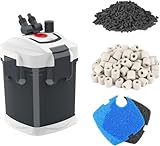
- Best Value: AQQA 581GPH Canister Filter, Ultra-Quiet 3-Stage Filtration Aquarium Filter | Powerful External Canister Filters with Quartz Balls & Filter Cotton, Fits Tanks Up to 150 Gallon, 35W
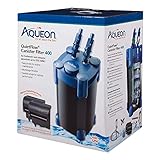
- Premium Choice: Aqueon QuietFlow Canister Aquarium Filter 100-150 Gallons | 100-150 gallon fish tank Canister Filter with biological, chemical and mechanical stages, spray bar, 400 GPH
For a 150 gallon aquarium, the safest approach is to choose a large canister filter such as the Fluval FX6 or a premium Eheim Professionel unit, or to run two mid-size canisters side by side, and to pick by real flow after media rather than by the tank rating printed on the box. A common rule of thumb among aquarists is to aim for roughly four to six tank turnovers per hour, which means about 600 to 900 gallons per hour of actual flow for this size.
As an Amazon Associate we earn from qualifying purchases at no extra cost to you.


Sizing a canister for 150 gallons
Makers publish a rated flow and a maximum tank size, but those figures are measured with an empty canister and no head height. Once media is packed in and hoses run up from a stand, real flow drops. That is why many fish keepers pick a filter rated for a larger tank than they own. Plant-heavy or lightly stocked tanks can live with the lower end of the flow range, while cichlid and large-fish setups with heavy waste suit the upper end.
Tank shape matters too. A tall 150 gallon tank adds head height, which cuts flow, while a long 6-foot tank may need the outlet split with a spray bar to spread water evenly. Check the hose diameter in the maker’s specification, because narrow hoses restrict flow and clog sooner.
At a glance
| Option | Best for | Maker-stated notes | Limits |
|---|---|---|---|
| Fluval FX6 | One-filter solution for large tanks | Maker rates it for very large aquariums, well above 150 gallons, with a self-priming pump and large media capacity | Large footprint; some owners report it as loud-ish at high flow |
| Fluval FX4 | Slightly lighter loads or planted tanks | Maker rates it for tanks smaller than the FX6; same family and design | Cutting it close at 150 gallons with heavy stocking |
| Eheim Professionel line | Quiet, long-term reliability | German-made, known for pump quality and tidy media baskets | Higher cost tier; larger models are needed at this size |
| Oase BioMaster family | Aquarists wanting built-in options such as heating | Maker offers models in multiple sizes, some with an integrated heater | Check which size is rated for your volume |
| Two mid-size canisters | Redundancy and budget control | Two units split the load and keep the tank filtered if one stops | Doubles cleaning chores and hoses |
Fluval FX6 for single-filter simplicity
The FX6 is the model most commonly named for large freshwater tanks. Fluval states that it is built for aquariums far above 150 gallons, and reviewers at hobbyist outlets often describe it as comfortably oversized for this volume. Its main selling points are the self-priming design, which removes the old hose-siphoning routine, and a large media volume that lets you layer coarse sponge, bio media and polishing pads.
Because it is rated high, it gives you headroom to run it with dirty media for longer between cleanings. The compromise is size. Make sure your cabinet can hold it and that you have room to open the lid and lift out the baskets.
Eheim Professionel for quiet and durability
Eheim canisters have a long record with hobbyists, and the company’s Professionel range is aimed at demanding setups. Look at the specification sheet for the largest model in the series suited to your tank, because smaller members of the family are rated for smaller aquariums. Aquarists often pick Eheim when low noise and long pump life are priorities, accepting the higher cost tier in exchange.
Oase and other premium brands
Oase BioMaster units come in several sizes and, in some versions, with a built-in heating element, which can tidy up a stand by removing an in-tank heater. Other makers produce large canisters as well, so use the maker’s tank rating plus your own flow target to filter the list.
Two canisters instead of one
Many large-tank owners run two filters. This divides biological capacity across two bodies, gives you a backup if a pump fails, and lets you service one at a time so the bacterial colony is never fully disturbed. It also lets you use two mid-range units rather than one premium unit, which can suit a tighter budget.
How to choose
- Target real flow. Plan for around 600 to 900 gallons per hour after media, adjusting for stock level and planting.
- Check the footprint. Measure the stand cabinet door and floor space, plus the clearance to lift the lid.
- Prefer large media baskets. More media volume gives you more biological capacity and longer service intervals.
- Look at hoses and fittings. Larger inner diameters keep flow up; quick-release valves make servicing cleaner.
- Plan a spray bar or lily pipe. The outlet design affects surface agitation, oxygen exchange and even flow across a long tank.
- Follow electrical guidance. Place the filter below the tank with a drip loop in the cable, and use a properly rated outlet. If you are unsure about wiring, consult a qualified electrician.
Pick X if
| If you … | Pick | Why |
|---|---|---|
| want one filter with generous headroom | Fluval FX6 | Rated well above this tank size, self-priming |
| prioritise quiet running and build quality | Eheim Professionel (largest suitable size) | Reputation for durable pumps |
| want fewer in-tank devices | Oase BioMaster with heater | Integrated heating on some models |
| want redundancy | Two mid-size canisters | One keeps running if the other fails |
| keep a lightly stocked planted tank | Fluval FX4 or equivalent | Lower flow need |
Alternatives
- Sump filtration: A sump gives huge media capacity and hides equipment, but it needs a drilled tank or an overflow box and more planning.
- Hang-on-back filters in pairs: Cheaper and easy to service, but several are needed to match one large canister.
- Large sponge filters with an air pump: Excellent for biological filtration and low flow, often used as a supplement.
Common mistakes
- Trusting the tank rating without allowing for media and head height.
- Washing all media in tap water at once, which can harm beneficial bacteria. Rinse it in old tank water and stagger the cleaning, as the maker’s manual advises.
- Putting the filter somewhere you cannot open it comfortably.
- Skipping a drip loop in the power cord, which can allow water to travel along it to the outlet.
Frequently Asked Questions
How much flow does a 150 gallon aquarium need?
Many aquarists aim for four to six turnovers per hour, or roughly 600 to 900 gallons per hour of real flow. Plant-focused tanks can use less and messy-fish tanks more.
Is the Fluval FX6 too big for a 150 gallon tank?
The maker rates it for much larger tanks, so it is not too big. Extra capacity means more media and slower clogging, and you can adjust the output with a spray bar if the current is strong.
How often should I clean a canister filter?
Intervals depend on stocking and feeding, but many owners service every one to three months. Clean in tank water, replace only part of the media at a time and follow the maker’s manual.
Can I run two canisters on one tank?
Yes, and many large-tank keepers do. It spreads the biological load, gives backup if one fails and lets you stagger cleaning.
Do canister filters make noise?
They are generally quieter than hang-on-back filters, but air trapped after servicing or a worn impeller can cause humming. Burp the air out as the manual describes and replace worn parts.
Is a sump better than a canister?
A sump offers more volume and flexibility but needs a suitable tank and more setup. For a standard undrilled tank, a canister is usually the simpler path.







Write Your Review
No reviews yet. Be the first to share your experience!