
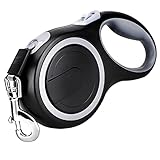
- Top Pick: 26Ft Retractable Dog Leash, Heavy Duty Great Leash for Dog up to 110 lbs, Anti-Slip Rubberized Handle, One-Handed Brake, Strong Nylon Tape, Tangle Free(Large Size).
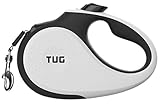
- Best Value: TUG Original Retractable Dog Leash, 16 ft (Large, White) | 360° Tangle-Free Retraction, 16 ft Tape, Quick Thumb Lock, Anti-Slip Handle, For Dogs Under 110 lbs
- Premium Choice: FLEXI® Classic Tape Retractable Dog Leash, Large, 26 ft – Black | German engineered, original flexi leash, durable quality for dogs up to 110 lbs, tangle-free, walking, reliable brake system
For large dogs, choose a retractable leash from the maker’s heavy-duty line, such as the flexi Goliath or Giant range, whose size ratings are published by dog weight, and match the rating to your dog’s weight with a margin rather than choosing on length alone; a tape-style heavy leash with a strong carabiner and a comfortable handle is the usual pick for powerful walkers. If your dog pulls hard or you walk near roads, a fixed-length leash or a long line is often the safer tool, and the sections below explain how to decide.
- Safety First: When a Retractable Leash Is and Is Not Appropriate
- Understand the Weight Rating
- At a Glance: Leash Types Compared
- Features to Look For
- Brands and Families to Consider
- Pick X If You Need This: Decision Table
- Budget Tiers Without Prices
- Fit and Handling Tips
- Common Mistakes
- Alternatives
- Frequently Asked Questions
As an Amazon Associate we earn from qualifying purchases at no extra cost to you.


Safety First: When a Retractable Leash Is and Is Not Appropriate
Retractables are designed for open, quiet areas where a dog can explore with some freedom. Veterinary and trainer organisations commonly advise against using them near traffic, in crowded places or with dogs that lunge, because the line can be hard to control and a sudden stop can cause injury. Rope burns and cut hands are well-documented hazards when a cord runs through bare skin. If your large dog is powerful or poorly trained, consult a trainer, and when in doubt, use a standard leash.
Understand the Weight Rating
Makers rate retractable leashes by maximum dog weight, and larger dogs need the strongest range. Flexi, for example, labels its leashes by size and states the maximum weight for each; the largest models in its range are designed for dogs up to roughly 110 pounds or more, but the exact figures differ between the Goliath, Giant and other lines, so read the label on the model you buy. Choose a rating above your dog’s weight to leave a margin, since a strong dog on a sudden lunge produces far more force than its static weight. Never use a leash rated below your dog’s weight.
At a Glance: Leash Types Compared
| Type | Strengths | Limits | Best for |
|---|---|---|---|
| Heavy-duty tape retractable | Flat tape is easier to see and hold, smoother than thin cord | Tape can still cut skin, jams if wet or dirty | Calm large dogs in open areas |
| Cord retractable | Lighter, compact | Thin cord burns hands, usually lower ratings in cheap models | Medium dogs, light use |
| Fixed-length nylon or leather leash | Predictable, strong, simple | No freedom to roam | Everyday walks, training, traffic |
| Long line (15 to 30 feet) | Gives freedom with no spring mechanism | Can tangle, needs open space | Recall training in fields |
| Hands-free or waist leash | Frees your hands, spreads load | Hard on the back if a strong dog lunges | Walkers and joggers with well-behaved dogs |
Features to Look For
Locking mechanism and brake
A smooth, reliable brake button matters more with a big dog. Look for a lock you can engage with your thumb without letting go. Many models have a one-hand lock that lets you stop the line instantly.
Handle and grip
Soft, ergonomic grips reduce hand fatigue; a handle with a wrist loop adds security, though you should not wrap it around your arm. Ergonomic designs from major makers aim to spread pressure over your palm.
Tape or cord material
Heavy-duty tape is thicker than the cord found on lighter models and is generally easier to grip. Reflective tape, offered by some makers, improves visibility at night. Keep the line dry and clean to avoid jamming.
Hardware
Check that the carabiner or clip is a robust metal part rated for the full weight. A swivel clip helps prevent twisting. Replace any leash whose hook is bent or whose tape frays.
Length
Common lengths range from about 16 to 26 feet. A shorter line gives more control with a strong dog, while a longer one suits wide open spaces. Match the length to where you walk, not just to the dog’s size.
Brands and Families to Consider
| Brand and line | Stated focus | Pick if |
|---|---|---|
| flexi Goliath | The maker’s larger-dog retractable range, offered in tape and cord forms | You want the best-known name in retractables for large dogs |
| flexi Giant | Heavy-duty line aimed at the biggest dogs in the maker’s range | Your dog is at or near the top of the weight limits |
| Other brands with heavy-duty retractables | Several pet brands list models rated for large dogs; check each label | You need an alternative style or grip |
| Fixed heavy-duty leashes (nylon, biothane, leather) | No mechanism to fail, strong clips | Your dog pulls or you walk in busy areas |
Lineups change over time, so read the maker’s current listing for the exact weight limit and length of the model before buying.
Pick X If You Need This: Decision Table
| Situation | Choose | Reason |
|---|---|---|
| Calm large dog, park or field | Heavy-duty tape retractable | Freedom with a strong, visible line |
| Dog pulls or lunges | Fixed leash and training | More predictable control |
| City sidewalks and traffic | Short fixed leash | Prevents sudden bolts into roads |
| Practicing recall | Long line | Distance without a spring mechanism |
| Night walks | Reflective-tape model, plus light-up collar | Better visibility |
| Hiking on trails | Fixed leash or hands-free system | Less tangling, steadier hold |
Budget Tiers Without Prices
At the budget tier, unbranded retractables often list generous weight limits but use lighter hardware and weaker springs; reviewers frequently report cord failures and brakes that stick, so treat such ratings cautiously. Mid-range models from established brands generally offer better build and clearer weight ratings. Premium tiers add comfort handles, reflective tape and replaceable parts. For a large dog, the extra spend is more justified than for a small one because failure carries a greater risk.
Fit and Handling Tips
- Attach the leash to a well-fitted harness rather than a collar if your dog pulls, to reduce neck strain; ask your vet if the dog has throat or spine issues.
- Keep your thumb near the brake, and lock the leash before the dog reaches the end of the line.
- Do not grab the tape or cord with bare hands when it runs out.
- Never drop a retractable leash; the handle can chase the dog and frighten it.
- Do not use it around other dogs where lines can tangle.
- Inspect the tape, clip and spring housing before every walk.
Common Mistakes
People most often buy by length when weight rating should be the starting point. Others use a retractable leash on pavement near traffic, let the line extend fully when passing other dogs, or keep a worn tape long after it frays. Skipping basic leash training so the dog learns that pulling extends the line is another common problem. A retractable is a tool for good manners, not a replacement for them.
Alternatives
- Standard six-foot leash: Strong and simple for everyday control.
- Long training line: Offers distance for practice without a mechanism.
- Front-clip harness: Can reduce pulling when paired with training.
- Double-handle traffic leash: Gives close control around busy areas.
Frequently Asked Questions
What weight rating do I need for a large dog?
Pick a leash whose stated maximum dog weight is clearly above your dog’s actual weight. Because pulling forces can exceed body weight, a margin is safer. The label on the specific model gives the maker’s limit.
Is tape better than cord for large dogs?
Many owners find tape easier to grip and see, and it is commonly used in heavier-duty lines. Cord is lighter but can burn skin more easily and is often found in lower-rated models. Either type can cause injury if mishandled.
Can a retractable leash be used for training?
Most trainers prefer a fixed leash or a long line for training, since the constant tension of a retractable can teach dogs to pull. If you do use one, keep it short and locked in training sessions.
How long should the leash be for a big dog?
Between 16 and 26 feet are common lengths; shorter gives more control. For walks in busy neighbourhoods, lock it at a short length or choose a fixed leash instead.
How do I stop my dog from pulling on a retractable?
Train loose-leash walking first with a fixed leash and reward your dog for staying close. A professional trainer can help with strong pullers. A front-clip harness may help but does not replace training.
When should I replace the leash?
Replace it if the tape or cord is frayed, the brake sticks, the clip is bent or the casing is cracked. Do not rely on a damaged leash with a strong dog; repair kits may be available from the maker for some parts.





Write Your Review
No reviews yet. Be the first to share your experience!