
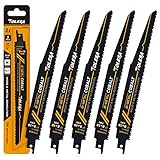
- Top Pick: TOLESA Bi-Metal Reciprocating Saw Blades, 9" 8+10TPI Demolition, 5-Pack | Bi-Metal with 8% Cobalt, Thicker and Wider Blades, Aggressive Teeth, Cuts Steel Pipe, Drywall, Chipboard, Composite
- Best Value: 10 Pack 9 Inch 8/14TPI Reciprocating Saw Blades for Diablo Sawzall Blades | for Wood and Nail-Embedded Wood Demolition, Metal Cutting 1/8-3/8 Medium Metals, General Purpose Cuts, Variable Tooth Design
- Premium Choice: 25 Pack 9 Inch 8/14TPI Reciprocating Saw Blades for Diablo Sawzall Blades | for Wood and Nail-Embedded Wood Demolition, Metal Cutting 1/8-3/8 Medium Metals, General Purpose Cuts, Variable Tooth Design
For demolition work, reach for a thick, 6 to 12 inch bi-metal or carbide-tipped blade with a coarse tooth count: carbide-tipped blades such as the Milwaukee Torch and Diablo Demo Demon lines suit nail-embedded wood, plaster and cast iron where bi-metal blades dull quickly, while good bi-metal demolition blades from Lenox, Dewalt and Bosch are the practical choice for general framing teardown. The best blade depends on what is hiding inside the wall, so this guide covers materials, tooth counts and lengths, then matches each to a job.
As an Amazon Associate we earn from qualifying purchases at no extra cost to you.


Why Demolition Blades Differ From Standard Ones
Demolition blades are built to survive metal, nails, screws and rough contact. They are thicker and wider than finish-cutting blades, which resists bending and flexing when you pry or twist the saw. Makers commonly describe thickness and body width in their product listings; read those values when choosing, since a thin blade will snap quickly in a wall full of fasteners. Because the cut is usually rough and the material unknown, the priority is durability and speed, not a clean edge.
Blade Materials Explained
| Material | Strengths | Weaknesses | Best for |
|---|---|---|---|
| Bi-metal (high-speed steel teeth on a flexible back) | Flexible, resists breakage, good all-round life | Dulls quickly on cast iron and hard materials | General demolition, framing with some nails |
| Carbide-tipped | Long life in abrasive and hard materials | More brittle in some designs, higher budget tier | Plaster, cement board, cast iron, heavy nail zones |
| Carbide grit (no teeth) | Cuts tile, brick, masonry slowly | Slow on wood, rougher finish | Masonry, tile, fibre cement |
| High-carbon steel | Inexpensive, cuts wood | Not for nails or metal, breaks easily | Clean wood pruning, not demolition |
Tooth Count and Blade Length
Teeth per inch
Lower TPI means larger teeth that remove material fast. For demolition in wood with nails, makers commonly list 5 to 8 TPI, or a variable range, while higher counts such as 10 to 18 TPI suit metal pipe and thin sheet. For mixed material, a variable-tooth design adapts to both.
Length
Six-inch blades handle most wall and stud work, nine-inch blades let you cut through a full 2 by 4 plus extra, and twelve-inch blades are for thick timber, pruning and deep reach. Longer blades flex more and are harder to control, so choose the shortest one that completes the cut.
Shank compatibility
Most current reciprocating saws accept a universal shank, but confirm your saw’s chuck type in its manual. Tool-free blade clamps need tang shapes that match the system.
Product Families to Compare
| Family | Stated focus | Pick if |
|---|---|---|
| Milwaukee Torch carbide-tipped | Maker positions it for the toughest demolition and cast iron | You cut metal-heavy walls often |
| Milwaukee Ax and Sawzall bi-metal | Thick, general-purpose demolition blades | You want balanced life and flexibility |
| Diablo Demo Demon | Maker lists thick bi-metal and carbide demolition options | You want strong performance at a mid-range tier |
| Lenox Gold and Lazer | Long-established demolition and metal-cutting lines | You want professional-grade blades |
| Dewalt Extreme and Tooth Tech | Rugged blades for wood with nails and mixed work | You already use Dewalt tools and want matching quality |
| Bosch Demolition and Carbide lines | Heavy-duty bi-metal and carbide options | You prefer a balanced mid tier |
Names and lineups change as makers update their ranges, so read the box or the maker’s page for the exact current model, length and TPI.
Pick X If You Need This: Decision Table
| Job | Choose | Reason |
|---|---|---|
| Cutting studs with nails in a remodel | 6 to 9 inch bi-metal demolition blade, about 6 TPI | Good balance of flex and durability |
| Cast iron pipe or heavy steel | Carbide-tipped metal-cutting blade | Holds an edge on abrasive metals |
| Plaster and lath | Carbide-tipped or thick bi-metal blade | Plaster dulls ordinary teeth fast |
| Cement board or tile | Carbide grit blade | Meant for abrasive masonry-type material |
| Pallets and nail-embedded lumber | Thick bi-metal demolition blade | Flexibility prevents snapping |
| Pruning logs and branches | Coarse pruning blade | Very fast in clean wood, not for nails |
Budget Tiers Without Prices
At the budget tier, bi-metal blades in multi-packs give decent value for light teardown if you are not cutting much metal. In the mid-range, thicker bodies and better tooth geometry from names such as Diablo, Bosch and Dewalt extend life noticeably in nail-heavy work. At the premium tier, carbide-tipped options from Milwaukee, Lenox and similar makers cost more per blade but are widely reported to outlast bi-metal in hard materials, which can lower your cost per cut if you do a lot of demolition.
Using Blades Safely and Making Them Last
- Wear eye protection, gloves and hearing protection; the saw kicks and blades can shatter.
- Unplug the saw or remove the battery before changing a blade.
- Check for live wiring, gas lines and plumbing before cutting into walls; shut off power at the breaker and consider a licensed electrician if unsure.
- Brace the saw shoe firmly against the work to cut vibration and reduce breakage.
- Let the blade do the work; excessive force overheats teeth and shortens life.
- Use a pivoting motion carefully, since twisting a stiff blade in a tight kerf can snap it.
- Store blades dry to avoid rust, and discard any bent or chipped blade.
Common Mistakes
Using a fine-tooth metal blade on wood clogs the teeth. Picking a long blade when a short one would do causes flexing and breakage. Many people also forget that carbide-tipped blades can chip if levered sideways. Finally, assuming one blade fits every job leads to dull teeth in the first wall; keep a mixed set of bi-metal and carbide on hand for unknown conditions.
Alternatives
- Oscillating multi-tool blades: Better for flush cuts around trim and in tight spots.
- Cut-off wheels on an angle grinder: Faster on rebar and thick steel, but sparks and dust require added precautions.
- Handsaws and demolition saws: Quiet and good for light tasks, slow for large jobs.
- Reciprocating saw blade kits: Assortments covering wood, metal and pruning for mixed work.
Frequently Asked Questions
What TPI should I use for demolition?
For wood with nails, makers commonly list around 5 to 8 TPI, or variable-tooth designs for mixed work. Higher counts around 10 to 18 TPI suit metal. Check the blade’s packaging for the materials it is rated to cut.
Are carbide-tipped blades worth it?
For abrasive or hard materials such as plaster, cast iron and nail-dense framing, reviewers and makers say they last much longer than bi-metal. They cost more per blade, so they suit frequent or demanding work more than occasional use.
Can I cut metal pipe with a demolition blade?
Many demolition blades are rated for nails and some metal, but dedicated metal-cutting blades with finer teeth work better on pipe. Cast iron needs a blade the maker specifically lists for it, and the cut should be done with proper protection.
Why do my blades keep breaking?
Typical causes are blades that are too long or thin, cutting with the saw shoe unsupported, twisting in the cut and cutting through unexpected metal. Use a thicker, shorter blade, brace the shoe and apply steady pressure.
Do all reciprocating saw blades fit all saws?
Most use a universal shank, but chuck designs differ. Check your saw’s manual for compatibility and confirm the tang matches before you buy multi-packs.
How do I know when a blade is worn out?
Slow progress, burning smells, smoking wood and rounded or missing teeth all signal a spent blade. Replace it before it binds, since forcing a dull blade increases kickback risk.





Write Your Review
No reviews yet. Be the first to share your experience!