
- Top Pick: Reencle Prime Electric Composter – 14L Kitchen Composter, Decomposes Up to 2.2 lbs Food Waste Daily, Odorless Indoor Composting with Whisper-Quiet Technology & Rapid Decomposition (Silver)
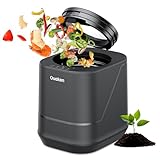
- Best Value: Ouaken 4L Electric Composter for Kitchen, Smart Countertop Compost Bin | Odorless | Low Noise | Auto Clean | Turn Food Waste into Fertilizer, Indoor Food Waste Compost Machine, White
- Premium Choice: Ouaken 4L Electric Composter for Kitchen, Smart Countertop Compost Bin | Odorless | Low Noise | Auto-Cleaning | Turn Food Waste into Fertilizer, Indoor Food Waste Compost Machine, Black
For most households, an electric countertop food recycler such as the Lomi or the Vitamix FoodCycler is the easiest indoor composter, while a worm bin or a true composting unit like the Reencle Prime suits people who want real biological composting and are willing to manage it. The important catch is that the popular electric units dry and grind scraps rather than composting them in the biological sense, so the output usually needs mixing into soil or a compost pile.
As an Amazon Associate we earn from qualifying purchases at no extra cost to you.

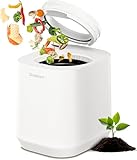
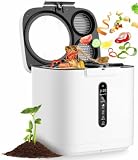
Three kinds of indoor composter
- Electric food recyclers. These heat, dry and grind scraps in hours. The Lomi, Vitamix FoodCycler and Mill fall here. The result is a dry, odour-light material.
- Continuous electric composters. Units such as the Reencle Prime keep a bed of microbes working over time, closer to real composting. Reviewers describe them as larger and more expensive.
- Passive indoor systems. Worm bins (vermicomposting) and bokashi buckets need no electricity but need some care and a place to put the finished material.
At a glance: the main options
| Option | Type | Stated features | Best for | Limits |
|---|---|---|---|---|
| Lomi | Electric food recycler | About 3 litre capacity; cycles range from about 3 to 20 hours, as reported by reviewers | Households that want a fast, countertop option | Some modes use pods, an ongoing cost; output is not finished compost |
| Vitamix FoodCycler (FC-50, Eco 3 and Eco 5) | Electric food recycler | Roughly 4 to 8 hours per cycle; about 2 litre capacity on a smaller model; 3-year warranty as listed | Small households and compact kitchens | Smaller capacity |
| Mill | Electric food recycler with service | Subscription and mail-in model, per reviewers | People who prefer a managed service | Monthly fee; relies on the service |
| Reencle Prime | Continuous composter | Marketed as true composting | Those who want real compost | Higher outlay, larger footprint |
| Worm bin | Vermicomposter | Worms break scraps down into castings | Gardeners and patient hobbyists | Needs temperature and moisture care |
| Bokashi bucket | Fermenter | Ferments scraps with a bran inoculant | Apartment dwellers who can bury or trench the result | Needs a place to finish the material |
Many of the roundups are written by or alongside sellers of competing products, so treat head-to-head tables as marketing, and consult the maker’s own specification sheets for capacity, noise and power.
Dehydrators versus true composters
One competitor comparison makes a point that is technically fair: the Lomi, Mill and FoodCycler dry and grind food waste rather than letting microbes turn it into stable compost. The output is useful as a soil amendment after mixing in, and it reduces volume and smell, but it is not the same as finished compost. If you want a quick, tidy way to keep scraps out of the bin, a dehydrator-style unit fits. If you want rich compost for houseplants, a worm bin or a continuous composter fits better.
How to choose
Capacity and household size
Makers list capacity in litres. A roughly 2 to 3 litre chamber suits one to three people who cook at home most days. Larger households may need to run more cycles or choose a larger unit. Check what the maker says about foods the machine can and cannot handle; bones, large pits and some fibrous or oily items are commonly restricted.
Cycle time and power use
Cycle times from about 3 to 20 hours are reported for Lomi and 4 to 8 hours for the FoodCycler. Energy use around 1 kWh per cycle is quoted for the FoodCycler in one roundup. A longer cycle can run overnight; a shorter one fits a single evening.
Noise and placement
Both Lomi and FoodCycler are listed around 45 dB in one comparison, which is quiet conversation level, though reviewers describe real units as audible in a small flat. Put the machine on a stable counter with space for airflow, and keep it away from water.
Running costs and consumables
Some Lomi modes use pods, and Mill uses a subscription. Filters on electric units need periodic replacement. Add these to the purchase decision.
What happens to the output
Plan where the output goes. Dried material can be mixed into potting soil in small amounts, added to a compost pile, or used in garden beds as the maker advises. Do not use it straight on seedlings.
Pick this if…
| Pick this if… | Choose |
|---|---|
| You want a countertop machine with good reviews overall | Lomi |
| You live alone or have a small kitchen | Vitamix FoodCycler |
| You prefer a managed subscription | Mill |
| You want genuine composting inside | Reencle Prime or a worm bin |
| You have no power outlet to spare and some patience | Bokashi or worm bin |
Budget, mid-range and premium
Budget. Bokashi buckets and simple worm bins are the most affordable and need no electricity.
Mid-range. Smaller electric recyclers such as FoodCycler models sit here.
Premium. The Lomi, Mill and Reencle Prime cost more. Reviewers describe the Reencle as the highest outlay of the group.
Alternatives
- Municipal food scrap collection. Some cities collect kitchen waste, which removes the need for equipment.
- Freezer bag and drop-off. Freeze scraps and take them to a community garden or drop-off point.
- Outdoor compost bin. If you have a balcony or yard, a closed bin can handle more volume.
Common mistakes
- Expecting finished compost from a dehydrator-style machine.
- Putting restricted items, such as bones or large pits, into units that exclude them.
- Ignoring consumable costs like pods and filters.
- Using the dried output straight on seedlings.
- Overloading a worm bin with citrus or oily food.
Frequently Asked Questions
What is the best indoor composter for most people?
Many 2026 roundups name the Lomi as best overall and the Vitamix FoodCycler as a compact or budget-minded choice. Both are electric recyclers that dry and grind scraps.
Do electric composters make real compost?
Not in the strict sense. Dehydrator-style units produce a dry, ground material that is mixed into soil or compost to finish breaking down. Continuous composters and worm bins are closer to true composting.
How long does a cycle take?
Reviewers cite roughly 3 to 20 hours for Lomi depending on mode, and about 4 to 8 hours for the FoodCycler. Check the maker’s manual for your exact model.
Are indoor composters noisy?
One comparison lists both Lomi and FoodCycler at about 45 dB. That is quiet in a large kitchen but noticeable in a small flat, especially overnight.
Can I put meat, bones or dairy in?
It depends on the machine. Some electric units accept small amounts of meat and dairy, while bones, large pits and some fibrous items are commonly restricted. Always follow the manual, and use worm bins and bokashi with care around meat.
What do I do with the finished output?
Mix it into potting soil or garden beds in small proportions, or add it to a compost pile. Let it settle before planting delicate seedlings.







Write Your Review
No reviews yet. Be the first to share your experience!