
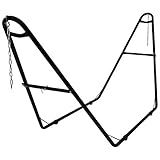
- Top Pick: Sunnydaze Universal Heavy-Duty Hammock Stand for Outside, Chains Included
- Best Value: Elevon Hammock Stand, Heavy Duty Adjustable Steel Hammock, 9-Foot, 450-Pound Capacity, Weather Resistant and Easy to Assemble
- Premium Choice: ONCLOUD 9 FT Hammock Stand Only, Heavy Duty Adjustable Indoor Outdoor Space Saving Steel Stand with Carrying Case, Universal Hammock Stand with 450 Pounds Capacity for Garden (Black)
The best hammock stands pair a weight rating at least 20% above your heaviest user’s load with a footprint that actually fits your yard — most failures we see in reader feedback come from mismatched length, not flimsy metal. Below we break down which stand types suit which hammocks and spaces.
As an Amazon Associate we earn from qualifying purchases at no extra cost to you.


How to size a stand to your hammock
Hammock length is the single most overlooked spec. Measure your hammock’s total end-to-end distance (including suspension ropes), then add 6–12 inches — that’s the minimum interior span your stand needs. A stand that’s too long forces the hammock into a tight, tippy curve; too short and it drags on the ground.
A quick worked example: a standard Brazilian-style double hammock runs about 13 feet end to end. You need a stand with at least a 13.5-foot interior span, which means roughly a 15-foot total footprint once you include the frame and end posts. On a small patio (10 × 12 ft), that stand simply won’t fit diagonally — you’d want a compact 9–10 ft stand and a shorter single hammock instead.
For weight capacity, apply the 20% rule: two adults totaling 350 lb need a stand rated 420 lb minimum. Ratings assume centered, static loads — swinging and off-center sitting multiply stress.
Our picks by use case
Best overall steel stand: Vivere 15ft Universal Stand
The long-running benchmark for steel stands. Powder-coated steel, roughly 450 lb capacity, and an interior span that accepts hammocks from about 9 to 14 feet via adjustable chain hooks — that flexibility is why it remains the default recommendation. Assembly is a five-bolt job, typically under 20 minutes with no tools beyond the included wrench. The tradeoff: at around 40 lb it’s moveable but not portable in the true sense, and the powder coat chips if stored outdoors through winter, so budget a cover or garage space. Usually $90–$130.
Best wood stand: Petra Leisure / arc-style spruce stands (spec class)
Solid wood arc stands — typically laminated European spruce or larch — are the premium option for a permanent yard installation. Look for 450+ lb capacity, a 13–15 ft span, and oil or weather-seal treatment. Assembly takes 45–90 minutes with the included bolts, and you’ll want a second person for the arc sections. Reapply sealant once a year if it lives outdoors. Expect $250–$450 for spruce; hardwoods like teak or larch run higher.
Best portable stand: ENO SoloPod or Kammok Swiftlet
True portability is its own category. The Kammok Swiftlet uses aluminum struts that break down to car-camp size, weighs around 18 lb, and assembles tool-free in under five minutes — it also converts into a sunshade frame. Capacity is typically 300–400 lb depending on the configuration, adequate for a single user. The ENO SoloPod is heavier but quicker. These usually cost $150–$250, and you’re paying for packability, not raw capacity.
Best budget option: Sunnydaze / Zupapa 9–10 ft stands (spec class)
Entry-level steel stands in the 9–10 ft range cost $60–$100 and are fine for single hammocks and users under ~250 lb. Check the span spec carefully — many budget models top out at 11 ft interior, which rules out most double hammocks. Assembly is fast (10–15 minutes) but the thinner tubing flexes more, which shortens outdoor life. Good for testing whether you’ll actually use a hammock before upgrading.
Spec comparison
| Stand | Type | Weight capacity | Interior span | Stand weight | Assembly time | Weather resistance |
|---|---|---|---|---|---|---|
| Vivere 15ft Universal | Powder-coated steel | 450 lb | ~13–14 ft (adjustable) | ~40 lb | 15–20 min, tools incl. | Good; cover or store indoors in winter |
| Spruce arc stand (spec class) | Laminated wood | 450–500 lb | 13–15 ft | 70–90 lb | 45–90 min, two people | Very good with annual sealant; shade-friendly |
| Kammok Swiftlet | Aluminum portable | 300–400 lb | Adjustable, ~11 ft | ~18 lb | Under 5 min, tool-free | Excellent; aluminum won’t rust |
| Budget 9–10 ft steel | Thin-gauge steel | 250–350 lb | 9–11 ft | 25–30 lb | 10–15 min | Fair; thin coating rusts if left wet |
Decision matrix: which stand for your situation
| Your situation | Recommended type | Key spec to check |
|---|---|---|
| Small patio (under 10 × 12 ft) | Compact 9–10 ft steel or portable | Total footprint, not just interior span |
| Medium/large yard, double hammock | 15 ft steel (Vivere-class) | Interior span ≥ hammock length + 6″ |
| Permanent installation, aesthetics matter | Wood arc | Sealant type, anchor points for wind |
| Camping, tailgating, apartment balcony | Portable aluminum (Swiftlet-class) | Folded size vs. vehicle trunk |
| Two adults, 350+ lb combined | Steel or wood, 450 lb+ rated | Apply the 20% headroom rule |
| Spreader-bar hammock | Stand ≥ 14 ft interior with chain extenders | Spreader hammocks hang flatter — need more span |
What the spec sheet won’t tell you
- Height matters as much as length. The optimal hang point for a gathered-end hammock is roughly 4–5 ft off the ground at an ~30° angle. Some budget stands mount hooks low, forcing a shallow, back-straining hang.
- Steel gauge is the hidden spec. Stands in the $60–$90 tier often use 1.0–1.2 mm tubing vs. 1.5 mm+ on mid-range models. If the listing doesn’t state gauge, assume thin and derate the capacity ~15% for dynamic loads.
- Wind is the real enemy of wood arcs. A sail-like hammock in an arc stand acts as a lever. In exposed yards, add ground anchors or take the hammock down when unused.
- Footprint ≠ interior span. A “15 ft stand” often occupies closer to 16.5 ft end-to-end. Always check total dimensions against your space, plus ~2 ft clearance on each side so you don’t clip furniture getting in.
- Hammock compatibility is two-way. Spreader-bar hammocks want long stands and taut hangs; Brazilian/gathered-end hammocks are forgiving. Pair a spreader-bar with a short stand and it will bottom out regardless of the weight rating.
FAQ
Can a hammock stand stay outside year-round?
Powder-coated steel tolerates a season outdoors; over winter it chips and rusts at the joints. Wood arcs do best with annual sealant. If you can’t store it indoors, a fitted cover extends life significantly.
Do I need special hardware to hang my hammock on a stand?
Most stands include S-hooks or chains that fit standard hammock loops. If your hammock uses ropes, carabiners or tree straps adapt it easily. The critical thing is matching the hang length, not the connector type.
Is a wood stand worth double the price of steel?
Only if the stand is a permanent yard fixture. Wood arcs hold value aesthetically and weather better over 5+ years, but for seasonal or moving use, steel delivers the same function for less than half the cost.






Write Your Review
No reviews yet. Be the first to share your experience!