
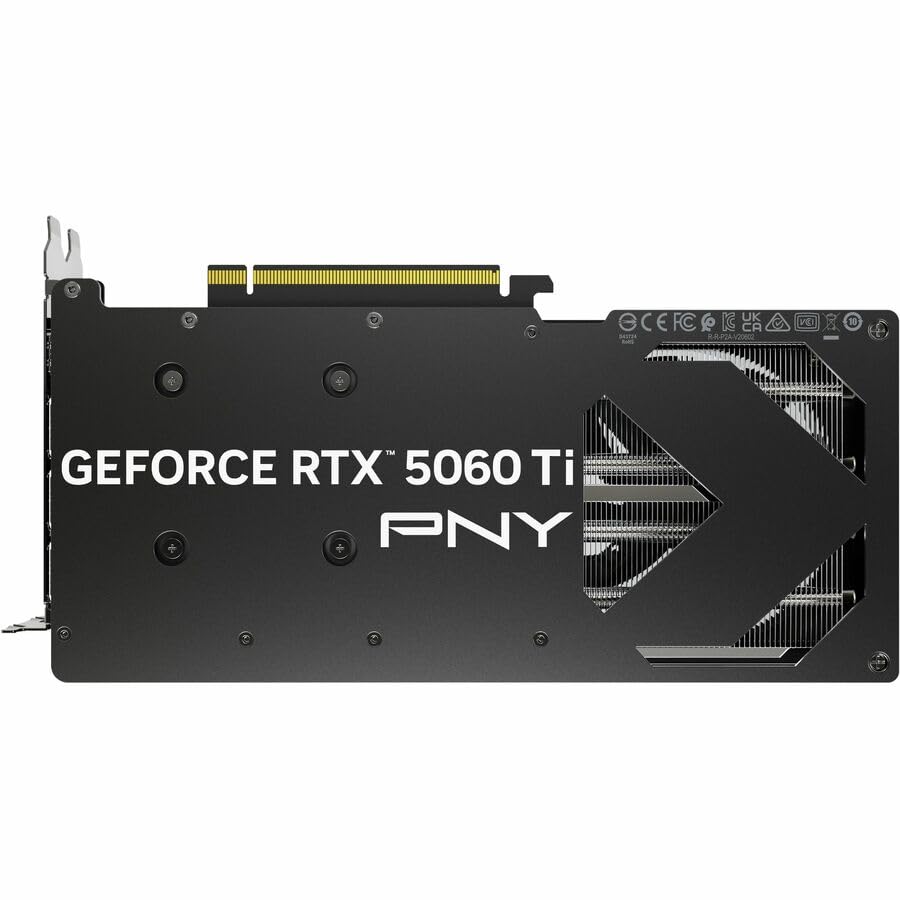

Editor's Pick
EVGA GeForce GTX 1070 SC GAMING ACX 3.0, 8GB GDDR5, LED, DX12 OSD Support (PXOC) Graphics Card 08G-P4-6173-KR
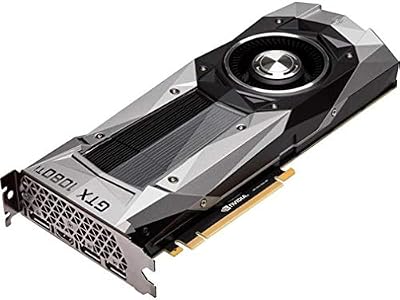


Rtx 2060 Vs Gtx 1070 remains one of the most hotly contested matchups in the budget gaming community in 2026. As modern game titles demand increasingly robust hardware, entry-level and budget PC enthusiasts are constantly searching for the sweet spot between price and performance. Both of these graphics cards have achieved legendary status over the years, serving as the reliable backbones for millions of gaming rigs globally.
Deciding the Winner in the Classic Mid-Range Battle
Navigating the pre-owned and refurbished graphics card market can be incredibly overwhelming for PC builders attempting to maximize their frame rates per dollar. To make an informed purchase, you must understand the immediate performance differences, core architectural designs, and how broader market conditions affect your buying decision.
As an Amazon Associate we earn from qualifying purchases at no extra cost to you.




The Quick Verdict: Which GPU Wins in 2026?
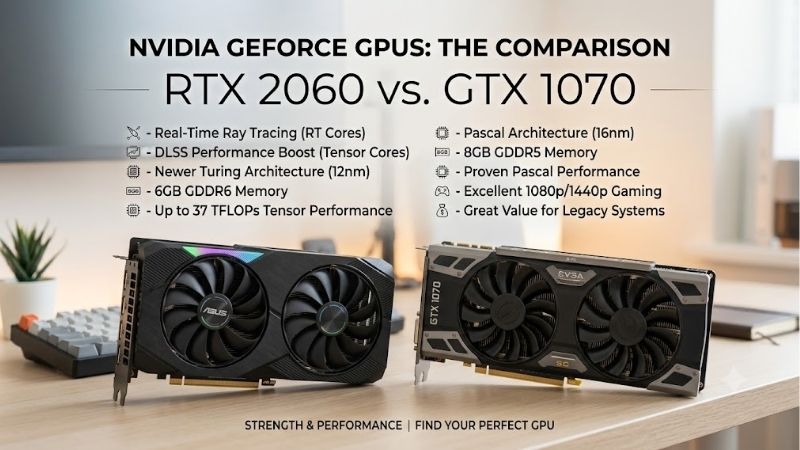
For gamers who want a fast, definitive answer on this classic matchup, the RTX 2060 emerges as the overall winner for the vast majority of modern setups. While the GTX 1070 holds a distinct advantage with its larger 8GB VRAM buffer, the RTX 2060 counters with much faster GDDR6 memory, superior Turing architecture, and crucial access to NVIDIA Deep Learning Super Sampling (DLSS 2.0).
DLSS acts as a massive performance multiplier in demanding modern titles, allowing the RTX 2060 to deliver playable frame rates where the GTX 1070 begins to struggle. If you plan to play modern eSports titles and casual indie games, the GTX 1070 is still a highly capable machine, but for forward-looking compatibility and driver support, the RTX 2060 is the smarter investment.
Check the latest price of the RTX 2060 on Amazon. Check the latest price of the GTX 1070 on Amazon.
Check the latest price on Amazon:
Core Specifications and Architecture Comparison
To understand why these cards perform the way they do, we must examine their underlying specifications. The GTX 1070 is built on the older 16nm Pascal architecture, utilizing 8GB of GDDR5 memory over a wide 256-bit bus. On the other hand, the RTX 2060 is constructed on the 12nm Turing architecture, bringing 6GB of much faster GDDR6 memory running on a narrower 192-bit bus.
| Technical Specification | NVIDIA GeForce GTX 1070 | NVIDIA GeForce RTX 2060 |
|---|---|---|
| Architecture | Pascal (16nm) | Turing (12nm) |
| CUDA Cores | 1920 | 1920 |
| VRAM Capacity | 8GB GDDR5 | 6GB GDDR6 |
| Memory Bus Width | 256-bit | 192-bit |
| Memory Bandwidth | 256 GB/s | 336 GB/s |
| Boost Clock Speed | 1683 MHz | 1680 MHz |
| TDP (Power Draw) | 150 Watts | 160 Watts |
| Ray Tracing Cores | None (Software Emulated) | 30 RT Cores |
| Tensor Cores (DLSS) | None | 240 Tensor Cores |
Though they share the exact same number of CUDA cores, the architectural improvements of Turing allow the RTX 2060 to perform more instructions per clock cycle. Additionally, the substantially higher memory bandwidth of the RTX 2060 helps compensate for its lower total capacity in bandwidth-intensive rendering tasks.
Market Dynamics: AI Chip Policies and Rising Hardware Costs
The global graphics card market is experiencing unprecedented structural shifts that directly impact budget buyers looking at these older cards. Recently, geopolitical adjustments have allowed NVIDIA to ship its powerful enterprise-grade H200 AI chips to major tech markets in China. Because these AI chips command massive profit margins, NVIDIA and its manufacturing partner TSMC have heavily prioritized enterprise silicon production over consumer gaming GPUs.
At the same time, retail prices of newer gaming laptops, desktop power supplies, motherboards, and memory modules continue to climb due to inflation and rising raw material costs. This general upward trend in new PC component prices is driving budget-conscious gamers back to the secondary and refurbished market. Because modern mid-range cards are becoming increasingly expensive, picking up a reliable older card like the RTX 2060 or GTX 1070 has become a highly logical move to avoid overpaying for your system.
Deep Dive Face-Off: Real-World Gaming Performance
Raw specifications only tell half the story when evaluating older hardware in modern gaming scenarios. To truly see how these graphics cards compare, we must analyze their performance across different screen resolutions, advanced rendering features, and overall power efficiency.
1080p and 1440p Gaming Benchmarks
At standard 1080p resolution, both graphics cards deliver a highly respectable gaming experience, particularly in popular competitive multiplayer games. In titles like Valorant, Fortnite, and Apex Legends, you can easily expect stable frame rates well exceeding 100 frames per second at high graphics settings. However, when transitioning to demanding single-player adventure games, the differences between the two cards become much more pronounced.
The RTX 2060 holds an average performance lead of roughly 10% to 15% over the GTX 1070 in pure rasterization tasks at 1080p. When stepping up to 1440p, the GTX 1070 occasionally narrows the gap in games that require large asset textures, thanks to its 8GB frame buffer. However, the RTX 2060 still manages to pull ahead in most scenarios due to its faster memory subsystem and superior geometry processing capabilities.
Ray Tracing, DLSS, and Future-Proofing
One of the biggest generational leaps between Pascal and Turing is the introduction of dedicated hardware for real-time ray tracing and artificial intelligence. The GTX 1070 lacks physical RT or Tensor cores, meaning it must run ray tracing through software emulation, which completely tanks game performance. Realistically, ray tracing is entirely unplayable on a Pascal-based card.
While the RTX 2060 is the entry-level card for ray tracing, its RT performance is modest at best. However, its true secret weapon is DLSS. In compatible modern games, activating DLSS allows the RTX 2060 to render the game at a lower internal resolution and upscale it using AI Tensor cores. This feature dramatically boosts frame rates, offering a massive advantage over the GTX 1070, which must rely on less advanced spatial upscalers like AMD FSR.
Power Efficiency, Thermal Management, and Noise Levels
When it comes to power consumption, both graphics cards are remarkably efficient compared to modern power-hungry flagships. The GTX 1070 features a rated TDP of 150 Watts, while the RTX 2060 is slightly higher at 160 Watts. In real-world gaming workloads, both cards draw very similar amounts of energy from your power supply unit, making them excellent choices for systems utilizing a standard 500-watt power supply.
Thermal performance and operating noise levels are heavily dependent on the specific aftermarket cooler design you choose. Models featuring multi-fan setups from reputable brands generally keep both GPUs running comfortably under 75 degrees Celsius under full load. Because the Pascal architecture of the GTX 1070 runs highly efficiently on a mature process node, it often runs slightly cooler and quieter than early dual-fan RTX 2060 designs.
Making the Right Purchase Decision
Choosing between these two cards requires balancing your immediate gaming needs with your budget constraints. We must weigh the clear pros and cons of each card, look at viable modern alternatives, and determine which type of gamer benefits most from each option.
Pros and Cons of the Rtx 2060 Vs Gtx 1070 Matchup
Understanding the direct trade-offs of each graphics card will help you avoid buyer’s remorse down the road. Both of these cards shine in different areas, and what works for an eSports player might not work for someone trying to play the latest open-world games.
RTX 2060 Pros:
- Dedicated Tensor cores allow the use of NVIDIA DLSS for major frame rate improvements.
- Faster GDDR6 memory bandwidth keeps minimum frame times highly consistent.
- Features hardware-accelerated ray tracing and modern mesh shading technologies.
- Recieves more frequent driver optimization updates from NVIDIA in 2026.
RTX 2060 Cons:
- The 6GB VRAM buffer can limit maximum texture settings in some modern titles.
- Typically commands a slightly higher price tag on pre-owned marketplaces.
GTX 1070 Pros:
- Generous 8GB VRAM buffer prevents stuttering caused by memory overflow.
- Wider 256-bit memory bus provides excellent raw rasterization capacity.
- Generally available at a lower price point, making it highly cost-effective.
GTX 1070 Cons:
- Completely lacks dedicated hardware for DLSS or real-time ray tracing.
- Pascal architecture is older, resulting in slower performance in DX12 titles.
The Modern Alternative for Forward-Looking Gamers
If you find yourself hesitant about the trade-offs of both cards—namely the 6GB VRAM limit of the RTX 2060 or the aging architecture of the GTX 1070—it may be worth looking at a slightly newer alternative. The RTX 3060 12GB stands out as a phenomenal alternative that bridges the gap perfectly. It offers modern Ampere architecture, excellent DLSS support, and a massive 12GB VRAM buffer that easily handles any modern game at 1080p or 1440p.
While the RTX 3060 costs slightly more than both legacy cards, it offers significantly greater peace of mind for future gaming releases. Given the current trend of rising PC component prices, investing slightly more upfront for an RTX 3060 can save you from needing another upgrade in the near future.
Check the latest price of the RTX 3060 on Amazon.
Final Verdict: Who Should Choose What?
In the final assessment, your choice boils down to what kinds of games you play and how much you value modern software features. The GTX 1070 remains an incredibly solid, budget-friendly option for gamers who focus strictly on older AAA games, competitive eSports, or indie titles where high-resolution textures are not a major priority. Its 8GB VRAM buffer keeps it highly stable in traditional DX11 environments.
However, if you want to play modern releases that utilize DirectX 12, complex physics, and advanced upscaling technologies, the RTX 2060 is undoubtedly the superior choice. The inclusion of DLSS ensures that the RTX 2060 can stretch its lifespan much further into the future than the GTX 1070 ever could, making it the definitive winner of this classic mid-range comparison.
Conclusion
When evaluating the Rtx 2060 Vs Gtx 1070 matchup in 2026, it is clear that architectural innovation ultimately triumphs over raw memory capacity. While the GTX 1070 deserves immense praise for its historical longevity and generous 8GB of VRAM, the RTX 2060 offers the modern features, DLSS compatibility, and architectural efficiency required to navigate today’s gaming landscape. As hardware prices continue to rise and supply remains unpredictable due to enterprise AI manufacturing trends, securing a highly capable card like the RTX 2060 is a fantastic way to enjoy high-quality PC gaming without breaking the bank. Evaluate your budget, check your local listings, and grab the card that best aligns with your gaming goals today!
Frequently Asked Questions
Which is faster overall?
They are close in rasterisation, with the RTX 2060 usually a little ahead in newer engines and the GTX 1070 holding up better where its 8GB of VRAM matters. Once DLSS is available the RTX 2060 pulls clearly ahead, since the GTX 1070 has no tensor cores.
Is 6GB on the RTX 2060 a serious limitation?
It is the card weakest point. Several modern titles exceed 6GB at 1080p ultra with high texture packs, forcing you down a settings notch. The GTX 1070 8GB handles those cases more gracefully, so heavily modded games or large texture packs favour the older card.
How does driver support compare?
Turing on the RTX 2060 remains on the current driver branch with ongoing Game Ready releases and DLSS support. Pascal on the GTX 1070 has moved to legacy status with security updates only, so new games may launch without any optimisation for it.
What power supply do they need?
The RTX 2060 is rated around 160W and the GTX 1070 about 150W, both typically from a single 8-pin connector, so a good 500 to 550W unit covers either. Neither needs modern ATX 3.x cabling, which makes both easy upgrades for older systems.
Which is the better used buy today?
The RTX 2060 in most cases, because DLSS and active driver support extend its usable life. Choose the GTX 1070 only if it is meaningfully cheaper and you play titles where the extra 2GB of VRAM matters more than upscaling and ray tracing support.
Ready to decide? Our #1 pick for 2026 is the Technical Specification.
Live price & availability on Amazon.




Write Your Review
No reviews yet. Be the first to share your experience!