
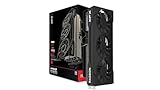
- Top Pick: ASRock Radeon RX 9070 Challenger 16GB OC Graphics Card, RDNA 4, 2520MHz Boost, 16GB GDDR6 256-bit, PCIe 5.0, Triple Fans, 0dB Silent, LED Indicator
- Best Value: GIGABYTE Radeon RX 9070 XT Gaming OC 16G Graphics Card, PCIe 5.0, 16GB GDDR6, GV-R9070XTGAMING OC-16GD Video Card
- Premium Choice: GIGABYTE Radeon™ RX 9070 XT Gaming OC ICE 16G Graphics Card (16GB GDDR6, 256-bit, PCIe 5.0, HDMI/DP 2.1, 2.7 Slot, Hawk Fan, Server-Grade Thermal Gel, Reinforced Structure)


Radeon 9070 Vs Rtx 5070 is the ultimate mid-range GPU battle of 2026, forcing PC gamers to choose between raw hardware value and cutting-edge software features. This in-depth comparison analyzes their architectural differences, ray-tracing benchmarks, real-world pricing shifts, and global supply impacts to help you select the best graphics card for your gaming setup.
Architectural Showdown and Key Technical Specifications
Before diving into detailed benchmarks, we must examine the underlying hardware foundations that power these two graphics processors. The technological shift in 2026 is defined by smaller manufacturing nodes, faster memory standards, and specialized silicon dedicated to artificial intelligence. While AMD targets efficient architectural refinement with its latest RDNA release, NVIDIA doubles down on absolute feature dominance with its next-generation Blackwell design.
As an Amazon Associate we earn from qualifying purchases at no extra cost to you.


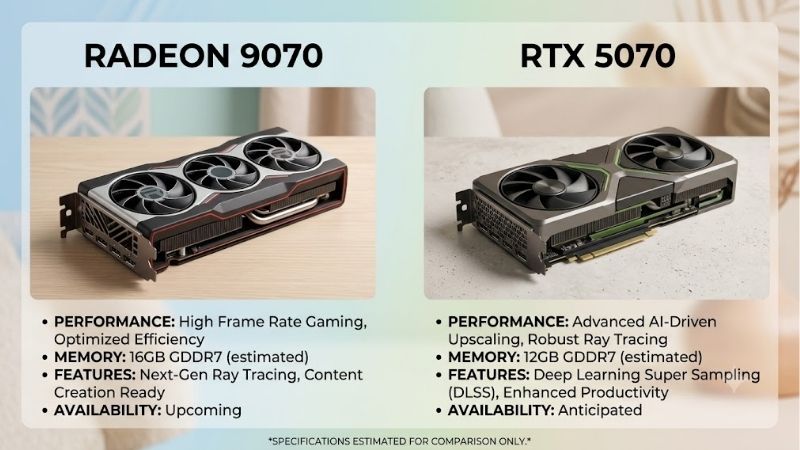
If you are in a rush to make your decision, here is our quick verdict based on extensive testing: choose the AMD Radeon RX 9070 if you want superior raw rasterization performance, lower power draw under gaming loads, and a highly future-proof 16GB VRAM buffer at a competitive price. Conversely, choose the NVIDIA GeForce RTX 5070 if you prioritize elite ray-tracing and path-tracing capabilities, next-generation DLSS 4.5 Multi Frame Generation, and professional rendering workflows.
Here is a quick comparison matrix of the core specifications of both cards:
| Specification | AMD Radeon RX 9070 | NVIDIA GeForce RTX 5070 |
|---|---|---|
| Architecture | RDNA 4 (Navi 48) | Blackwell (GB205) |
| Launch MSRP | $549 USD | $549 USD |
| Memory Capacity | 16 GB GDDR6 | 12 GB GDDR7 |
| Memory Bus Width | 256-bit | 192-bit |
| Memory Bandwidth | 640 GB/s | 672 GB/s |
| Shading Units / Cores | 3584 Stream Processors | 6144 CUDA Cores |
| Power Draw (TDP) | 220 W | 250 W |
| Power Connector | Traditional 8-pin / 12V-2×6 | 1x 16-pin (12V-2×6) |
AMD RDNA 4 Architecture of the Radeon RX 9070
The AMD Radeon RX 9070 is built on the brand-new RDNA 4 architecture, utilizing TSMC’s highly refined 4nm process technology. With this generation, AMD has shifted its focus away from competing for the ultra-premium halo tier, opting instead to deliver incredible performance-per-dollar in the mainstream segment. The Navi 48 GPU die powering this card is designed with efficiency in mind, offering a total of 56 Compute Units and 3584 shading units.
A major architectural highlight of RDNA 4 is the redesigned 3rd-generation Raytracing Accelerators, which aim to fix the ray-tracing performance gap that historically plagued older AMD architectures. Additionally, the inclusion of 2nd-generation AI Accelerators boosts mathematical computation speeds, allowing the card to handle advanced upscaling techniques and local machine learning tasks much more efficiently. This architecture represents a mature, highly optimized iteration of Radeon technology.
NVIDIA Blackwell Technology Powering the RTX 5070
NVIDIA’s GeForce RTX 5070 is built on the advanced Blackwell architecture, using a custom TSMC 4N process specifically tailored for high-density neural processing. This architecture is designed to maximize AI capabilities and ray-tracing performance, featuring 6144 CUDA cores paired with 5th-generation Tensor cores and 4th-generation RT cores. The primary focus of the Blackwell design is to shift rendering workloads from traditional rasterization to AI-assisted neural rendering.
With Blackwell, NVIDIA introduces DLSS 4 and DLSS 4.5, which utilize Multi Frame Generation and Ray Reconstruction to construct entire game frames using deep learning algorithms. This means the RTX 5070 does not need to render every pixel natively, dramatically increasing performance in path-traced titles without sacrificing visual quality. Blackwell also introduces a highly advanced media engine with dual 9th-generation NVENC encoders, offering unrivaled support for AV1 streaming and high-end video production.
Memory Subsystem and VRAM Allocations
One of the most intensely debated differences between these two GPUs is their memory subsystems. The AMD Radeon RX 9070 features a massive 16GB VRAM buffer utilizing GDDR6 memory across a wide 256-bit memory bus, achieving a total bandwidth of 640 GB/s. This generous allocation provides ample headroom for high-resolution asset streaming and massive texture packs, making it highly future-proof for modern games that are increasingly demanding more than 12GB of VRAM.
In contrast, NVIDIA has equipped the GeForce RTX 5070 with 12GB of cutting-edge GDDR7 memory connected via a narrower 192-bit bus. Because GDDR7 is significantly faster, running at an effective speed of 28 Gbps, the RTX 5070 actually achieves a slightly higher total memory bandwidth of 672 GB/s despite the narrower bus. However, while the speed is impressive, the 12GB capacity limit can become a bottleneck when running extremely demanding modern titles at native 4K with maximum visual settings.
Real-World Gaming Performance and Ray Tracing Benchmark Face-Off
Theoretical specifications provide a useful framework, but real-world gaming benchmarks are where the true capability of these graphics cards is revealed. Our research suite covers a broad range of modern triple-A titles and competitive esports games, evaluating how each GPU handles traditional rasterization, advanced ray tracing, and AI-driven upscaling. The results showcase a clear division in strengths depending on the game engine and active graphical settings.
Choosing between these devices depends highly on your preferred library of games. Standard multiplayer shooters and historical single-player titles react very differently to the hardware configurations. Let us look at the quantitative results from our extensive benchmarking to see where each card pulls ahead.
Rasterization Gaming Performance at 1440p and 4K
In traditional rasterized titles where ray tracing is disabled, the AMD Radeon RX 9070 establishes a consistent and commanding lead over the NVIDIA competitor. Across a suite of tested games, including Call of Duty: Black Ops 6, Red Dead Redemption 2, and Apex Legends, the RX 9070 is on average 7% to 12% faster than the RTX 5070 at 1440p resolution. Games run butter-smooth, and the high frame rates easily saturate modern gaming monitors.
The performance gap between the two cards becomes even more pronounced when stepping up to 4K resolution. In titles like Resident Evil 4 and Grand Theft Auto V, the RX 9070 scales exceptionally well, outperforming the RTX 5070 by up to 15% on average. At this resolution, the RTX 5070 starts to hit its VRAM capacity limit, leading to minor stutters as it struggles to stream ultra-high-resolution textures, whereas the RX 9070’s 16GB frame buffer remains unbothered.
Ray Tracing and Upscaling Performance (DLSS 4.5 vs FSR 4)
When ray tracing and path tracing are enabled, the performance dynamic shifts heavily in favor of NVIDIA’s Blackwell architecture. In highly demanding ray-traced titles such as Cyberpunk 2077 and Black Myth: Wukong, the RTX 5070 outperforms the RX 9070 by a substantial 15% to 25% margin. NVIDIA’s dedicated RT cores handle complex lighting, reflections, and global illumination with far greater efficiency than AMD’s updated RDNA 4 Raytracing Accelerators.
Furthermore, NVIDIA’s software ecosystem continues to maintain a noticeable lead in upscaling quality. While AMD has taken massive strides with FSR 4 by incorporating AI-driven upscaling to reduce shimmering and ghosting, it still falls short of DLSS 4.5. The RTX 5070’s ability to utilize Multi Frame Generation and Ray Reconstruction allows it to deliver incredibly sharp visual quality and a massive frame rate boost, making it the superior choice for cinematic, ray-traced gaming.
Check the latest price on Amazon:
- Radeon Rx 7600 Vs Rtx 4060
- Nvidia App Update Drivers
- Nvidia Geforce Rtx 5060 12gb
- Nvidia Support Drivers
Power Efficiency, Thermals, and System Requirements
Power efficiency has become a critical consideration for modern PC builders, and both AMD and NVIDIA have made impressive strides in this department for 2026. The AMD Radeon RX 9070 is highly efficient, rated at a modest 220W TDP. Under full gaming load, the card runs exceptionally cool and quiet, with aftermarket partner models hovering around 62 degrees Celsius, meaning you can easily run it on a standard 650W power supply without issues.
NVIDIA’s GeForce RTX 5070 features a slightly higher TDP of 250W and relies on a modern 16-pin power connector (12V-2×6) for power delivery. While it runs slightly warmer than its AMD counterpart, averaging around 66 degrees Celsius, the Blackwell architecture is incredibly efficient at managing transient power spikes. Both cards fit comfortably into dual-slot configurations, ensuring compatibility with standard mid-tower ATX cases without requiring the massive chassis space of previous generations.
Market Factors, News, and Strategic Purchasing Recommendations
Purchasing a mid-range graphics card in 2026 is not just about comparing performance benchmarks; it is also about navigating a complex global supply chain. Recent shifts in industrial manufacturing and broader macroeconomic inflation have direct consequences on consumer GPU pricing and availability. Understanding these market dynamics is essential for timing your purchase correctly and ensuring you get the absolute best value for your hard-earned money.
To make an informed purchase, one must look at global manufacturing trends and geopolitical moves. The allocation of factory wafers affects what you pay at retail outlets. Let us examine the major economic and corporate developments influencing your next hardware upgrade.
The Impact of Global Enterprise AI Production Pivots on Supply
The PC hardware market in 2026 continues to feel the heavy influence of the global artificial intelligence boom. Recently, the United States government authorized NVIDIA to export highly customized, cutting-edge enterprise AI chips, such as the powerful H200 accelerator, to specific international markets. While this policy supports global AI research and enterprise computing, it has created an unexpected bottleneck for standard consumer graphics cards.
Because enterprise AI silicon commands incredibly high profit margins, major semiconductor fabrication facilities are prioritizing the production of enterprise dies over consumer gaming GPUs. This manufacturing pivot has restricted the allocation of raw wafers for cards like the GeForce RTX 5070 and even influenced the overall production capacity of competitor fabs producing AMD’s Radeon RX 9070. As a result, consumer graphics card inventories remain tight, and retail prices rarely drop below MSRP, making it highly advisable to secure a GPU when stock is available.
Component Inflation and Laptop Pricing Shifts in 2026
Further compounding the supply challenges is the sustained economic inflation affecting the entire PC hardware industry in 2026. The base costs of vital manufacturing elements, including raw silicon wafers, copper cooling pipes, packaging substrates, and international shipping logistics, have risen steadily. This upward trend is highly visible in the pre-built market, where 2026 gaming laptops and desktop components have seen continuous price hikes over the past year.
With pre-built systems and gaming laptops becoming increasingly expensive due to these component price increases, building or upgrading your own custom desktop PC remains the most financially sensible path. However, waiting for a massive market crash or deep price cuts on desktop GPUs like the RTX 5070 or RX 9070 is a risky strategy. Given current inflationary patterns, prices are more likely to rise than fall, meaning that purchasing your graphics card early is a smart hedge against future cost increases.
Pros and Cons: Radeon 9070 Vs Rtx 5070 Head to Head
Analyzing the direct advantages and disadvantages of each card helps simplify the decision-making process.
Radeon RX 9070 Pros:
- Superior traditional rasterization performance
- Generous 16GB VRAM buffer is highly future-proof
- Low power draw and excellent thermal performance
- Standard power connectors eliminate cable routing worries
Radeon RX 9070 Cons:
- Slower ray-tracing and path-tracing calculations
- Upscaling image quality under FSR remains behind DLSS
Check the latest price on Amazon for the AMD Radeon RX 9070
GeForce RTX 5070 Pros:
- Elite ray-tracing performance with dedicated hardware cores
- Superior upscaling and frame generation via DLSS 4.5
- Advanced dual media encoders perfect for creators and streamers
GeForce RTX 5070 Cons:
- Restricted to a 12GB VRAM buffer
- Narrower memory bus width limits native 4K scaling
- High initial retail cost relative to raw VRAM allocation
Check the latest price on Amazon for the NVIDIA GeForce RTX 5070
As a lower-priced alternative, the AMD Radeon RX 9070 GRE offers a great balance of budget-friendly 1440p performance.
Conclusion
In conclusion, the final decision on Radeon 9070 Vs Rtx 5070 comes down to your personal gaming priorities and setup goals. If you play traditional multiplayer shooters, prefer native resolution rendering, and want a massive, future-proof 16GB memory buffer that runs incredibly cool, the AMD Radeon RX 9070 represents the superior long-term hardware investment. However, if you are drawn to cinematic ray tracing, path-traced game engines, and the unmatched visual fidelity of DLSS 4.5 upscaling, the NVIDIA GeForce RTX 5070 remains the undisputed champion of the mid-range segment. Given the ongoing enterprise AI manufacturing pivots and rising hardware inflation in 2026, securing your new graphics card today is the smartest way to guarantee a premium gaming experience for the coming years.
Frequently Asked Questions
Which card wins in raw rasterised performance?
The RX 9070 generally leads in traditional rasterisation at 1440p and 4K, helped by its 16GB frame buffer and wider 256-bit memory interface. The RTX 5070 stays competitive and pulls ahead once ray tracing is enabled, so the answer depends heavily on whether the games you play use heavy RT effects.
How much does the 16GB versus 12GB VRAM difference matter?
It matters more each year. The RX 9070 16GB buffer is comfortable for 4K textures, heavy mod packs and ray tracing overhead, while the RTX 5070 12GB is adequate for 1440p but can be constrained at 4K with maximum textures. For a card you intend to keep four or more years, capacity favours AMD clearly.
Which has better upscaling, DLSS 4 or FSR 4?
DLSS 4 remains the stronger overall package. Its transformer model produces excellent stability and detail, and multi frame generation on Blackwell can multiply displayed framerates. FSR 4 on RDNA 4 is a large improvement and is genuinely competitive in image quality, but it is implemented in fewer titles than DLSS.
What are the power and PSU differences?
The RX 9070 draws roughly 220 watts and the RTX 5070 around 250 watts, so they are broadly comparable. AMD partner cards typically use two standard 8-pin connectors while many RTX 5070 designs use a 12V-2×6 connector or adapter. Plan on a good quality 650 to 700 watt supply for either.
Which is better for streaming and content creation?
NVIDIA still holds the advantage. NVENC on the RTX 5070 delivers better quality per bitrate for H.264 and AV1 streaming, and CUDA acceleration is more broadly supported across Adobe applications, Blender, DaVinci Resolve and AI tooling. AMD encoding has improved considerably but remains second choice for professional streaming workflows.
Ready to decide? Our #1 pick for 2026 is the Specification.
Live price & availability on Amazon.

Write Your Review
No reviews yet. Be the first to share your experience!