

Editor's Pick
msi Gaming GeForce GT 1030 4GB DDR4 64-bit HDCP Support DirectX 12 DP/HDMI Single Fan OC Graphics Card (GT 1030 4GD4 LP OC)

Nvidia healthcare has quietly become one of the most significant frontiers for the company, extending its AI and computing expertise from gaming and data centres into medicine and life sciences. From speeding up medical imaging to accelerating drug discovery, Nvidia’s technology increasingly sits behind the scenes of modern healthcare innovation. This review explains, in plain terms, what Nvidia healthcare actually involves, the key platforms it offers, the real-world applications, and the opportunities and challenges that shape its future, without offering any financial or investment advice. The goal is simply to make sense of a fast-moving field, so you can understand where Nvidia fits and why it matters.
What Nvidia Healthcare Is
Before the applications, it helps to understand what Nvidia is actually doing in this field and why. Its role is less about being a medical company and more about providing the computing engine that powers healthcare AI.
As an Amazon Associate we earn from qualifying purchases at no extra cost to you.







Overview of Nvidia’s Healthcare Push
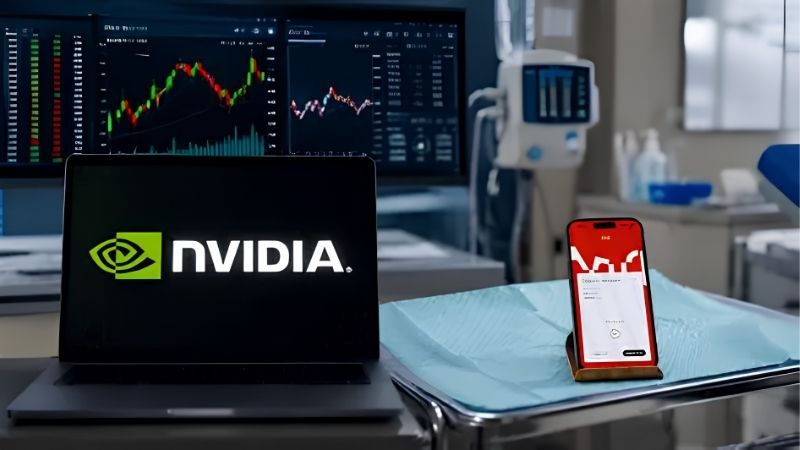
Nvidia healthcare refers to the company’s broad effort to apply its GPUs and AI software to medicine, biology and life sciences. Rather than making medical devices itself, Nvidia provides the computing platforms that hospitals, researchers and companies build upon. This positions it as an enabler of healthcare innovation rather than a direct provider of care. That distinction matters, because it means Nvidia’s influence is spread across countless partners rather than concentrated in any single product.
The core idea is that many healthcare challenges, from analysing scans to modelling molecules, are enormous computing problems. Nvidia’s hardware and software are well suited to accelerating exactly these kinds of tasks. That fit is why the company has invested heavily in dedicated healthcare tools. In many cases, work that once took days of computation can be compressed into hours, which changes what researchers can realistically attempt.
In effect, Nvidia supplies the powerful engine while others design and build the vehicles around it. Understanding that enabler role is key to grasping how its technology ultimately reaches patients indirectly.
Key Platforms and Tools
Nvidia offers several specialised platforms aimed at healthcare, spanning medical imaging, genomics and drug discovery. These provide researchers and developers with optimised tools rather than requiring them to build everything from scratch. Each targets a specific corner of the healthcare and life-sciences landscape.
Its platforms typically bundle libraries, frameworks and pre-built models tuned for medical and scientific work. This lets specialists focus on the science rather than the underlying computing complexity. The result is faster development of healthcare AI applications. By handling the heavy technical plumbing, these platforms free medical experts to concentrate on the problems only they can solve.
Together, these tools form an ecosystem designed to accelerate innovation across the medical field. They are the practical means through which Nvidia’s healthcare vision is delivered.
Who It Is For
Nvidia’s healthcare tools are aimed at researchers, medical technology companies, hospitals and pharmaceutical firms rather than individual patients. These organisations use the technology to build faster, smarter healthcare solutions. The end benefits then reach patients through improved tools and treatments.
Developers and data scientists working on medical AI are a core audience, as are academic and clinical researchers. For them, Nvidia’s platforms can dramatically speed up demanding computational work. That acceleration is often the difference between a project being feasible or not. When a calculation shrinks from weeks to hours, entire lines of research that were once impractical suddenly become possible.
For the general public, the relevance is indirect but real, as this technology shapes the care they eventually receive. Understanding it offers insight into where healthcare innovation is heading. Even patients who never hear of these platforms may one day benefit from the faster diagnoses or treatments they help create.
Applications and Impact
The value of Nvidia healthcare becomes clear in its real-world uses. Here are the main areas where its technology is making a tangible difference across medicine and research.
Medical Imaging and Diagnostics
One of the most prominent applications is in medical imaging, where AI can help analyse scans such as X-rays, CT and MRI images faster and more consistently. Nvidia’s computing power enables the demanding processing these AI models require. This can support clinicians in spotting patterns and speeding up workflows. Handling routine analysis quickly can free radiologists to spend more of their attention on the difficult, ambiguous cases.
Faster, AI-assisted image analysis has the potential to reduce delays and support earlier detection of issues. The technology is designed to assist medical professionals rather than replace their judgement. Human oversight remains central to how these tools are intended to be used. The aim is to give clinicians sharper tools and more time, not to remove the expert from the decision.
This imaging work is among the clearest examples of Nvidia healthcare in action. It shows how raw computing power can translate directly into practical, tangible clinical benefit for patients and staff alike.
Drug Discovery and Genomics
Drug discovery is another major area, where AI can model molecules and predict how potential treatments might behave. These simulations involve enormous computation, exactly the kind of work Nvidia’s hardware accelerates. The aim is to shorten the long, costly process of developing new medicines. Even modest reductions in that timeline can translate into treatments reaching patients sooner and at lower cost.
In genomics, Nvidia’s technology helps analyse vast amounts of genetic data far more quickly than before. Faster genomic analysis can support research into diseases and more personalised approaches to treatment. The scale of data involved makes acceleration genuinely valuable here. Sequencing produces vast datasets, and being able to process them quickly is often what makes large studies practical at all.
Both fields highlight how computing power can push the boundaries of medical research. They are areas where speed can translate directly into scientific progress.
Hospitals, Devices and Digital Health
Beyond research, Nvidia’s technology supports medical devices, hospital systems and digital health tools. It can power AI features in equipment and help manage the growing flood of healthcare data. This broadens its impact from the laboratory into everyday clinical settings.
Edge computing, where AI runs directly on or near a device, is increasingly relevant for real-time medical applications. Nvidia provides platforms designed for these demanding, low-latency scenarios. Such capabilities matter for devices that must respond instantly. In a clinical setting, the difference between a response in milliseconds and one in seconds can be genuinely important.
Together these applications extend Nvidia healthcare across the whole care journey. From research bench to hospital bedside, its technology is increasingly present.
Opportunities, Challenges and Outlook
With the applications clear, it is worth weighing the bigger picture honestly. Here are the opportunities, the real hurdles, and a measured view of where things may head.
Opportunities and Challenges
Here is the honest ledger for Nvidia healthcare as a field of technology.
Opportunities: faster diagnostics, accelerated drug discovery, more personalised medicine, and powerful tools for researchers. Challenges: strict regulation, the need for careful validation, data privacy concerns, and the high cost and complexity of adoption.
The pattern is clear: the potential is substantial, but healthcare’s high stakes mean progress must be careful and well tested. Balancing innovation with safety is the defining tension of the field. Moving too fast risks patient safety, while moving too slowly delays real benefits, so the middle path is essential.
Adoption Hurdles
Healthcare is a heavily regulated field, and any AI tool must be rigorously validated before it can be trusted with patient care. This makes adoption slower and more demanding than in many other industries. Safety and evidence rightly come before speed.
Data privacy is another significant hurdle, since medical information is highly sensitive and tightly protected. Any technology handling it must meet strict standards and earn the trust of both regulators and patients. These requirements shape how quickly tools can be deployed. Earning that trust takes time and evidence, which is why healthcare AI tends to arrive more gradually than consumer technology.
Cost and complexity also slow adoption, as integrating advanced AI into existing systems is far from trivial. These hurdles are not flaws in the technology but realities of applying it responsibly in medicine. Taking them seriously is exactly what separates trustworthy healthcare AI from tools that overpromise and underdeliver.
The Outlook for Nvidia Healthcare
The broad direction points toward AI becoming an increasingly important tool across medicine, with computing platforms central to that shift. Nvidia is well positioned as a provider of the underlying technology. Its role as an enabler gives it broad relevance across the field. Because so many healthcare AI efforts rely on similar computing foundations, that enabling position touches a wide range of projects.
That said, the pace of real-world impact depends heavily on regulation, validation and careful clinical adoption. Progress in healthcare is deliberately measured, and that will continue. Expectations should be grounded in that reality rather than hype.
This overview describes Nvidia’s healthcare technology and its potential; it is not financial or investment advice. Anyone considering business or investment decisions should consult qualified professionals and their own research.
See more:
- Nvidia gear store
- Nvidia number of employees
- Nvidia Jetson Xavier Developer Kit
- GeForce graphics driver
Conclusion: Understanding Nvidia Healthcare
Nvidia healthcare represents a serious and growing effort to apply the company’s AI and computing strengths to medicine, powering advances in medical imaging, drug discovery, genomics and digital health as an enabler rather than a direct care provider. The opportunities are significant, from faster diagnostics to more personalised treatment, but they are balanced by real challenges around regulation, validation, privacy and cost that keep progress careful and measured. As AI becomes more woven into healthcare, understanding Nvidia healthcare offers a useful window into where the field is heading. This article is an informational overview only and does not constitute financial or investment advice.
Frequently Asked Questions
What does NVIDIA actually build for healthcare?
NVIDIA supplies the compute platform and software frameworks rather than clinical products. Its healthcare stack includes Clara for medical imaging, MONAI for imaging AI research, Parabricks for accelerated genomic analysis, BioNeMo for biomolecular models, and Holoscan with IGX for real time sensor processing in surgical and diagnostic devices.
Is MONAI an NVIDIA product or open source?
MONAI is an open source framework for medical imaging deep learning, co-founded by NVIDIA and King’s College London and now governed as a community project. NVIDIA contributes heavily and provides enterprise deployment tooling, but researchers can use the core framework freely without any NVIDIA commercial licence.
What hardware do hospitals and labs use for this work?
Research and clinical AI training typically runs on datacentre accelerators, while deployed medical devices often use the IGX platform or Jetson modules for edge inference with the reliability and long lifecycle support that regulated equipment requires. Workstation RTX PRO cards cover local development and imaging visualisation.
Does NVIDIA get FDA clearance for medical AI?
No. NVIDIA provides the computing platform, and regulatory clearance is the responsibility of the medical device manufacturer or software developer building on top of it. Holoscan and IGX are designed to support that process with long term software support, but the submission belongs to the device maker.
How does Parabricks speed up genomics?
Parabricks reimplements standard secondary analysis pipelines such as alignment and variant calling on GPUs, turning workloads that previously required many hours of CPU time into runs measured in tens of minutes while producing results consistent with the established CPU based tools those pipelines were validated against.



Write Your Review
No reviews yet. Be the first to share your experience!