
Nvidia investments extend far beyond selling chips: the company has quietly become one of the most active investors in the entire AI ecosystem. Through a venture arm and large strategic stakes, it has backed everything from cloud providers to foundation-model labs. This article explains how Nvidia invests, its biggest bets, the controversy surrounding the strategy, and the risks worth understanding before drawing conclusions.


Nvidia as an AI Investor
Most people know Nvidia for its GPUs, but its investment activity has become a strategic pillar in its own right. Understanding the two channels it invests through is the key to making sense of the portfolio.
As an Amazon Associate we earn from qualifying purchases at no extra cost to you.


Two Investment Arms
The separation of these two functions is not merely organizational bookkeeping; it reflects genuinely different mandates and risk appetites. NVentures operates like a traditional venture fund, spreading many comparatively modest bets across early- and growth-stage startups in the hope that a few become enormous winners. Corporate Development, by contrast, concentrates far larger sums into a small number of established, strategically critical partners where the goal is as much about securing supply, capacity, or capability as about financial return. Reading any given Nvidia investment correctly starts with identifying which of these two very different playbooks produced it.
Nvidia invests through two distinct channels. NVentures is its dedicated venture-capital arm, backing startups across AI, computing, robotics, and software, while a separate Corporate Development function handles the very largest strategic stakes, joint ventures, and acquisitions.
The scale of the two differs enormously: NVentures writes venture-sized checks into promising companies, while Corporate Development can deploy amounts orders of magnitude larger into major infrastructure players.
Knowing which arm made a given investment helps interpret it, since a NVentures seed round and a multibillion-dollar strategic stake serve very different purposes.
Why Nvidia Invests
This ecosystem-first rationale distinguishes Nvidia’s investing from that of a pure financial investor, and it explains some decisions that would look odd through a returns-only lens. A startup that will consume large quantities of Nvidia GPUs is valuable to Nvidia even if the equity stake itself never delivers a spectacular exit, because the hardware demand and the deepening of the platform can matter more than the investment gain. Understanding this motive is essential, since it means Nvidia’s portfolio is best read as a strategic map of where the company wants accelerated computing to spread rather than as a conventional bet on financial upside alone.
Nvidia’s investing is deeply strategic. By backing companies that build on its hardware and platforms, it strengthens the broader ecosystem that drives demand for its chips, creating a reinforcing loop.
The thesis is that supporting AI infrastructure providers, model labs, and application builders expands the market for accelerated computing, benefiting Nvidia even when a given investment is modest.
In effect, the company invests to grow the pie, not just to earn financial returns, which is why so many of its bets sit squarely within the AI supply chain.
The Scale of Activity
The signaling power of Nvidia’s participation is itself a notable feature of this activity. Because the company sits at the technical and commercial center of the AI industry, its decision to back a startup is widely read as an endorsement of that company’s relevance to the future of computing, which can help attract other investors and customers. This gives Nvidia’s checks an influence beyond their dollar value, effectively letting the company help shape which parts of the AI ecosystem receive the capital and attention needed to grow.
Nvidia’s investment footprint expanded dramatically as the AI boom accelerated, spanning dozens of companies across seed rounds to enormous late-stage financings and strategic stakes disclosed in regulatory filings.
This activity turned Nvidia into a gravitational center of AI funding, with its participation often signaling confidence that draws other investors into a round.
The sheer breadth of the portfolio is what makes Nvidia’s investments a story worth understanding alongside its chip business rather than a footnote to it.
The Biggest Bets
A handful of investments stand out for their size and strategic weight. These flagship positions illustrate how Nvidia’s capital reinforces its core business.
CoreWeave: The Flagship Stake
The CoreWeave relationship also became the clearest public illustration of the circular dynamics that critics and supporters argue about. Nvidia invests capital into CoreWeave; CoreWeave uses funds to buy and deploy Nvidia hardware and commits to future Nvidia infrastructure; and Nvidia holds equity that appreciates if CoreWeave thrives on the back of that very hardware. Whether one sees this as savvy ecosystem-building or as demand that partly finances itself, the arrangement is undeniably emblematic of how tightly Nvidia’s investing, selling, and strategic positioning have become intertwined in the AI era.
CoreWeave, a cloud provider that rents access to Nvidia GPUs, is the marquee investment. Nvidia first put in about $100 million in 2023, supported the company’s 2025 IPO with a large share order, and later added roughly $2 billion more.
Alongside the capital came deep commercial ties, with CoreWeave adopting Nvidia platforms and committing to deploy future Nvidia infrastructure, binding the two companies closely together.
The position illustrates Nvidia’s strategy perfectly: invest in a customer that in turn buys enormous quantities of Nvidia hardware, reinforcing demand while taking an equity stake in the growth.
Other Strategic Stakes
The investment in a chip-design software leader is particularly revealing about Nvidia’s strategic thinking, because it reaches back up the supply chain toward the tools used to create advanced semiconductors themselves. Rather than confining its bets to customers who buy GPUs, Nvidia has shown willingness to invest across the entire arc of the AI stack, from the software that designs chips to the data centers that run them. That breadth suggests a company trying to fortify every layer on which its own dominance ultimately depends.
Beyond CoreWeave, Nvidia has taken sizable positions in other infrastructure and technology players, including a multibillion-dollar investment in chip-design software leader Synopsys and stakes in cloud and AI-infrastructure firms.
These bets follow the same logic of strengthening the tools and platforms that surround Nvidia’s chips, from design software to the data centers that house its GPUs.
Regulatory filings periodically reveal these holdings, offering a window into where Nvidia sees the AI supply chain heading next.
The NVentures Portfolio
What stands out about the NVentures roster is how deliberately it tracks the frontier of where computation is becoming a bottleneck. Foundation-model labs need vast training clusters, robotics startups need real-time inference, drug-discovery firms need to simulate molecular interactions, and fusion researchers need to model plasma, and every one of those needs maps onto demand for accelerated computing. By backing companies at each of these frontiers, Nvidia positions itself to benefit regardless of which specific applications of AI ultimately prove most transformative, hedging across the entire landscape rather than betting on a single winner.
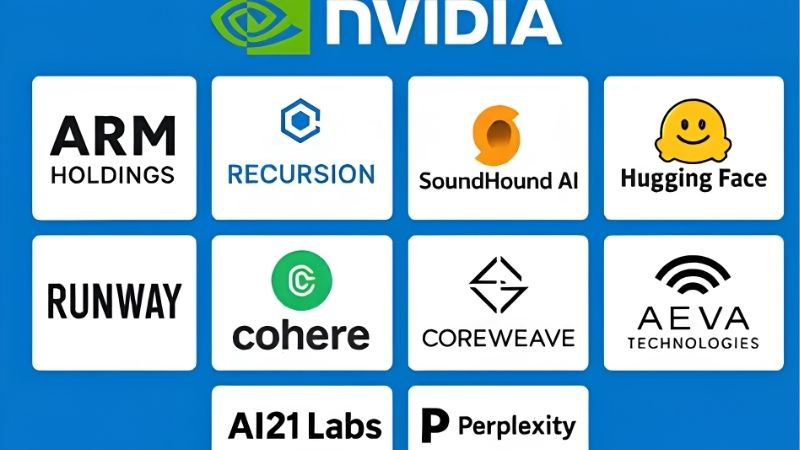
Through NVentures, Nvidia has backed a striking roster of AI companies, participating in financings for foundation-model labs, robotics startups, and infrastructure providers alike.
The portfolio spans generative AI, autonomous systems, biotech and drug discovery, quantum computing, and developer tools, reflecting a bet on AI transforming many industries at once.
This diversity across the AI landscape is what makes NVentures a strategic map of where Nvidia expects accelerated computing to create the next wave of value.
The Debate, Risks, and Trade-Offs
Nvidia’s investment strategy is not without controversy, and weighing its pros and cons is essential to understanding it fully.
The Circular-Financing Critique
The debate matters beyond mere labeling because it bears directly on how observers judge the durability of Nvidia’s growth. If a meaningful share of demand is being underwritten by Nvidia’s own capital flowing to customers, some argue, then the revenue may be less organic and more vulnerable than the headline numbers suggest. Defenders respond that every large infrastructure transition in history has involved suppliers helping finance early adopters, and that the underlying demand for AI computing is real and vast. Where one lands on this question significantly shapes one’s overall view of the company.
Critics describe some of Nvidia’s investments as “circular financing,” arguing that by funding customers who then buy its chips, Nvidia effectively subsidizes its own sales and may flatter demand.
Supporters counter that AI infrastructure buildouts require huge upfront capital, and that strategic investment is a normal way to accelerate a market Nvidia is well positioned to serve.
Both views hold some truth, and the debate is worth understanding because it shapes how observers interpret the durability of Nvidia’s revenue.
Pros and Cons of the Strategy
Execution risk is easy to underrate amid the excitement, yet it is a genuine part of the ledger. Startups in the portfolio can and do fail, high valuations set during a period of intense enthusiasm can compress sharply if sentiment cools, and large strategic stakes concentrate even more of Nvidia’s fortunes in the single AI theme it is simultaneously helping to fund. None of this means the strategy is unwise, but it does mean the investment portfolio amplifies both the upside and the downside of the AI cycle rather than diversifying Nvidia away from it.
The pros of Nvidia’s investment approach include strengthening its ecosystem, securing demand, and gaining equity upside in fast-growing partners. The cons include concentration in the AI supply chain and the circular-financing perception.
There is also execution risk: startups can fail, valuations can fall, and large strategic stakes tie Nvidia’s fortunes even more tightly to the AI narrative it is helping to fund.
A balanced view holds these benefits and risks together rather than treating the investment portfolio as purely a strength or purely a red flag.
Investing in Nvidia and a Disclaimer
A separate question is whether to invest in Nvidia itself, which is entirely different from understanding Nvidia’s investments. This article does not address that decision or offer any recommendation.
Please note that this content is for informational purposes only and is not financial or investment advice. Details of investments and stakes can change, and third-party summaries may lag or contain errors.
Always verify with official filings and reputable sources, and consult a licensed financial advisor before making any investment decision of your own.
See More:
- TechPowerUp GPU
- Nvidia H200 GPU price
- RTX 5050 Mobile
- Nvidia competitors
- Nvidia Reflex low latency on or off
The Bottom Line on Nvidia Investments
Nvidia investments reveal a company that is not only selling the picks and shovels of the AI era but also funding the miners, through NVentures and large strategic stakes like CoreWeave that reinforce its ecosystem while inviting a circular-financing debate. To explore the hardware at the center of all this activity, browse our GPU reviews and guides — and remember that nothing here is investment advice, so do your own research and consult a professional before acting on any of it.
Frequently Asked Questions
What kinds of investments does NVIDIA make?
Three broad categories. Minority equity stakes in startups through its NVentures arm, larger strategic investments in AI infrastructure and model companies made from the balance sheet, and non-cash support through the Inception programme in the form of credits, discounts and engineering access. The disclosed equity positions appear in its quarterly and annual SEC filings.
Why does NVIDIA invest in companies that also buy its chips?
Because funding the ecosystem expands demand for accelerated computing and helps ensure new AI workloads are built on CUDA rather than on competing platforms. Critics describe some of these arrangements as circular, where investment capital returns as hardware orders. NVIDIA’s position is that it is seeding markets that would otherwise develop more slowly or on rival silicon.
Where can I see NVIDIA’s investment portfolio?
Publicly traded holdings are disclosed in the 13F filings and in the investments note of the 10-Q and 10-K. Private stakes are generally disclosed in aggregate rather than company by company, though individual deals often become public through the startup’s own funding announcements. SEC EDGAR is the authoritative free source for all of these documents.
Do these investments materially affect NVIDIA’s financial results?
They can. Gains and losses on equity stakes flow through other income and expense, and marks on publicly listed holdings can swing quarterly net income noticeably even when the operating business is unchanged. This is one reason analysts focus on operating income and segment revenue when judging the underlying business performance rather than headline net income alone.
Are there regulatory concerns about these investments?
Competition authorities in the United States, Europe and elsewhere have examined whether strategic investments combined with supply allocation could disadvantage rivals, and NVIDIA has disclosed regulatory inquiries as risk factors in its filings. Nothing about that scrutiny is unusual for a company with this market position, but it is a live consideration rather than a settled one.







Write Your Review
No reviews yet. Be the first to share your experience!