
- Top Pick: BSEED Surge Protector Home Appliance,Single Outlet Power Voltage Protector,Voltage Brownout Surge Refrigerator 1440 Watts,Voltage Brownout Plug Outlet, 1875W, 125V, 15A(1 Pack)
- Best Value: Fosmon Refrigerator Surge Protector, 3 Outlet Heavy Duty Appliance Surge Protector with High Joules for Fridge, Microwave, Washing Machine, Garage Door, 1200J, 1875 Watts, 3 Prong, ETL Listed- 2 Pack
- Premium Choice: Refrigmatic 2 in 1 Voltage & Surge Protector for Refrigerators | Protects refrigerators Up to 27 cu. ft. against high and low voltage, brownouts and spikes. Includes safety delay time
The best surge protector for a refrigerator is a single-outlet or wall-mounted unit that is UL 1449 listed, rated for at least the 15-amp, 120-volt load of a household fridge, with a high joule rating and a low voltage protection rating, and that is plugged straight into a grounded wall outlet without any extension cord. Many refrigerator makers publish their own guidance on this point, so read the owner’s manual before buying anything.
As an Amazon Associate we earn from qualifying purchases at no extra cost to you.


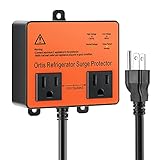
Safety First: What to Do Before You Buy
A refrigerator has a compressor motor that draws a short burst of extra current every time it starts. Some appliance makers tell owners to plug the unit directly into a dedicated, grounded outlet and avoid power strips and extension cords; others allow a properly rated surge protector. Read the section of your manual about electrical requirements and follow it. If your outlet is loose, discolored, warm to the touch or does not hold the plug firmly, stop and have a licensed electrician inspect it. Do not use a cheap multi-outlet strip rated lower than the fridge needs. Nothing in this guide is a substitute for an electrician or the appliance maker’s instructions.
Why a Fridge Benefits From Surge Protection
Voltage spikes from storms, utility switching and large loads nearby can stress the control board and compressor. Modern refrigerators contain electronic boards for temperature sensing, defrost cycles, ice makers and displays, and these boards are the parts most often named when people discuss surge damage. A surge protector reduces the chance of a spike reaching them. It does not guarantee protection from a direct lightning strike, and it does not replace whole-home surge protection installed at the panel by an electrician.
Specs That Matter
UL 1449 listing
UL 1449 is the standard used in North America for surge protective devices. A listed product has been evaluated against that standard, and its label shows a voltage protection rating, often shortened to VPR. Look for the listing on the product or packaging.
Voltage protection rating
The VPR indicates how high a let-through voltage the device allows during a surge. Standard ratings are 330, 400, 500, 600 and above. Lower is better, so a 330 or 400 rating is preferable to a 600 rating.
Joule rating
Joules describe how much surge energy the device can absorb before it wears out. Higher is better, but the figure is not standardized to the same extent as VPR, so use it to compare products of the same category rather than as a single deciding factor. Makers frequently list ratings in the hundreds to thousands of joules.
Amperage and wattage
Standard North American outlets and plugs are rated 15 amps, which corresponds to about 1,800 watts at 120 volts. A fridge typically uses far less in normal running, but its startup draw is higher, so the protector’s rating should not be lower than the appliance’s nameplate requirement. Check the nameplate inside the fridge.
Outlet count and layout
A single-outlet protector is the cleanest answer for a fridge, because it needs no extra sockets and keeps the cord run short. If a multi-outlet unit is the only option, reserve the fridge as the only high-draw device on it.
Protection status light
Surge protectors wear out after absorbing surges. An indicator light for protection status tells you when the protection circuit has stopped working. Replace the unit when that light goes out, or on a schedule suggested by the maker.
At a Glance: Product Types Compared
| Type | Best for | What to confirm | Limits |
|---|---|---|---|
| Single-outlet wall tap (makers include Belkin, APC, Tripp Lite, Eaton) | Most kitchen fridges | UL 1449 listing, 15 amp rating, joules, VPR | Protects only one appliance |
| Heavy-duty appliance surge protector with a short cord | Fridges where the outlet sits behind the unit | Cord gauge and plug fit behind the fridge | Cord may be short |
| Wall-mounted protector with a grounded plug and flat plug profile | Tight spaces where fridge sits flush to the wall | Flat or right-angle plug design | Check the manual for allowed use |
| Multi-outlet surge strip | Chest freezer corner, garage fridge with other loads | 15 amp total rating, no daisy-chaining | Easy to overload |
| Whole-home surge protective device (installed at the panel) | Complete protection for all circuits | Must be installed by a licensed electrician | Installation is professional work |
Budget, Mid-Range and Premium Tiers
| Tier | Typical features | Who it suits |
|---|---|---|
| Budget | UL 1449 listed single-outlet or small strip, basic joule rating, protection light | Apartment fridge in a low-risk area |
| Mid-range | Higher joules, lower VPR, sturdy housing, better warranty terms | Everyday kitchen use and homes with frequent storms |
| Premium | Highest joule ratings, connected equipment warranty from the maker, extra status indicators, or a whole-home panel device | Expensive fridges with smart features, or homes with outage-prone grids |
Connected equipment warranties offered by some makers cover certain damage to plugged-in devices under their own terms, which often exclude lightning or have claim conditions. Read the fine print rather than relying on the headline.
Pick X If Decision Table
| Pick this | If |
|---|---|
| Single-outlet UL 1449 protector | You want a simple fix for a kitchen fridge and the manual allows it |
| Flat-plug wall-mount protector | The fridge sits tight against the wall and a bulky plug will not fit |
| Multi-outlet strip with 15-amp rating | A garage fridge shares the outlet with a freezer or a light and the manual permits it |
| Whole-home protector | You want protection for every appliance and PC in the house and have an electrician available |
| No protector, direct to wall | The fridge maker says to plug directly into the wall |
Common Mistakes
- Using a thin extension cord, which may overheat under compressor load.
- Plugging a surge strip into another strip, which breaks listing conditions.
- Choosing a protector by joule number alone and ignoring VPR and UL listing.
- Ignoring the protection light and keeping an expired unit in service for years.
- Assuming a surge protector prevents damage during power outages or brownouts, when it addresses spikes rather than loss of power or sustained low voltage.
- Ignoring a warm plug or outlet, which can point to a wiring problem that needs an electrician.
Brownouts, Outages and Other Protection
Surge protectors address short spikes. Outages and low-voltage events are different. Some appliance owners add a refrigerator-specific voltage monitor or delay device that waits a few minutes before restoring power to the compressor, a feature the manufacturers of such devices describe as protecting against short-cycling after an outage. Ask the fridge maker whether this is relevant for your model. Gamers who keep a PC on a UPS should keep the fridge on its own circuit rather than sharing a UPS, because the startup draw of a compressor can overwhelm small units.
Alternatives to Consider
- Refrigerator voltage protector or delay device: addresses outages and low voltage in addition to spikes.
- Whole-home surge protective device: installed by an electrician at the main panel.
- Dedicated circuit: an electrician can add a dedicated outlet for the fridge.
- Smart plug with energy monitoring: useful for visibility but not surge protection unless the maker lists UL 1449 compliance.
Frequently Asked Questions
Do refrigerators need a surge protector?
Not every maker requires one, and some state that the fridge should go directly into the wall outlet. A surge protector may still reduce risk for models with electronic boards, but follow the owner’s manual first.
Can I use a regular power strip for a refrigerator?
A basic power strip without surge protection adds no protection and may add a failure point. If you use any strip, it should be listed, rated at least 15 amps, and permitted by the fridge maker.
How many joules should a fridge surge protector have?
Higher is better, but compare joules together with the UL 1449 listing and voltage protection rating. Many makers sell units from several hundred to a few thousand joules.
How often should I replace a surge protector?
Replace it when the protection indicator light goes out, after a major surge event, or according to the maker’s guidance. Protective components degrade with use.
Will a surge protector save the fridge in a lightning strike?
No device can promise that. A point-of-use protector reduces the risk from typical spikes, and whole-home protection installed by an electrician adds another layer.
Should the fridge share a circuit with other appliances?
A dedicated circuit is preferred by many appliance makers because it avoids tripped breakers and voltage drops. An electrician can confirm what your home wiring supports.



Write Your Review
No reviews yet. Be the first to share your experience!