
- Top Pick: TV Antenna for Smart TV Indoor, Digital TV Antenna for Local Channels | HD Digital Antenna with Amplifier Signal Booster for Local Channels Supports 4K 1080p-16.5 ft Long Cables
- Best Value: Antennas Direct ClearStream 2V Outdoor TV Antenna | 20-Inch Mast, Reflectors, Hi-VHF Elements, UHF VHF Signals, Multi-Directional, UHD 4K, 8K, NEXTGEN TV
- Premium Choice: GE Outdoor HD Digital TV Antenna, Long Range Smart TV Antenna | Supports 4K 1080P HD Smart TV VHF UHF, J Mount Included for Attic or Outdoor, Weather Resistant, 29884
If you live within a few dozen miles of your local broadcast towers, a flat or compact indoor/outdoor antenna from Mohu or ClearStream is usually enough; farther out, or in a hilly area, a roof or attic mounted outdoor antenna rated for a longer range is the safer choice. The deciding factors are distance to the transmitters, obstacles in between and where the antenna can be placed.
As an Amazon Associate we earn from qualifying purchases at no extra cost to you.

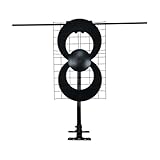


Antenna classes at a glance
| Class | Example lines | Best for | Limits |
|---|---|---|---|
| Thin flat indoor | Mohu Leaf family | Apartments, windows, near-tower locations | Shorter reach; placement sensitive; the maker groups indoor models in a 0 to 50 mile range class |
| Indoor/outdoor compact | ClearStream Eclipse and similar | Window, attic, balcony or mast mounting | Mid-range reach; needs good placement and a clear sight line |
| Outdoor directional | ClearStream 2V, 4V and similar from Antennas Direct | Rural and fringe areas; the maker groups outdoor models at 50 to 70 miles | Needs a mast, aiming and cable run |
| Attic or RV | Dedicated attic and RV models | Hidden installs, travel | Attic materials can weaken signal |
| Amplified options | Many Mohu, Winegard and Channel Master models | Long cable runs or splitting to several TVs | Amplifiers can overload strong signals and add noise |
How to choose an indoor/outdoor antenna
Find your towers first
Before comparing products, look up the broadcast towers near you using a transmitter locator. The Antennas Direct site offers such a tool, and the FCC’s DTV reception maps and other free tools do the same. They show distance, direction and which channels are available, which tells you whether a small indoor antenna is realistic or whether you need an outdoor model.
Treat range figures as best-case
Makers publish range numbers in miles. Those assume a clear line of sight. Walls, trees, hills and tall buildings reduce actual reception, and the direction of the towers matters. If towers are all in one direction, a directional antenna works well; if they are scattered, an omnidirectional or multidirectional design is easier.
VHF and UHF
Most stations broadcast on UHF, but some local channels still use VHF high-band. If your channels include VHF, check that the antenna is designed to receive it. Small flat antennas sometimes favor UHF.
Indoor placement and outdoor mounting
Antennas often work best high and near a window facing the towers. Outdoor mounting usually increases signal quality, but requires attention to grounding and mast safety. Follow the manufacturer’s instructions and local rules, and keep any mast well clear of power lines. If you are unsure about roof work or grounding, contact a licensed installer.
Amplifiers
An amplifier helps when you lose signal through a long cable or a splitter. It does not create signal where there is none, and near a strong tower it can overload your tuner. Many people begin without an amplifier and add one only if needed.
ATSC 3.0 and your TV
Some stations now broadcast NextGen TV (ATSC 3.0) alongside standard ATSC 1.0. The antenna still receives the same radio frequencies, while the TV or an external tuner handles the format. Check your television’s tuner support if you want these newer broadcasts.
Picks by scenario
| Pick this if… | Consider | Why |
|---|---|---|
| You live in a city and want a discreet window antenna | Mohu Leaf family | Thin design that sits near a window |
| You want a flexible indoor-or-outdoor installation | ClearStream Eclipse or similar compact model | Can be placed on a window, attic or mast |
| You are rural or far from towers | ClearStream 4V or another outdoor directional antenna | Larger outdoor design in the maker’s longer range class |
| You need to feed multiple TVs | Amplified model or distribution amplifier | Offsets splitter and cable loss |
| You live in an RV or travel often | A dedicated RV or portable antenna | Built for varied reception sites |
Budget tiers
Budget
Thin indoor antennas are inexpensive and work in strong-signal areas. They are a low-risk way to test whether over-the-air TV suits your home.
Mid-range
Compact indoor/outdoor and basic outdoor antennas with better build quality and longer stated range. This tier suits most suburban homes.
Premium
Large outdoor directional antennas, multidirectional designs and mast kits for fringe reception. Expect additional installation cost for masts and grounding.
Setup tips that matter
- Run a full channel scan after any move of the antenna, since the TV does not update channels automatically.
- Move the antenna a few inches at a time and rescan, because small shifts can change reception.
- Use quality coaxial cable and keep the run short.
- Keep the antenna away from routers, power adapters and LED lights that may add interference.
- For outdoor installs, use grounded mounting hardware and follow the manufacturer’s instructions.
- Reception can change with weather and leaf cover, so watch it across seasons before drawing conclusions.
Common mistakes
- Trusting a big mileage claim without checking actual tower distance.
- Pointing the antenna in the wrong direction.
- Adding an amplifier to a strong-signal location.
- Forgetting to rescan channels.
- Splitting the signal to many TVs without compensating for the loss.
- Installing a mast near overhead lines.
Gaming and streaming notes
For a gaming room that doubles as a TV spot, an antenna is a free way to receive local news and sports without a subscription. Place it away from PC power supplies and routers to limit interference, and use a TV or tuner box with a recent tuner if you want newer broadcast formats.
Alternatives
- Roof or attic outdoor antenna: best for weak-signal locations.
- Network tuner box: sends over-the-air channels to devices across your home.
- Streaming services: a fallback if local reception is poor.
Frequently Asked Questions
Is an indoor/outdoor antenna better than an indoor-only one?
It is more flexible because you can try it indoors and move it to an attic or mast if reception is weak. Whether it performs better depends on placement and the tower distance.
Do I need an amplified antenna?
Not always. Amplification can help with long cable runs or splitters but may overload strong signals. Start without one and add it only if you see signal loss.
How far can a TV antenna receive?
Makers list distance classes, such as indoor models in a shorter range and outdoor models in a longer one. Real reception depends on terrain, buildings and the direction of the towers, so use a transmitter locator.
Why do some channels drop out?
Weak signal, interference, bad placement and weather can all cause dropouts. Reposition the antenna, shorten the cable and rescan channels.
Will an antenna work with ATSC 3.0?
The antenna receives the radio signals, while the TV or a tuner box decodes the format. Make sure your TV supports the format if you want those broadcasts.
Is it safe to install an outdoor antenna myself?
It can be, but roof work and grounding carry real risks. Follow the manual, stay away from power lines and hire a licensed installer if you are unsure.



Write Your Review
No reviews yet. Be the first to share your experience!