
Our Short List of 3

- Best for: Solo regional drivers who restock food every day or two and have limited cab floor space.
- Capacity from title: 15 liter
- Power from listing: 12/24V DC, with AC adapter for 110 to 240V
- Temperature range from listing: -4°F to 50°F
- Cooling type: Compressor

- Best for: Long-haul drivers who load a full week of food and want one box for frozen and fresh storage.
- Capacity from title: 30 quart
- Power from listing: 12/24V DC and 110 to 240V AC adapter
- Temperature range from listing: -22°C to 10°C
- Cooling type: Compressor
- Best for: Drivers who want fast pull-down cooling after shopping and a gentler overnight draw.
- Capacity from title: 30 quart
- Power from listing: 12/24V DC, with AC adapter included
- Temperature range from listing: -22°C to 10°C
- Cooling type: Compressor
All 3 Picks at a Glance
| Product | Specs | Action |
|---|---|---|
| Alpicool C15 Portable Refrigerator, 15 Liter |
| Check price on Amazon |
| F40C4TMP Portable Refrigerator, 30 Quart |
| Check price on Amazon |
| BougeRV CRPRO Portable Refrigerator, 30 Quart |
| Check price on Amazon |
For a driver, a cooler is not really about cold drinks. It is about whether dinner on day three of a run is still safe to eat, whether medication stays inside its storage range through a hot afternoon in a parked cab, and whether a week of real food can ride along instead of another week of truck stop counters. A box that only keeps things coolish, or one that flattens the starting battery overnight, fails at the job that actually matters.
This roundup speaks to long-haul drivers with a sleeper cab, regional drivers home twice a week, and owner-operators planning their own cab layout. Every option below is a compressor based electric cooler that runs on vehicle power, and each capacity, temperature range and power detail is drawn from the name and listing information on its Amazon product page.
Quick Picks
As an Amazon Associate we earn from qualifying purchases.
| Product | Best for | Key spec from title |
|---|---|---|
| Alpicool C15 Portable Refrigerator, 15 Liter | A solo driver who needs a compact box beside the seat | 15 liter capacity, 12/24V DC |
| F40C4TMP Portable Refrigerator, 30 Quart | Week-long food storage in a sleeper cab | 30 quart capacity, 12/24V DC and AC power |
| BougeRV CRPRO Portable Refrigerator, 30 Quart | Drivers who switch between max cooling and eco running | 30 quart capacity with ECO and MAX modes |
| EUHOMY 12 Volt Refrigerator, 26 Quart | A mid-size box for meals plus drinks on regional routes | 26 quart capacity, 12/24V DC |
How to Choose
Size the box against your route, not your appetite
Start with the calendar. A regional driver who reloads food every second day can live happily with a compact box in the fifteen liter range, holding a couple of meals, drinks and a small ice substitute free interior. A long-haul driver shopping once a week needs roughly double that space, because meal prep containers stack poorly and bottles waste corners. Measure the cab spot you have in mind before ordering anything, including the lid swing and the space the power cord needs, and check the external dimensions on the product page against that tape work. A cooler that fits the route but not the cab helps nobody.
Compressor cooling versus thermoelectric cooling
The listings worth your money for truck work use a compressor, the same basic technology as a household fridge, and they state a temperature range that reaches well below freezing. Thermoelectric boxes, often labelled simply as warmers and coolers, can only push the interior a set amount below the surrounding air, so a hot cab in summer defeats them exactly when you need them most. Read the stated range on the product page: a box that lists a low point around minus four degrees Fahrenheit can freeze water bottles and hold frozen meals, while one that stops near forty degrees is a drinks chiller wearing a fridge costume.
Protect the truck battery while you sleep
Any cooler that runs overnight is drawing on the same electrical system that has to start the engine in the morning. Better listings describe a battery protection or voltage monitor setting, usually with levels you select, which cuts the cooler off before the truck battery drops too far. Look for that wording on the product page and learn where the control sits before your first night out. Pair it with sensible habits: run the box on its eco setting overnight, pre-chill food at home, and let the alternator do the heavy lifting while you are rolling rather than asking a parked truck to feed the fridge for a full weekend.
Plan the power path before the box arrives
A cab cooler needs a clean route from socket to box. Confirm the listing includes a DC power cord long enough to reach from your chosen spot to the outlet you actually plan to use, and note whether an AC adapter is included for pre-chilling at home or in a motel room. Drivers who idle little should think about where the box sits while parked and how the cord crosses the cab, because a cable pinched by a seat rail or stretched across a walkway will fail mid-season. Check plug type, cord length and included adapters on the product page rather than assuming the box arrives ready for your exact setup.
The 4 Best Options
Alpicool C15 Portable Refrigerator, 15 Liter
- Best for: Solo regional drivers who restock food every day or two and have limited cab floor space.
- Capacity from title: 15 liter
- Power from listing: 12/24V DC, with AC adapter for 110 to 240V
- Temperature range from listing: -4°F to 50°F
- Cooling type: Compressor
Solo regional drivers who restock food every day or two and have limited cab floor space.
Measure your intended spot first, because fifteen liters fills quickly once meal containers go in, and the next size up may suit week-long runs better.
Small cabs reward small boxes, and this fifteen liter unit is the pick for a driver whose cooler has to share space with a jump seat, a bag and a pair of boots. It still uses compressor cooling with a stated range reaching below freezing, so it holds a day or two of meals, a few drinks and a frozen bottle rather than merely taking the edge off warm cans. Day cab and regional drivers who restock often will find the footprint easier to live with than a full sleeper sized chest, and it lifts in and out without a wrestling match.
F40C4TMP Portable Refrigerator, 30 Quart
- Best for: Long-haul drivers who load a full week of food and want one box for frozen and fresh storage.
- Capacity from title: 30 quart
- Power from listing: 12/24V DC and 110 to 240V AC adapter
- Temperature range from listing: -22°C to 10°C
- Cooling type: Compressor
Long-haul drivers who load a full week of food and want one box for frozen and fresh storage.
Check the external dimensions and lid clearance on the product page against your sleeper layout, since a thirty quart chest needs a planned home, not a spare corner.
Thirty quarts is the working size for a sleeper cab, and this model is built around that brief. The listing gives a wide temperature range that reaches deep freezing, so a driver can load frozen dinners at the bottom and keep fresh food above them, then shift the setting as the week empties the box. It runs from vehicle power on the road and from household current through its adapter, which makes Sunday pre-chilling on the kitchen counter straightforward. For a driver cooking from the cab most nights, this is the capacity class where meal planning stops feeling like a puzzle.
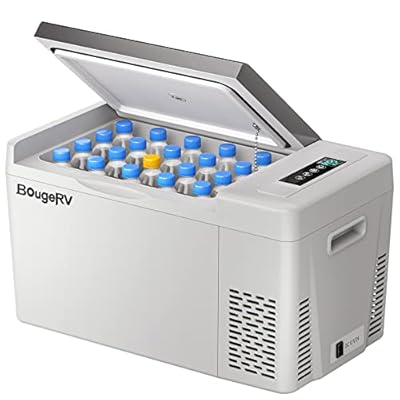
BougeRV CRPRO Portable Refrigerator, 30 Quart
- Best for: Drivers who want fast pull-down cooling after shopping and a gentler overnight draw.
- Capacity from title: 30 quart
- Power from listing: 12/24V DC, with AC adapter included
- Temperature range from listing: -22°C to 10°C
- Cooling type: Compressor
Drivers who want fast pull-down cooling after shopping and a gentler overnight draw.
Confirm what cords and adapters are listed as included before ordering, because home pre-chilling depends on the AC adapter being in the box.
BougeRV pitches the CRPRO at drivers and campers who watch their battery gauge, and the listing highlights its two running modes: a max mode for pulling warm food down quickly after a grocery stop, and an eco mode that sips power through the night. That split suits truck life well, because the cooling problem at a midday loading dock is the opposite of the problem at two in the morning in a rest area. The thirty quart interior matches the other big box here, so the choice between them comes down to controls, layout and the details on each product page.
EUHOMY 12 Volt Refrigerator, 26 Quart
Sitting between the compact Alpicool and the thirty quart pair, this twenty-six quart EUHOMY suits the driver whose route lands in the middle: out for three or four days, eating most meals from the cab, but not batch cooking a full week at once. The listing states compressor cooling with a range that reaches below freezing, vehicle power as the primary supply, and battery protection for parked running. It is a sensible size for a passenger seat footwell or a modest sleeper shelf, holding stacked meal boxes and drinks without swallowing the whole cab floor.
Specs
- Capacity from title: 26 quart
- Power from listing: 12/24V DC, with AC adapter for home use
- Temperature range from listing: -4°F to 50°F
- Cooling type: Compressor
- Battery protection: Low voltage cut-off settings
Best for: Regional drivers running three to four day trips who need real food storage without a full-size chest.
Watch out for: Compare the stated internal capacity with your usual containers, since quart ratings are measured differently across brands and a favourite meal box may stack poorly.
ASIN: B08ZY3X5PD
Which One Fits Your Situation
You run long-haul and shop once a week
Weekly shopping demands the big boxes. Either thirty quart option holds a week of planned meals with room for drinks, and both reach freezing temperatures for the first days of the run. Choose the F40C4TMP if the dual power setup and wide stated range appeal, or the BougeRV if switching between max and eco modes sounds like your driving pattern. Load frozen items first, eat them as they thaw midweek, and let fresh food take over the space they leave behind.
You are home most nights on regional work
A compact box earns its keep here. The Alpicool C15 covers a day of meals and drinks, cools fast between stops, and comes out of the cab in seconds when you park at home. You are not paying in cab space for capacity you never fill, and restocking from the home fridge each morning keeps everything fresh without deep freezing. Drivers who occasionally stretch to a second night can add a frozen bottle as ballast and still travel light.
Your cab is your kitchen for three or four days
The EUHOMY twenty-six quart box matches this rhythm. It swallows several days of meal prep containers, keeps drinks separate enough to find in the dark, and still leaves floor room for boots and a work bag. Its below-freezing range lets you start the trip with one or two frozen dinners as a buffer for the last day, when fresh supplies run thin and the nearest decent food stop is an hour behind you.
You worry about the truck starting in the morning
Battery protection is your headline feature, whichever size you pick. The BougeRV CRPRO makes its eco mode and protection settings central to the listing, which suits a driver who parks for long stretches without idling. Set the protection level conservatively, pre-chill everything before departure, and run max cooling only while the engine turns. A cold breakfast is a small price against a jump start call at dawn in a rest area.
Common Mistakes
- Buying a thermoelectric box for summer truck work and expecting it to behave like a fridge in a hot cab.
- Choosing capacity from a photo instead of measuring the cab space, lid swing and cord route first.
- Leaving the cooler on its highest draw setting overnight without checking the battery protection level.
- Packing warm food straight from a shop shelf and blaming the cooler for a slow pull-down.
- Blocking the cooler vents against a seat or bag, which forces the compressor to work harder all day.
Frequently Asked Questions
Will a 12V cooler drain my truck battery overnight?
It can if you ignore the protection settings. The compressor models in this guide list battery protection or low voltage cut-off features, which stop the cooler before the battery falls to a chosen level. Set that level with starting in mind, pre-chill the load while driving, and use eco mode overnight. A cooler managed that way runs through a normal rest break without leaving you hunting for a jump in the morning.
How cold does a truck cooler need to get for food?
Fresh food should sit at refrigerator temperatures, and frozen meals need a box that reaches below freezing, which is why the stated ranges in these listings matter. Models here list low points around minus four degrees Fahrenheit or minus twenty-two degrees Celsius, so they can hold frozen dinners early in a trip and settle back to fridge duty later. Check the range on the product page rather than trusting the word cooler on the box.
Can I run one of these coolers at home before a trip?
Yes, when the listing includes an AC adapter, and most of the models above do. Plugging the box in at home lets you load food that is already cold, which takes strain off the truck system during the first hours of driving. Confirm the adapter is listed as included on the product page for the exact model you order, because cord and adapter bundles vary between sizes in the same range.
Where is the best place to put a cooler in the cab?
Pick a spot with airflow around the vents, a short and safe cord route, and lid clearance you can actually use at a rest stop. Passenger footwells, a flat sleeper shelf and the floor behind a seat all work when the dimensions fit. Measure first, including the space your hand needs to open the lid fully, and keep the box clear of heater outlets, which fight the compressor through the whole trip.




Write Your Review
No reviews yet. Be the first to share your experience!