
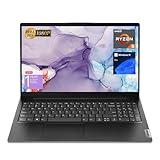
- Top Pick: Lenovo V15 Laptop, 15.6" FHD Display, AMD Ryzen 5 5500U Hexa-core Processor (Beat Intel i7-1065G7), 16GB RAM, 512GB SSD, HDMI, RJ45, Numeric Keypad, Wi-Fi, Windows 11 Pro, Black
- Best Value: HP 15.6" FHD Business Laptop, 2026 Edition, AMD Ryzen 7 7730U (Beats Intel Core i7-1255U), 16GB RAM, 512GB SSD, Wi-Fi 6, HDMI, Numeric Keypad, Windows 11
- Premium Choice: HP 15.6 inch FHD IPS Touch Laptop, AMD Ryzen 7 7730U, 16GB DDR4 RAM, 512GB SSD, Webcam, Windows 11 Home, Copilot AI, Natural Silver, 15-fc0057wm
AMD Ryzen vs Intel Core for Laptops: The 2026 Answer
There is no single winner in the AMD Ryzen vs Intel Core for laptops debate — the right pick depends on what the laptop has to do. If you want the best gaming performance per dollar and long battery life in a thin chassis, AMD’s Ryzen chips (especially the X3D variants with stacked cache) usually win; if you need Thunderbolt, better platform-level AI acceleration, or the absolute fastest single-core for CPU-bound simulation and productivity, Intel’s Core Ultra line usually wins. The short version: match the chip to the chassis and the workload, not to the brand.
- AMD Ryzen vs Intel Core for Laptops: The 2026 Answer
- Quick Comparison: Which Laptop Platform Wins for Which Job
- Gaming Performance: Where the Gap Actually Shows Up
- Battery Life: The Platform Advantage AMD Still Holds
- Integrated Graphics: AMD Is Usually Ahead, Intel Is Catching Up
- Thermals and Power Limits: The Spec Sheet’s Biggest Lie
- AI Features and NPUs: Intel’s Current Edge
- Upgrade Options: Nearly Identical, and Nearly Nonexistent
- Price: Where the Value Sits
- How to Choose: A Decision Path
- Frequently Asked Questions
- Related Guides
Quick Comparison: Which Laptop Platform Wins for Which Job
| Use case | Best pick | Why | Typical laptop price |
|---|---|---|---|
| Gaming on battery (rare, but measurable) | AMD Ryzen | Better performance-per-watt in the 35–65 W band; X3D cache helps 1% lows | $1,000–$2,200 |
| Plugged-in gaming, max FPS | Intel Core Ultra | Higher single-core boost; more Thunderbolt eGPU options | $1,200–$2,500 |
| All-day battery in a thin laptop | AMD Ryzen | Efficient cores and strong idle power management | $600–$1,100 |
| Thunderbolt dock / eGPU workflow | Intel Core Ultra | Native Thunderbolt 4/5 support on most models | $900–$1,800 |
| Integrated graphics for light gaming | AMD Ryzen (Radeon 800M/890M class) | RDNA-based iGPU is typically faster than Intel Arc integrated at the same TDP | $700–$1,300 |
| Local AI / NPU-heavy workloads | Intel Core Ultra | Higher NPU TOPS on the latest generation, broader ISV support | $1,000–$2,000 |
Gaming Performance: Where the Gap Actually Shows Up
In a gaming laptop, the CPU’s job is to keep the GPU fed. At 1080p and 1440p, both platforms are usually GPU-bound, so the CPU brand matters less than the GPU tier. The differences appear in three places:
As an Amazon Associate we earn from qualifying purchases at no extra cost to you.


- 1% low frame times. AMD’s X3D parts (large L3 cache) tend to reduce frame-time spikes in open-world and simulation games. Published reviews typically show 1% lows improving by roughly 5–15% versus a comparable non-X3D chip, though the exact figure varies with the game, resolution, and patch.
- CPU-bound titles. Strategy games, large-scale shooters, and flight sims lean hard on single-thread performance, where Intel Core Ultra often holds a small edge.
- Upscaling and frame generation. With DLSS 4 and FSR 4 both widely supported by 2026, the CPU’s role shrinks further — a mid-range chip plus aggressive upscaling can hit 144 Hz at 1440p more reliably than a top CPU with no upscaling.
Practical takeaway: if your GPU is an RTX 5060-class or higher, spend the extra on the GPU, not the CPU brand. If you’re choosing between two laptops with the same GPU, the CPU difference will be worth roughly 5–10% in most games and more in CPU-heavy ones.
Battery Life: The Platform Advantage AMD Still Holds
Battery life is where the platforms diverge most clearly. AMD’s laptop chips have historically delivered better performance-per-watt in the 15–45 W range, which is exactly the band a thin-and-light runs in. Intel has closed much of the gap with its Core Ultra generation, but independent reviews of thin laptops typically still show AMD models lasting 1–2 hours longer on a light workload (web browsing, video, documents) at the same battery capacity.
Here is the calculation that matters more than the brand:
Runtime (hours) ≈ Battery capacity (Wh) ÷ Average platform power draw (W)
Example: a 70 Wh battery with a 7 W average draw gives 10 hours; the same battery at 10 W gives 6.5 hours. A 3 W difference — easily the gap between a well-tuned AMD and Intel thin laptop — is the difference between “all day” and “pack the charger.”
What actually moves the needle more than the CPU logo:
- Panel type. An OLED panel at 120 Hz can draw 2–4 W more than a 60 Hz IPS panel showing the same content. On a 60 Wh battery, that alone can cost 1.5–2.5 hours.
- Refresh rate. Dropping from 120 Hz to 60 Hz on a variable-refresh display typically saves 10–20% of display power.
- Discrete GPU idle power. A laptop with a dGPU that won’t fully power down can idle at 10 W+ instead of 5 W — halving runtime.
Integrated Graphics: AMD Is Usually Ahead, Intel Is Catching Up
For light gaming without a discrete GPU — esports titles, older games at 1080p, and 30–60 FPS in modern titles at low settings — AMD’s Radeon integrated graphics (the 800M/890M class) generally outperform Intel’s Arc integrated graphics at the same power budget, per published reviews. Intel’s Arc iGPU has improved significantly and is competitive in the latest generation, particularly for video encoding and AI inference.
What the spec sheet won’t tell you: integrated graphics performance is dominated by memory bandwidth, not core count. Both platforms use shared LPDDR5X system memory. A laptop with faster memory (LPDDR5X-8533 vs. LPDDR5-6400) can gain 8–15% in iGPU gaming even with the same chip — and because laptop memory is usually soldered, you cannot fix a slow-memory config after purchase. Check the memory spec before you buy any iGPU-only gaming laptop.
Thermals and Power Limits: The Spec Sheet’s Biggest Lie
Two laptops with the same CPU can perform 30–40% apart because of power limits and cooling. A chip rated for 45 W might run at 28 W in a thin chassis after the thermal budget is exhausted, or at 65 W in a thicker gaming chassis. Vendors rarely advertise the sustained figure.
What to look for instead:
- Published sustained power (PL1/long-term TDP) from a reputable review, not the boost figure in marketing.
- Chassis thickness and fan count — a 20 mm laptop with two fans will almost always beat a 16 mm laptop with one, regardless of CPU brand.
- Thermal throttling behavior. Some laptops sustain higher clocks in “performance” mode at the cost of 45–50 dB fan noise; others stay quiet but lose 15% performance.
Rule of thumb: when comparing two laptops, a 10 W higher sustained power limit is worth more than a one-tier CPU upgrade. If the AMD laptop sustains 45 W and the Intel one sustains 35 W, expect the AMD machine to win multi-threaded tasks and often gaming, even if the Intel chip has the better spec sheet.
AI Features and NPUs: Intel’s Current Edge
By 2026, both platforms ship NPUs, but Intel’s Core Ultra line generally advertises higher TOPS (trillions of operations per second) and has broader software support for local AI features such as background blur, live captioning, and on-device assistants. AMD’s NPUs are capable and improving, and for most users the NPU is not the deciding factor — the discrete GPU handles heavy AI workloads far faster anyway. If a specific application you use names an NPU requirement, check that the laptop meets it; otherwise, ignore the TOPS number.
Upgrade Options: Nearly Identical, and Nearly Nonexistent
Neither platform offers a meaningful CPU upgrade path in laptops — the processor is soldered in essentially every modern thin and gaming laptop. What you can usually upgrade:
- RAM: Some gaming laptops still use SO-DIMM slots (upgradeable); most thin laptops use soldered LPDDR5X (not upgradeable). Buy the RAM you’ll need on day one.
- Storage: M.2 NVMe slots are common on both platforms; many gaming laptops have two.
- Wi-Fi card and battery: Often replaceable, sometimes not.
The practical implication: the AMD vs. Intel choice is locked in at purchase. Compare the exact configurations you can buy, not the theoretical platform potential.
Price: Where the Value Sits
At the same tier, AMD and Intel laptops are usually within $50–$150 of each other. The bigger value swings come from:
- Last-gen chips. A previous-generation Ryzen or Core Ultra laptop often costs 15–25% less than the current one for a 5–10% performance difference.
- GPU tier. Moving from an RTX 5050-class to an RTX 5060-class GPU usually costs $100–$200 and gains far more gaming performance than any CPU upgrade.
- Memory and storage. A 16 GB/512 GB config versus 32 GB/1 TB typically differs by $100–$200; for gaming and AI work, 32 GB is increasingly the safer floor.
How to Choose: A Decision Path
- Set your GPU tier first. Decide the graphics class you need (integrated, RTX 5050-class, RTX 5070-class). This determines 70% of gaming performance.
- Check the sustained power limit. Find a review that lists long-term power draw for the exact model. A higher sustained limit beats a nominally faster chip.
- Match the platform to your workload. Gaming plus battery life → AMD Ryzen. Thunderbolt docks, eGPU, CPU-bound productivity, or NPU-specific apps → Intel Core Ultra.
- Verify memory speed and capacity. For iGPU gaming, LPDDR5X-8533 or faster matters. For everything else, 32 GB is the 2026 sweet spot.
- Check the display. A 144 Hz+ panel with good response time will do more for your gaming experience than either CPU brand.
Frequently Asked Questions
Is AMD Ryzen better than Intel Core for gaming laptops in 2026?
For most gaming laptops, AMD Ryzen offers slightly better performance-per-watt and stronger 1% lows thanks to larger caches, while Intel Core Ultra often has a small single-core edge. In practice, the GPU and the laptop’s sustained power limit matter far more than the CPU brand. Choose based on the specific model’s cooling and GPU tier, not the logo.
Which platform has better battery life in laptops?
AMD Ryzen laptops generally last longer on light workloads at the same battery capacity, often by 1–2 hours per published reviews. However, display type, refresh rate, and whether the discrete GPU powers down fully can easily outweigh the CPU brand difference. Always compare the exact model’s battery capacity in watt-hours alongside its panel specs.
Do I need an NPU for AI features on a laptop?
Most mainstream AI features (background blur, live captions, on-device assistants) run fine on either platform’s NPU. Heavy AI work like local image generation or model fine-tuning relies on the discrete GPU’s VRAM and compute, not the NPU. Only check NPU TOPS if a specific application you use states a requirement.
Can I upgrade the CPU in a laptop later?
No — in virtually all modern laptops, the CPU is soldered to the motherboard on both AMD and Intel platforms. RAM and storage upgrades are sometimes possible, but the processor choice is permanent. This is why comparing exact configurations at purchase matters more than comparing platform roadmaps.
Is AMD or Intel better for integrated graphics gaming?
AMD’s Radeon integrated graphics (800M/890M class) are typically faster than Intel’s Arc integrated graphics at the same power budget, per published reviews. The deciding factor is often memory bandwidth — laptops with faster LPDDR5X memory gain 8–15% in iGPU gaming. Since laptop memory is usually soldered, check the memory speed before buying.
What matters more: the CPU brand or the GPU tier?
The GPU tier matters far more for gaming. Moving up one GPU class typically gains more performance than any CPU upgrade and usually costs $100–$200 more. Once the GPU is set, the CPU brand is worth roughly 5–10% in most games and more only in CPU-bound titles like strategy games and simulations.
Ready to decide? Our #1 pick for 2026 is the Gaming on battery (rare, but measurable).
Live price & availability on Amazon.





Write Your Review
No reviews yet. Be the first to share your experience!