
- Top Pick: NVIDIA RTX PRO 4000 Blackwell Graphics Card – 24GB GDDR7 ECC Memory, PCIe 5.0 x16, 4X DisplayPort 2.1b, Single Slot Full Height AI Workstation GPU, Retail Packaging
- Best Value: PNY VCNRTXPRO2000B-PB NVIDIA RTX PRO 2000 Blackwell 16GB GDDR7 128B Graphics Cards
- Premium Choice: NVIDIA RTX PRO 4000 SFF Blackwell 24GB GDDR7 ECC – PCIe 5.0×8, 4X mDP 2.1b, Low-Profile Dual-Slot AI Workstation GPU Retail


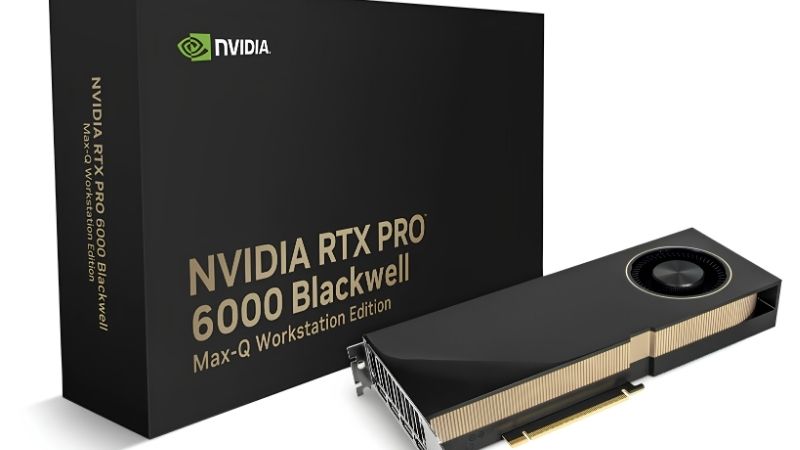
The nvidia rtx pro gpu line is where professional computing meets the latest Blackwell architecture, and its flagship, the RTX PRO 6000 Blackwell, is billed as the most powerful desktop GPU ever made. With up to 96GB of ECC GDDR7 memory, 24,064 CUDA cores, and pro-grade drivers, it targets AI developers, 3D artists, and engineers rather than gamers. But at roughly $8,500 and 600W, it demands serious commitment. This review breaks down what the RTX Pro GPU offers, how it performs, and whether its workstation power justifies the price.
What the NVIDIA RTX Pro GPU Is
The RTX PRO Blackwell series is NVIDIA’s professional workstation GPU family, the successor to the RTX 6000 Ada generation and the Quadro line before it. Built for reliability, huge memory, and certified professional software rather than pure gaming, these cards sit in a different world from consumer GeForce models. The flagship RTX PRO 6000 Blackwell anchors the range as a self-contained AI and rendering powerhouse for the desktop.
As an Amazon Associate we earn from qualifying purchases at no extra cost to you.


The RTX PRO Blackwell Family
The RTX PRO line spans several tiers to match different professional needs and budgets. The range includes the flagship RTX PRO 6000 alongside lower models like the RTX PRO 5000, 4500, and 4000, each scaling cores and memory for its price point.
NVIDIA also splits the flagship into distinct editions for different environments. The Workstation Edition is an actively cooled, dual-slot card for towers and deskside workstations, while the Server Edition uses passive cooling for rack deployments, and a Max-Q variant balances power for dense multi-GPU setups.
This structure means the RTX Pro GPU is not a single product but a family, letting professionals choose the tier and form factor that fits their workflow. The flagship 6000 is the halo model that defines the line’s capabilities. Most buyers gravitate to the flagship for its memory, but the lower tiers matter too, offering professionals a way into the certified-driver ecosystem without the full flagship outlay when their workloads are less memory-hungry.
RTX PRO 6000 Flagship Specs
The headline numbers are staggering for a desktop card. The RTX PRO 6000 Blackwell uses the full GB202 die with 24,064 CUDA cores, 752 fifth-generation Tensor cores, and 188 fourth-generation RT cores, paired with 96GB of GDDR7 ECC memory on a 512-bit bus.
That memory is the real story. The 96GB buffer with 1.79 TB/s of bandwidth is double the previous generation and the largest on any single workstation GPU outside data-center HBM cards, letting it hold enormous models and datasets entirely in local memory.
Connectivity and power match the ambition: PCIe 5.0, four DisplayPort 2.1b outputs for multi-monitor 8K setups, a single 16-pin connector, and a 600W rating cooled by a double-flow-through design. It is engineering built for sustained professional load, not gaming flair. Every design choice, from the ECC memory to the double-flow-through cooler to the DisplayPort-only outputs, signals a card meant to run flat out for hours in a workstation rather than to chase gaming benchmarks.
Professional Features That Set It Apart
Beyond raw specs, the RTX Pro GPU earns its name through pro-grade features. ECC memory ensures data integrity for long, mission-critical workloads, while certified drivers validated for applications from Autodesk, Dassault, and Siemens guarantee stability in professional software.
Multi-Instance GPU support lets a single card be partitioned into isolated instances, so multiple workloads or users can share it securely and efficiently. This is a data-center-class capability brought to the workstation.
The card also includes ninth-generation NVENC encoders with 4:2:2 support for professional video, plus DLSS 4 and neural shaders for visualization. These features target real professional pipelines rather than the gaming feature set of consumer cards. Individually these features may seem incremental, but together they are what separate a professional card from a fast consumer one, and they are precisely why studios and engineering firms pay the premium.
RTX Pro GPU Performance and Value
Specs only matter in how they translate to work, so here is how the RTX Pro GPU performs across AI and creative workloads, what owners report, and how its price has behaved in a turbulent 2026 memory market.
AI and Large Language Model Workloads
The RTX Pro GPU’s defining strength is local AI. Its 96GB of memory lets professionals fine-tune large language models up to around 70 billion parameters at FP8 on a single card, running models that simply will not fit on consumer GPUs.
In benchmark testing it outpaces even the RTX 5090 in sustained AI inference, and the gap widens as model complexity and context length grow, reflecting the consistency of the Blackwell architecture under heavy transformer workloads. Fifth-generation Tensor cores with native FP4 support drive these gains.
The forward-looking appeal is turning a desktop into a self-contained AI lab. For developers prototyping generative AI, agentic systems, or local inference without renting cloud compute, the RTX Pro GPU removes the memory ceiling that limits consumer hardware. For teams that would otherwise split a large model across multiple cards or rent cloud time, keeping everything on one local GPU simplifies the workflow and can pay for itself over months of heavy use.
Rendering, CAD and Simulation
Creative and engineering professionals see equally dramatic gains. One owner reported that upgrading from an RTX A6000 with 48GB cut a DaVinci Resolve render from five and a half hours to just one hour, with a single RTX PRO 6000 outperforming a dual RTX 6000 Ada setup.
The huge memory buffer is what enables this, letting professionals render billion-polygon scenes, work with massive point clouds, and run real-time simulations without hitting the memory walls that stall consumer cards. High-resolution, high-frame-rate immersive media becomes practical on one GPU.
For CAD, VFX, and scientific visualization, the certified drivers and ECC memory add the reliability these fields demand. The result is a card that shortens iteration times and keeps demanding professional workflows entirely on the desktop. The practical payoff is faster iteration: when a render or simulation that once took most of a day finishes in an hour, professionals can try more ideas and hit deadlines that were previously out of reach.
RTX Pro GPU Price Reality in 2026
Price is where enthusiasm meets reality. The RTX PRO 6000 Blackwell launched in March 2025 at roughly $8,565, but its price has since climbed, with retail typically ranging from $8,000 to over $9,200 and some listings pushing far higher.
The 2026 memory market is a major driver. A tight supply has pushed prices across the industry up rather than down, and a card carrying 96GB of premium GDDR7 ECC is especially exposed, which is why its price has risen well above the launch figure rather than settling.
There is cautious good news, but it is weak and in the future. Prices have stopped climbing as steeply as they did in late 2025, and new memory capacity, including two Micron plants in Idaho, is coming but not until 2027-2028. For buyers, this means the RTX Pro GPU’s premium is unlikely to ease soon, so those who need its capability should budget for current pricing rather than wait for relief. For a business, the calculation is usually about productivity rather than sticker price, since even an inflated card that saves hours daily can justify itself, but the timing does mean there is little advantage in delaying a needed purchase.
Is the NVIDIA RTX Pro GPU Worth It? Pros, Cons and Advice
With performance and price on the table, the verdict depends entirely on your work. This section lays out the honest pros and cons, compares the RTX Pro GPU to consumer and data-center alternatives, and gives a final recommendation.
RTX Pro GPU Pros and Cons
The pros are extraordinary: class-leading 96GB of ECC memory, huge CUDA and Tensor core counts, certified pro drivers, MIG partitioning, professional video engines, and performance that shortens real workflows from hours to minutes.
The cons are just as clear: a roughly $8,500 price that has risen further in 2026, a demanding 600W power draw, no NVLink for multi-GPU scaling, and a professional focus that offers no value to gamers. It is a specialized tool, not an all-rounder.
Net assessment: for the professionals it targets, the RTX Pro GPU is transformative and often worth every dollar, while for anyone outside AI, rendering, or engineering it is simply the wrong card. Its value is entirely workload-dependent.
RTX Pro GPU vs Consumer and Data-Center Options
Against consumer cards, the comparison is about memory. The RTX 5090 matches the RTX Pro 6000 on memory bandwidth and FP4 support but caps out at 32GB and lacks ECC, making it the better value only when your models and scenes fit in that smaller buffer.
Against data-center hardware, the trade-off is scaling. The H100 offers HBM memory and NVLink for training the largest models across many GPUs, but costs several times more, so the RTX Pro GPU is the sweet spot for single-GPU professional work below that tier.
For those who need the capability only occasionally, renting an RTX PRO 6000 from a cloud provider is a genuine alternative to the near-$9,000 outlay. Buying makes sense when the card runs constantly rather than in short bursts. That rent-versus-buy line is worth calculating honestly against your actual utilization, because a card sitting idle most of the week is far harder to justify than one running around the clock.
Who Should Buy It and Final Recommendation
The RTX Pro GPU suits AI developers fine-tuning large models locally, 3D and VFX artists rendering massive scenes, and engineers running simulations that exceed consumer memory. For these professionals, the time saved quickly justifies the cost.
Gamers, casual creators, and anyone whose work fits in a consumer card’s memory should look to a GeForce RTX model instead and save thousands. The RTX Pro GPU is overkill and poor value outside its intended fields. Being honest about which category you fall into saves both money and disappointment, since the card’s strengths are invisible to workloads that never touch its memory or certified drivers.
If your professional workload demands its memory and reliability, the RTX Pro GPU is a worthwhile investment despite the price. Use the link to check current RTX PRO 6000 pricing and availability and decide whether buying or renting fits your needs.
See more:
- amd driver auto-detect tool
- nvidia geforce rtx 5080 best buy
- TechPowerUp GPU-Z
- nvidia china
- nvidia etf price
Conclusion
The nvidia rtx pro gpu, led by the RTX PRO 6000 Blackwell, is a specialized powerhouse that brings 96GB of ECC memory, immense compute, and certified professional drivers to the desktop, transforming AI, rendering, and engineering workflows. It is not for gamers, and its roughly $8,500 price has climbed further in a tight 2026 memory market with little relief expected soon. For the professionals who need its capability, though, it delivers genuinely game-changing performance. Use the link above to check current RTX Pro GPU pricing and decide whether to buy or rent for your work.
Frequently Asked Questions
What is the difference between RTX Pro cards and GeForce cards?
RTX Pro cards, formerly branded Quadro then RTX A-series, use the same underlying architecture but add far larger VRAM pools, ECC memory support, certified ISV drivers for CAD and simulation software, longer availability guarantees, and blower or passive cooling designed for multi-GPU workstation and server racks. They cost several times more than a GeForce card of similar raw speed.
How much VRAM does the top RTX Pro Blackwell card have?
The RTX PRO 6000 Blackwell generation carries 96GB of GDDR7 with ECC, roughly triple the 32GB on a GeForce RTX 5090. That capacity is the entire point of the product, since large model inference, huge CAD assemblies, 8K video timelines and complex simulation datasets simply do not fit in consumer memory regardless of how fast the GPU is.
Do I need an RTX Pro card for Blender, Resolve or Premiere?
For most freelancers and small studios, no. A GeForce RTX 5080 or 5090 delivers comparable or better performance per dollar in those applications. RTX Pro makes sense when you need more than 32GB of VRAM, ECC for error-sensitive simulation, certified drivers demanded by an enterprise support contract, or multiple cards in a dense chassis.
What power and cooling does an RTX Pro card need?
The workstation flagship draws up to 600W and there are lower-power Max-Q variants around 300W for dense multi-GPU builds, plus passively cooled server editions that rely on chassis airflow. They use the 12V-2×6 connector and require an ATX 3.1 class supply. Never install a server variant in a desktop case without directed airflow.
Do RTX Pro cards perform better in games?
Generally no, and often slightly worse. Gaming clocks are lower, cooling is optimised for sustained multi-card operation rather than peak boost, and the drivers are tuned for viewport and compute stability rather than game-specific optimisation. Buying an RTX Pro card for gaming is one of the most expensive mistakes a new builder can make.




Write Your Review
No reviews yet. Be the first to share your experience!