
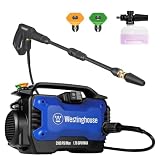
- Top Pick: Westinghouse ePX3100s Electric Pressure Washer, 2100 Max PSI 1.76 Max GPM with Foam Cannon and Turbo Nozzle, for Cars/Fences/Driveways/Home/Patios
- Best Value: Pressure Washer, Power Washer with 4 Quick Connect Nozzles 1 Foam Cannon, High Pressure Cleaning Machine for Cars/Fences/Driveways/Patios/Farms/Home Cleaning(Bright Green)
- Premium Choice: Westinghouse ePX3100 Electric Pressure Washer, 2300 Max PSI 1.76 Max GPM with Anti-Tipping Technology, Onboard Soap Tank, Pro-Style Steel Wand, 5-Nozzle Set, for Cars/Fences/Driveways/Home/Patios
For most people with a patio, a car and a garden fence, a compact corded electric washer in the 1500 to 2000 PSI range is the right pick, and anyone who wants the lightest, simplest option should look at a small cordless or handheld unit instead. Weight is the whole point of this category, so the guide below sorts machines by how they are carried, stored and used rather than by raw power alone.
As an Amazon Associate we earn from qualifying purchases at no extra cost to you.


Quick answer by buyer
| Model family | Best for | Key stated spec area | Main limit |
|---|---|---|---|
| Sun Joe SPX3000 | All-round home cleaning, decks, cars | The maker lists roughly 2000 PSI class output from a corded motor | Corded, so reach depends on extension cable and hose |
| Sun Joe SPX1000 style compact units | Small patios, bikes, garden furniture | Lower PSI class, small body | Slow on stained concrete |
| Greenworks electric washers | Occasional use, easy storage | Entry and mid PSI classes with onboard storage | Plastic fittings on lower trims |
| Ryobi electric and 40V cordless models | Buyers already in the Ryobi battery system | Corded 2000 PSI class and battery versions | Battery runtime is limited on big jobs |
| Karcher K-series (such as the K2 and K3 ranges) | Buyers who want a compact body and good accessories | The maker publishes PSI-equivalent and flow figures per model | Flow rates sit lower than larger home models |
| Worx Hydroshot class handhelds | Cars, bikes, grills, boat decks | Portable battery unit drawing from a bucket or hose | Not for driveways or heavy grime |
Always read the specification label of the exact unit you buy. Makers revise models often and the same name can carry slightly different numbers between regions.
What “lightweight” really means for a pressure washer
Most compact electric washers weigh somewhere between the weight of a small bag of shopping and a medium suitcase. The motor and pump are the heavy parts, so the lightest machines are usually the ones with lower pump output. A body that is easy to lift into a car boot also tends to have a shorter power cord, a thinner hose and a smaller onboard detergent tank. Light weight is helpful, but it is only useful if the machine can still clean what you own.
Look for these carry-related features:
- A fold-down or telescoping handle so the washer rolls rather than needs lifting.
- Onboard storage for the wand, nozzles and cord, which stops loose parts from going missing.
- A hose and cord length listed by the maker, since a short set forces you to drag the unit around.
- Quick-connect fittings on the spray gun, which save time and avoid cross-threading.
Understanding the numbers
PSI and GPM
PSI is the pressure at the nozzle and GPM is the flow rate in gallons per minute. Cleaning power is a combination of both, which is why some makers publish a combined cleaning-units figure. A washer with high PSI but very low flow can feel punchy yet clean slowly across a wide surface. Reviewers who cover the category often point out that a mid-pressure unit with decent flow can beat a higher-PSI unit with weak flow on large flat areas.
Motor type
Induction motors are heavier and quieter and are found on larger machines. Universal motors are lighter and louder, and they dominate the compact class. For a lightweight buyer, a universal motor is a reasonable trade for carrying comfort.
Nozzles and accessories
Most units ship with a set of colour-coded quick-connect nozzles, commonly a narrow zero-degree jet, 15, 25 and 40 degree fans and a soap nozzle. The zero-degree tip can mark wood and strip paint, so keep it for masonry or avoid it altogether. A surface cleaner attachment is optional, and for decks and patios it greatly improves evenness.
Detailed look at each pick
Sun Joe SPX3000: the benchmark compact
The SPX3000 is the model most reviewers use as a reference point for compact corded electric washers. The maker lists a high-pressure motor in the 2000 PSI class, a fold-down handle, onboard storage and a dual detergent tank system. It suits cars, fences, grills and light concrete cleaning. Its limits are those of any corded compact washer: it will not strip years of ground-in oil from a garage floor quickly, and a long extension cord can reduce performance if it is too thin.
Sun Joe compact and entry models
Sun Joe also sells smaller, cheaper units aimed at light chores. They are easy to store and well suited to bicycles, patio furniture and bins. Treat them as seasonal tools rather than workhorses.
Greenworks electric washers
Greenworks offers a range of corded washers and a separate battery line in its 40V and 60V systems. The corded models are compact and tend to include onboard hose reels or nozzle storage on higher trims. If you already own Greenworks batteries, the cordless options are worth a look for jobs that are close to the house.
Ryobi corded and battery washers
Ryobi sells both corded electric washers and battery-powered ones that run on its 40V platform. The appeal is shared batteries with a mower, trimmer or blower. Battery runtime is the obvious limit, so a spare pack is sensible for anything beyond a car and a bin.
Karcher K-series
Karcher is a long-standing washer brand and its K-series compact washers are built for home use. The maker typically publishes a PSI-equivalent figure, flow rate, hose length and weight for each model. Reviewers generally note the good accessory ecosystem, including brushes and surface cleaners. Flow rates on the smallest models are modest, so expect cleaning time to be longer on large areas.
Handheld battery units
Worx Hydroshot and similar handhelds are the lightest option by a wide margin. They can draw from a bucket, a lake or a garden hose and run on a small battery. They are good for car wheels, camping gear and bikes. They are not intended to replace a washer for decks or driveways.
Pick X if …
| If you … | Choose | Why |
|---|---|---|
| Want one machine for car, patio and fence | A 2000 PSI class corded compact such as the SPX3000 | Best balance of power and carry weight |
| Live in a flat with a balcony | A handheld battery unit | Smallest and lightest, runs from a bucket |
| Already own a battery tool system | The matching Ryobi or Greenworks cordless washer | Shared batteries, no cord to trail |
| Want strong accessories and brand support | A Karcher K-series model | Wide range of add-ons and parts |
| Clean only a few times per year | An entry-level corded compact | Lowest cost tier, easy storage |
Budget tiers without prices
- Budget: small corded washers and handheld units. Good for light chores and occasional use. Expect more plastic and shorter hoses.
- Mid-range: 1800 to 2000 PSI class corded compacts with onboard storage and quick-connect nozzles. This is where most buyers should land.
- Premium: higher-flow compact machines, brand-name cordless systems with larger batteries and models with metal pump heads. Worth it if you clean often.
Common mistakes to avoid
- Chasing PSI alone and ignoring flow rate.
- Using the zero-degree nozzle on wood, vehicles or soft siding.
- Running a long, thin extension cord. Use the gauge the maker states and keep connections off wet ground.
- Buying a handheld for a driveway job.
- Skipping the hose and cord length when comparing models.
- Letting the pump run dry or storing it with water inside during freezing weather.
Safety and care
Electricity and water need respect. Use a washer plugged into a properly protected outdoor outlet and follow the manual for the cord and any ground-fault protection the maker specifies. If you are unsure about your outlet, ask a qualified electrician. Keep the spray away from people, pets and windows at close range, wear eye protection and closed shoes, and never point the jet at your own hands or feet. At the end of the season, drain the pump and hoses as the manual describes so that freezing does not crack parts.
Alternatives to consider
- Garden hose nozzle with a turbo head: enough for light dust and pollen on a bike or window frame.
- Surface cleaner attachment: pairs well with any compact washer for large flat areas.
- Rental of a higher-power machine: sensible if you only need to strip a large driveway once.
Frequently Asked Questions
Is 1500 PSI enough for a home?
For cars, bikes, garden furniture and light patio dirt, yes. For old oil stains, moss on paving or paint removal you will want a higher rating and better flow, or you will spend much longer on each area.
Are cordless pressure washers as good as corded ones?
Not on power or runtime. Battery models trade output for convenience, so they suit small jobs near a water source. Corded compacts still lead for decks and fences.
Can I use a lightweight washer on a car?
Generally yes with a wide fan nozzle and a sensible distance. Follow the vehicle and washer manuals, avoid the narrow jet and keep clear of damaged paint, trim and seals.
What extension cord should I use?
Use the cord type and gauge the maker lists in the manual, as thin or long cords can overheat and cut performance. If the manual advises against extension cords, follow that instead.
Do I need detergent?
No, but soap speeds cleaning on greasy or algae-stained surfaces. Use detergent approved by the maker so you do not damage seals in the pump.
How should I store the washer over winter?
Drain water from the pump, hose and wand, then keep the unit somewhere frost-free. Water left inside can freeze and crack the pump, and that is rarely covered as normal wear.





Write Your Review
No reviews yet. Be the first to share your experience!