
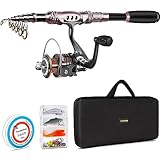
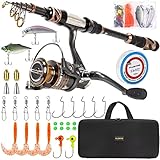
- Top Pick: PLUSINNO Fishing Rod and Reel Combos Carbon Fiber Telescopic Fishing Pole with Reel Combo Sea Saltwater Freshwater Kit Fishing Rod Kit (Gold 5.91FT Ambidextrous)
- Best Value: Ghosthorn Telescopic Fishing Rod and Reel Combo,7PCS Complete Fishing Kit | Graphite Telescopic Fishing Rod,Collapsible Fishing Pole with Spinning Reel,Complete Fishing Gear Kit Freshwater Saltwater
- Premium Choice: PLUSINNO Fishing Rod and Reel Combos -24 Ton Carbon Fiber Telescopic Fishing Pole – Spinning Reel 12 +1 Shielded Bearings Stainless Steel BB-Free Carrier Bag Case, Travel Saltwater Freshwater Fishing
The best compact fishing rod and reel depends on how you travel: a multi-piece travel rod such as the St. Croix Triumph Travel suits anglers who want real casting performance in a carry-on tube, a telescopic combo such as the Ugly Stik or KastKing telescopic setups suits backpackers and casual shore fishing, and a small pre-spooled kit suits kids and emergency kits. Compact gear trades some sensitivity and power for packability, so the trip and the target fish decide the winner.
As an Amazon Associate we earn from qualifying purchases at no extra cost to you.


At a glance
| Type / example | Best for | What makers highlight | Limits |
|---|---|---|---|
| Multi-piece travel rod (for example St. Croix Triumph Travel, Okuma Voyager Travel) | Flights, hiking, serious freshwater and light saltwater | Rods that break into several sections with a tube or case | Ferrule joints can slightly alter feel; mid-range tier |
| Telescopic combo (for example KastKing Blackhawk telescopic) | Backpacking, car glove box, casual anglers | Collapses to short length, reel included | Less sensitivity; guides can bind if sand gets in |
| Ultralight spinning combo (for example Shimano or Daiwa small spinning reels on a short rod) | Trout, panfish, small streams | Light spinning reel matched to a short, light-power rod | Not for heavy fish |
| Pocket or kit rod (survival or kids kits) | Emergency kits, children | Very compact, pre-spooled | Limited durability |
| Penn or Okuma saltwater travel setups | Beach and pier trips | Corrosion-resistant reels, heavier line ratings | Rinse after every salt trip |
How to choose a compact setup
Rod style
Multi-piece rods typically break into three to five sections, which pack into a tube around the length of a long carry-on. They are generally favoured by travelling anglers because their action is closer to a one-piece rod. Telescopic rods collapse into very short lengths and are the easiest to stash, but the sections can bind or slip if cleaned poorly.
Length, power and action
Longer rods cast farther. Shorter rods are easier to manage in tight spaces. Rod power, listed by makers from ultralight to heavy, sets the lure and line weights it handles. Fast action rods bend near the tip and give a quick hook-set. For general freshwater, a medium-light, fast-action spinning rod is a common starting point. For pier and surf fishing, a medium or medium-heavy rod with a corrosion-resistant reel is more appropriate.
Reel size and type
Spinning reels are the easiest for beginners and suit most compact rods. Reels are numbered by size; smaller numbers pair with ultralight setups and larger numbers with heavier fish. Check the maker’s stated line capacity and drag rating. Sealed or corrosion-resistant reels are the better choice for salt.
Line
Many compact combos come pre-spooled, which is helpful for first-time buyers. Monofilament is forgiving, braid is sensitive and strong for its diameter, and fluorocarbon leader is nearly invisible. Match the line weight to the rod’s stated range.
Case or tube
A hard tube protects rod sections during air travel. Soft cases are lighter but offer less impact protection. Check airline rules for sizes before your trip.
Regulations and fishing licences
Whatever you buy, check local licence requirements and species rules before fishing. These vary by place, and fines are real.
Who each setup suits
Flying anglers
A multi-piece rod in a hard tube and a compact spinning reel is the most flexible choice. It gives enough performance for bass, trout and light saltwater without the packing problem of a one-piece rod.
Backpackers and hikers
Telescopic rods and ultralight combos fit in a pack’s side pocket. Weight and length are the main criteria, and anglers usually accept some loss of sensitivity.
Kids and beginners
Pre-spooled kits with a simple spincast reel are easy to operate. Smaller anglers should have a rod length that suits their height. An adult should supervise, particularly around hooks and water.
Gamers on a trip
For gamers who fish on trips as a change of pace, a basic telescopic combo in a duffel is a low-effort option that fits next to a handheld console and charger.
Pick X if … decision table
| Pick this if … | Choice |
|---|---|
| You fly with fishing gear regularly | Multi-piece travel rod with hard tube |
| You want the smallest possible package | Telescopic combo |
| You mostly fish small streams | Short ultralight spinning combo |
| You will fish from a pier or beach | Saltwater-rated reel on a medium-power travel rod |
| You are buying for a child | Pre-spooled kids spincast kit |
| You need an emergency kit | Pocket survival rod kit |
Care and maintenance
- Rinse reels and telescopic sections with fresh water after salt or sandy trips, then dry them completely.
- Wipe ferrules clean, and follow the maker’s guidance on whether to wax them.
- Loosen the drag when storing to avoid compressing drag washers.
- Collapse telescopic sections gently; do not force a stuck section.
- Replace old line each season.
- Store rods in their tube, away from heat and heavy objects.
Alternatives
- Standard two-piece rod offers better performance if you can transport a longer tube by car.
- Tenkara rods are telescopic, reel-free and extremely light for trout streams.
- Baitcasting travel combos suit experienced anglers who want bass techniques in a packable form.
- Rental gear at your destination if you rarely fish.
Common mistakes
- Buying a telescopic rod for heavy fish it was never rated to handle.
- Overloading a light rod with a lure above the maker’s stated weight range.
- Skipping a rinse after salt use, which causes corrosion.
- Forgetting the licence.
- Packing sections loose without a tube.
- Choosing a reel too large for the rod, which makes the setup unbalanced.
Frequently Asked Questions
Are telescopic fishing rods any good?
They are good for convenience and casual fishing. Reviewers generally note that they offer less sensitivity and can have guide alignment issues compared with multi-piece rods. For occasional trips and easy storage, they are a practical option.
What is the best compact rod for flying?
A multi-piece rod in a hard tube is the usual choice, because it keeps better action than telescopic styles and packs to carry-on size. Check the airline’s size and baggage rules, since limits vary. A rod tube packed in checked luggage may be safer if the carrier is strict.
What size reel should I pair with a compact rod?
Use the manufacturer’s stated rod line and lure weight range, then pick a spinning reel in a size that balances. Smaller reels in the 1000 to 2500 range are common for light freshwater, with larger sizes for heavier fish. Check the reel’s listed line capacity and drag rating.
Can I use a compact rod in saltwater?
Yes, if the reel is rated or built for salt and you rinse everything afterwards. Standard freshwater reels corrode faster. Check the rod’s stated power for the fish you want to catch.
Do I need a fishing licence for a trip?
In most places, yes. Rules and exemptions vary by region, species and age, so check local wildlife authority guidance before you go. Penalties can be significant.
How do I keep a telescopic rod from sticking?
Rinse and dry it after each trip, wipe each section clean and avoid forcing it closed when wet or sandy. Store it in a dry place. If a section sticks, stop pulling and consult the maker’s care instructions.





Write Your Review
No reviews yet. Be the first to share your experience!