
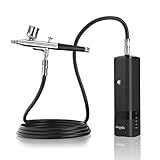
- Top Pick: Airbrush Kit with Compressor Portable Airbrush Kit 48PSI High-Pressure Non-Clogging Air Brush Set Cordless Rechargeable with 0.3mm Nozzle and Cleaning Brush for Painting,Nail Art, Makeup (black)
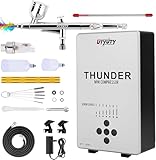
- Best Value: imyyds Airbrush Kit with Compressor, 32 PSI High Pressure Cordless Airbrush Gun, Portable Dual Action Airbrush Compressor Set, Handheld Mini Rechargeable Air Brushes for Painting, Model, Nail, Makeup
- Premium Choice: Airbrush Kit Air Brush Kit With Air Compressor Nail Charms Wireless Air Brush for Barber, Nail Art, Makeup, Model Painting (Black)
A battery-powered mini compressor with a built-in regulator suits miniature painters and PC-case or controller customizers who work away from a wall socket, while a corded studio compressor with an air tank is still the better pick for long sessions and fine, steady detail work. “Cordless” in this category means a compact piston or diaphragm compressor with an internal rechargeable battery or a removable battery pack, not a hose connected to a power tool battery. This guide explains what to look for, how the main types compare, and which kind of buyer each one suits.
As an Amazon Associate we earn from qualifying purchases at no extra cost to you.


Quick answer by buyer
| Buyer | Best type | Why | Main limit |
|---|---|---|---|
| Casual hobbyist painting figures or GPU backplates | Compact rechargeable mini compressor with regulator | Portable, quiet enough for a desk, no extension cords | Short run time on one charge, no tank on most |
| Detail painter who wants smooth fine lines | Rechargeable unit with small air reservoir and gauge | Reservoirs reduce pulsing at the nozzle | Heavier and larger |
| Model builder who paints for hours | Corded compressor with tank and moisture trap | Constant power, consistent flow | Needs an outlet |
| Cosmetic, nail or tattoo-stencil user | Mini rechargeable unit made for that use | Light, low pressure | Weak for thick paints |
| Workshop owner with power-tool batteries | Cordless inflator is not a substitute | Built for tires, not steady low pressure | No fine regulation |
What “cordless” really means for airbrushing
Most portable airbrush compressors that run without a wall socket are small piston units with a lithium-ion battery inside the housing. Makers describe them as portable or rechargeable and usually list a working pressure range in PSI, an air output in liters per minute, and a battery capacity or run time. Treat run-time claims as best-case figures, because actual time falls when you run higher pressure or spray thicker paint.
Power-tool battery inflators from brands such as DeWalt, Milwaukee and Makita are designed to fill tires and balls. They generally lack a fine regulator and a moisture trap, so they are not a sensible stand-in for a real airbrush compressor. If you already own a tool platform, the useful move is to look for whether the maker offers a compressor accessory that clearly lists airbrush use, rather than adapting a tire inflator.
Specs that matter most
Pressure range and regulation
Fine detail work with thin acrylics, inks or lacquers generally uses low pressure, while base coats and thicker primers need more. Look for an adjustable regulator or a dial that the maker describes as variable, with a gauge if possible. A unit with only on and off control forces you to tune pressure by trigger travel alone, which is tiring.
Air output and duty cycle
Small makers list output in liters per minute. A double-action gravity-feed airbrush with a 0.2 to 0.3 mm needle needs modest flow, while a larger 0.5 mm nozzle for primer or large surfaces needs more. Check the duty cycle the maker lists, since piston mini compressors can heat up and many are intended for intermittent use. Auto-stop functions that pause the motor when the trigger is released are a common feature and reduce noise and heat.
Battery
Compare the stated capacity in mAh or watt-hours, the charging method, and whether charging works while spraying. USB-C charging is convenient because it lets you top up from a power bank or laptop brick. A removable pack is useful if you do long sessions, but fewer small compressors offer it.
Air quality
Water vapor and oil mist show up as spatter. Piston compressors that are oil-free avoid oil contamination, and a moisture trap on the hose helps in humid rooms. If a unit does not include one, add an inline trap sold for airbrush hoses.
Noise and vibration
Compact units are louder per unit of air than larger tank compressors. Makers sometimes list decibels; use those figures only to compare units from the same listing format. Placing the compressor on a foam mat or towel reduces desk vibration.
Connections and compatibility
Most airbrushes use a 1/8 inch BSP female thread at the handpiece, and many mini compressors ship with a hose and adapter set. Check that the hose end matches your airbrush brand. Iwata, Badger and Harder and Steenbeck handpieces are often paired with adapters, and quick-disconnect fittings make switching easier. If you use a fine-detail airbrush, a short flexible braided hose reduces drag on the handpiece.
Budget tiers
| Tier | What to expect | Trade-off |
|---|---|---|
| Budget | Small rechargeable compressor, basic pressure dial, bundled hose and sometimes a starter airbrush | Louder, shorter run time, variable build quality |
| Mid-range | Better regulation, gauge, auto-stop, USB-C charging, a decent moisture trap | Still limited on thick paints |
| Premium | Established airbrush maker, quieter piston, reservoir, stronger warranty | Often corded; truly cordless premium choices are limited |
Reputable airbrush makers such as Iwata, Badger, Sparmax and Harder and Steenbeck are best known for corded studio compressors with tanks. Their battery-capable choices, where offered, tend to be compact. Read the maker page for the exact model, because naming and availability change between regions.
Who should pick what
| Pick this if you… | Choose |
|---|---|
| Paint small models at a desk and want portability | Compact rechargeable mini compressor with auto-stop |
| Want smoother fine lines for custom case art | Unit with a small tank or accumulator and a gauge |
| Paint for several hours at a time | Corded tank compressor and keep a mini unit as a backup |
| Travel to events or classes | Lightweight rechargeable unit with USB-C charging |
| Spray primer or large panels | Higher output tank unit, not a mini battery compressor |
Common mistakes
- Buying on maximum pressure alone. Fine work rewards steady low-pressure control more than a high peak figure.
- Ignoring the moisture trap. Humid rooms cause spitting and ruined finishes.
- Assuming a tire inflator will work. It lacks regulation and clean-air features.
- Skipping the fitting check. A mismatched thread stops you from spraying on day one.
- Trusting run-time claims blindly. Higher pressure and thicker paint drain the pack faster.
Care and safety
Use a ventilated space and a respirator rated for the paint you spray, because aerosolized paint particles and solvent vapor are a health concern. Follow the paint maker’s safety data sheet. Do not leave a charging lithium battery unattended, and use the cable and charger the maker supplies. Stop use if the housing swells, smells hot or the cell is damaged, and contact the maker. Clean the airbrush after each session so debris does not raise back-pressure on the compressor.
Alternatives to a cordless compressor
- Corded mini compressor with tank: steady output and quieter operation for a fixed bench.
- Canned propellant: low upfront cost for occasional use, but pressure falls as the can empties and it is poor value for regular painting.
- Battery power bank with a USB-powered compressor: a few compact units accept USB power input; read the maker’s input rating before relying on a bank.
Frequently Asked Questions
Can a power-tool battery run an airbrush?
Not in a way that makers generally support. Tool battery inflators are built for tires and lack fine regulation and moisture control. A compressor made for airbrushing is the safer option for paint quality.
How long does a cordless airbrush compressor run on one charge?
It depends on battery capacity, pressure and how often the motor cycles. Makers list best-case figures, and real sessions are usually shorter at higher pressure. If you paint for long periods, plan to charge between sessions or use a unit that charges while in use.
Do I need a tank?
A tank smooths pulsing and gives steadier fine lines, which helps with thin paints and detail. Many small battery units skip it to stay light. If your results show a pulse in the spray, a unit with a reservoir is worth considering.
What pressure should I use?
It depends on the paint and the nozzle size, and airbrush and paint makers publish guidance for their products. Thin paints generally run at lower settings than thicker coatings. Start low, test on scrap, and raise pressure gradually.
Is a cordless compressor loud?
Small piston units are noticeable, especially at higher pressure. Auto-stop and a padded surface help. If noise matters for shared rooms, check whether the maker lists a decibel figure.
Can I use it for non-paint jobs?
Some people use mini compressors for dusting or small inflation, but follow the maker’s manual. Heavy use outside the intended duty cycle can shorten the motor’s life.







Write Your Review
No reviews yet. Be the first to share your experience!