
- Top Pick: 2 Pack Dog Whistle – Dog Whistle to Stop Barking Neighbor's Dog & Long Range Recall, Adjustable Ultrasonic Silent Dog Whistle with Lanyard for Training Recall, Professional Obedience (Black & White)
- Best Value: KIVORA 4 Pack Dog Whistle to Stop Barking Neighbors Dog,304 Stainless Steel Adjustable Ultrasonic Silent Dog Training Whistle for Recall & Bark Control,Professional Whistle Suitable for All Dogs
- Premium Choice: KIVORA 4 Pack Dog Whistle to Stop Barking Neighbors Dog,304 Stainless Steel Adjustable Ultrasonic Silent Dog Training Whistle for Recall & Bark Control,Professional Whistle Suitable for All Dogs
An adjustable silent whistle such as the forePets WistCall or the Acme 535 is the better fit for a barking problem, while the fixed-pitch Acme 210.5 is a recall and close-range training whistle that works best with a dog already trained to it. No whistle reliably stops barking on its own, so treat any of them as a training cue, not a cure.
As an Amazon Associate we earn from qualifying purchases at no extra cost to you.
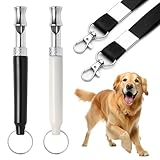


What a “silent” dog whistle is
A so-called silent whistle produces a high pitch that people hear only faintly or not at all, while dogs can hear it. Adjustable models let you slide or twist the barrel to change the pitch. Fixed models have one tone. Reviewers note an important caveat: the popular Acme 210.5 is a fixed-frequency whistle that people can hear, listed by Thepetbench at 5,900 Hz, so it is not truly ultrasonic.
The independent sources reviewed here are mostly pet-site roundups, and none supply hard evidence that whistles stop barking. What the whistle can do is interrupt a dog and give you a consistent, distance-friendly cue you then reward. Used that way, it supports training. Used by itself, it often does nothing.
At a glance
| Whistle | Type | Best for | Limits |
|---|---|---|---|
| Acme 210.5 | Fixed pitch, audible to people; around 5,900 Hz per Thepetbench | Recall and close-range commands, spaniel-style work | Not dedicated bark control; mixed buyer feedback |
| Acme 535 | Silent, adjustable | Owners who want to find and lock a pitch their dog responds to | Takes patience to set up |
| forePets WistCall | Silent, adjustable, with locking nut and anti-loss features per reviewers | Budget tier experimenting with pitch | Needs adjusting to find a pitch that works |
| Generic adjustable ultrasonic whistles | Adjustable, varied build | Low-cost trial | Quality and stated frequency range vary |
How to choose
Adjustable or fixed
PetsOnlyPets says a fixed Acme suits owners who know which frequency their dog responds to and want simplicity, whereas most people experimenting will do better with an adjustable whistle. Adjustable models let you try several pitches, then lock the one that gets a reaction, using a locking nut on models that have one.
Material and durability
Plastic and metal barrels both exist. Metal models tend to hold the set pitch better, but a loose barrel on any model can drift. Lanyards or key rings reduce loss.
Range
Whistles are cheap and light, which is their appeal for yard use. Wind, neighbouring noise and the dog’s age all change how far the sound carries or how well the dog hears it. Older dogs can have reduced high-frequency hearing.
Safety
Never blow at full strength close to a dog’s ears. Use short bursts. If barking is sudden, constant or tied to anxiety, pain or separation distress, speak to a vet or a qualified trainer rather than relying on a gadget.
How to use a whistle for barking
- Pick a quiet moment and find the pitch that gets a head turn or pause.
- Pair the sound with a treat several times without any barking present, so the dog links it with something good.
- When barking starts, blow once briefly. Reward the moment the dog stops and looks at you.
- Build duration gradually, then give a calm cue such as “quiet” before the whistle.
- If barking continues, stop. Repeated blasts can stress the dog and teach it to ignore the sound.
Pick this if you
| Situation | Pick |
|---|---|
| Want to experiment cheaply with pitch | forePets WistCall or a similar adjustable model |
| Want a more established adjustable whistle | Acme 535 |
| Mainly need recall or hand-signal training outdoors | Acme 210.5 |
| Have an elderly or hard-of-hearing dog | Skip whistles; use visual cues and ask a vet |
| Have a dog barking from anxiety | Contact a vet or behaviourist first |
Alternatives
- Clicker or marker word. A clicker marks quiet behaviour precisely and costs little.
- Enrichment. Puzzle feeders and longer walks address boredom, a common cause of barking.
- Desensitisation. If a trigger such as the doorbell causes barking, gradual exposure with rewards works better than interruption.
- Professional help. A trainer can identify the cause and set a plan.
Common mistakes
- Expecting a whistle to work with no training.
- Blowing repeatedly until the dog ignores it.
- Assuming “silent” means silent for neighbours’ dogs; other dogs may react too.
- Changing the pitch constantly so the dog never learns one signal.
- Ignoring the reason for the barking.
Reading the claims critically
Barking has many causes: boredom, territorial alerting, fear, attention seeking, separation distress and medical issues. A whistle addresses none of these by itself. It only creates a moment of interruption, and what happens next decides whether anything changes. If the dog barks at passers-by through a window, restricting the view or moving the dog’s resting spot often helps more than any sound. If barking is driven by loneliness, exercise, company and enrichment come first.
Frequency claims on packaging deserve caution too. Dogs hear well into the ultrasonic range, but individual hearing varies with breed, age and health, and cheap whistles do not always produce the pitch printed on the label. That is a reason to prefer adjustable models and watch the dog’s reaction rather than trusting a number.
Building a simple routine
- Week one: only conditioning. Whistle, then treat, with no barking involved.
- Week two: add mild triggers at a distance, such as a recorded doorbell at low volume, and whistle the moment the dog notices but before barking starts.
- Week three: raise the trigger intensity slowly and reward quiet. If barking restarts, step back to an easier level.
- Ongoing: keep a few treats handy and fade them gradually, keeping praise.
Short, consistent sessions of a few minutes work better than long ones. Everyone in the household should use the same cue so the dog is not confused.
When a whistle is the wrong tool
Skip it for noise phobias such as fireworks or storms, where an unexpected sound can add to the fear. Skip it for puppies still learning basics, for dogs showing aggression, and for anything resembling pain-related barking. In these cases a vet or certified behaviourist is the right first call. Avoid products that deliver punishment, since reputable training organisations advise against them.
Frequently Asked Questions
Do silent dog whistles stop barking?
Not by themselves. The sources reviewed describe whistles as a training tool, and none provide solid evidence of reliable results. Success usually comes from pairing the sound with rewards and addressing the cause of barking.
Is the Acme 210.5 really silent?
No. Reviewers say it is a fixed-pitch whistle that people can hear. It is popular for recall and close-range work rather than silent bark control.
Can a whistle hurt my dog’s ears?
Loud blasts close to the head can be uncomfortable. Use short, gentle bursts from a sensible distance, and stop if the dog flinches or avoids you.
Will my neighbour’s dog react?
It might. Any pitch a dog can hear can affect other dogs nearby, so use it mindfully in shared spaces.
How do I find the right pitch?
With an adjustable model, change the setting in small steps and watch for an ear flick or head turn. Lock it once you find a reaction, then keep it consistent.
When should I see a vet?
If barking starts suddenly, is constant, or comes with signs of distress, pain or confusion in an older dog, talk to a vet before training.





Write Your Review
No reviews yet. Be the first to share your experience!