
- Top Pick: GIGABYTE GeForce RTX 5070 Ti Gaming OC 16G Graphics Card, 16GB 256-bit GDDR7, PCIe 5.0, WINDFORCE Cooling System, GV-N507TGAMING OC-16GD Video Card
- Best Value: ZOTAC Gaming GeForce RTX 4070 Ti Super Solid OC DLSS 3 16GB GDDR6X 256-bit 21 Gbps PCIE 4.0 Gaming Graphics Card, IceStorm 2.0 Advanced Cooling, ZT-D40730RC-10P
- Premium Choice: ASUS TUF Gaming NVIDIA GeForce RTX 4070 Ti OC Edition Gaming Graphics Card (PCIe 4.0, 12GB GDDR6X, HDMI 2.1a, DisplayPort 1.4a), 3 Year Warranty
Top Rtx 4070 5080 Which Gpu Picks for 2026
Here are our current top rtx 4070 5080 which gpu picks, compared on real Amazon owner reviews, price, and features. Live prices update below.


Prime
Editor's Pick
ZOTAC Gaming GeForce RTX 5080 Solid CORE OC DLSS 4 16GB GDDR7 256-bit 30 Gbps PCIE 5.0 Gaming Graphics Card, IceStorm 3.0 Advanced Cooling, Spectra RGB Lighting, ZT-B50800J2-10A


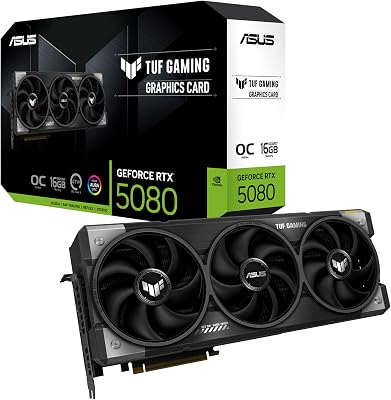
RTX 4070 Ti vs 5080 is the matchup that defines the gap between Nvidia’s last Ada generation and its current Blackwell flagship-tier card. One is a proven 1440p workhorse with 12 GB of GDDR6X; the other is a 16 GB GDDR7 monster built for 4K and the DLSS 4 era. This 2026 comparison breaks down the specs, the real frame rates, the power and pricing trade-offs, and exactly which buyer each card is built for, so you can decide before the next round of price hikes lands.
As an Amazon Associate we earn from qualifying purchases at no extra cost to you. Product prices and availability are accurate as of the date shown and are subject to change.




Quick Verdict: RTX 4070 Ti vs 5080 at a Glance
If you only read one section, read this one. The two cards are not in the same performance class, and the decision usually comes down to resolution, budget, and how long you plan to keep the card. Below is the fast answer, the full spec sheet, and the honest pros and cons of each.
The Fast Answer
The RTX 5080 wins decisively on raw performance, memory, and features. It is roughly 40 to 50 percent faster than the 4070 Ti at 4K, carries 16 GB of next-generation GDDR7, and unlocks DLSS 4 Multi Frame Generation, which the older card cannot run. For native 4K gaming and future-proofing, it is the clear pick.
The RTX 4070 Ti only makes sense if you find one well below its original price and you game primarily at 1440p. It remains a fast, efficient card, but its 12 GB buffer and 192-bit bus are increasingly the limiting factor in newer titles.
For most buyers in 2026, the 5080 at or near its $999 MSRP is the better long-term investment. If you want to lock in the stronger card, it is worth checking current availability and pricing below before stock tightens.
RTX 4070 Ti vs 5080 Specs Comparison
The spec sheet makes the generational leap obvious, especially in memory bandwidth and the move from GDDR6X to GDDR7.
| Specification | RTX 4070 Ti | RTX 5080 |
|---|---|---|
| Architecture | Ada Lovelace (AD104) | Blackwell (GB203) |
| CUDA Cores | 7,680 | 10,752 |
| Memory | 12 GB GDDR6X | 16 GB GDDR7 |
| Memory Bus | 192-bit | 256-bit |
| Bandwidth | ~504 GB/s | ~960 GB/s |
| Board Power (TGP) | 285 W | 360 W |
| DLSS Support | DLSS 3 (Frame Gen) | DLSS 4 (Multi Frame Gen) |
| Launch MSRP | $799 | $999 |
Pros and Cons of Each Card
Looking at the 4070 Ti vs 5080 trade-offs side by side clarifies who each card is for. The 4070 Ti’s strengths are efficiency and a lower entry cost; its weaknesses are memory capacity and bandwidth.
RTX 4070 Ti — Pros: lower 285 W power draw, excellent 1440p performance, smaller and easier to cool, strong DLSS 3 gains. Cons: only 12 GB VRAM, narrow 192-bit bus, no DLSS 4 Multi Frame Generation, falls behind at 4K.
RTX 5080 — Pros: 16 GB GDDR7, far higher bandwidth, DLSS 4 support, confident 4K performance, PCIe 5.0. Cons: 360 W power appetite, higher price, and like all Blackwell cards it is exposed to the steeper 2026 price increases.
One practical nuance separates the two on value. The 4070 Ti’s used and resale pricing has stayed high precisely because nothing cheaper offers a clean upgrade, so the “budget” card is not always as cheap as buyers expect. The 5080, by contrast, is a current-generation card whose price you can verify against a published MSRP. When you weigh real street prices rather than launch figures, the cost gap is often narrower than it first looks, which quietly strengthens the case for the faster card.
Deep Dive Face-Off: RTX 4070 Ti vs 5080
Headline specs only tell part of the story. The face-off below compares the two cards by the criteria that actually shape your daily experience: gaming performance, power and setup, and the feature stack that determines how long the card stays relevant.
Gaming Performance and Benchmarks
At 1440p, the gap is real but not always game-changing. The 4070 Ti still clears 100 FPS in most modern titles, while the 5080 pushes well beyond what a typical 1440p monitor can display. At this resolution, a CPU bottleneck can narrow the difference in some games.
At 4K, the picture changes completely. The 5080’s extra bandwidth and 16 GB buffer let it hold smooth frame rates where the 4070 Ti starts to stutter, particularly in texture-heavy games that push past 12 GB of VRAM. In ray-traced workloads the margin widens further, with the Blackwell card pulling 50 percent or more ahead.
The analytical takeaway is that the 4070 Ti is a 1440p card being asked to do 4K, while the 5080 is a native 4K card. If your monitor is 1440p, the 4070 Ti remains viable; if it is 4K or high-refresh, the 5080 is in a different league.
Putting real numbers to it helps. In a graphically heavy single-player title at 4K, the 4070 Ti usually lands in the 50 to 70 FPS range and can dip under 60 once ray tracing is enabled, while the 5080 holds an 85 to 115 FPS band and stays comfortably above 60 with ray tracing active. With DLSS 4 Multi Frame Generation switched on, the 5080 can push deep into triple digits in supported games, a result the 4070 Ti structurally cannot reproduce. In esports titles both cards exceed any practical refresh rate, so the gap never appears there, which is exactly why this matchup only matters for demanding AAA games and high-resolution displays.
Power, Efficiency, and Real-World Setup
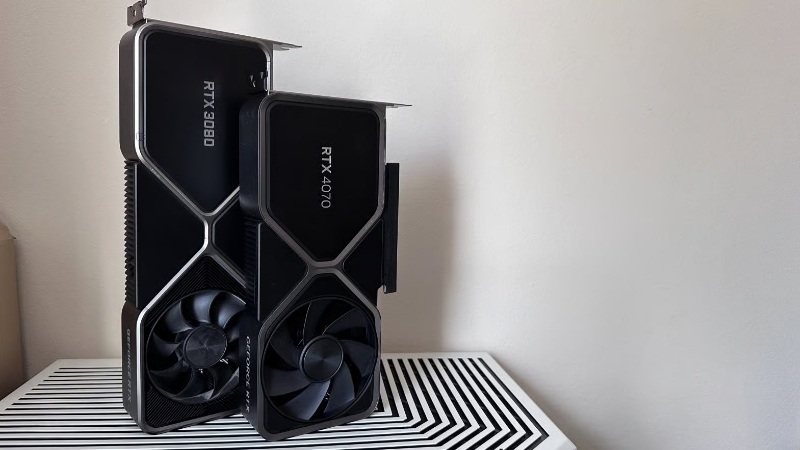
Power and physical fit are where the practical side of this comparison matters. The 4070 Ti’s 285 W rating means many builds run comfortably on a quality 700 W to 750 W power supply, and the cards tend to be more compact.
The 5080 raises that to 360 W, with Nvidia recommending an 850 W unit and the 16-pin 12V-2×6 connector. It is not extreme for its performance class, but it does mean checking your PSU headroom and case clearance before buying, especially if you are upgrading an older system.
For everyday use, both cards run quiet on modern triple-fan coolers. The difference is heat output: the 5080 simply dumps more watts into your case, so airflow planning pays off if you want to keep noise and temperatures low.
Features, DLSS, and Future-Proofing
This is where Blackwell’s advantage compounds over time. The 5080 supports DLSS 4 with Multi Frame Generation, which can insert multiple AI-generated frames between rendered ones, dramatically lifting frame rates in supported titles. The 4070 Ti is capped at DLSS 3 single Frame Generation.
The experimental angle worth testing is how much that feature gap matters as more games adopt DLSS 4. In titles that support it, a 5080 can post frame counts the 4070 Ti structurally cannot reach, regardless of raw shader power. The larger 16 GB buffer also leaves more headroom for high-resolution textures and local AI workloads.
For a buyer thinking three or four years ahead, the feature and memory gap is arguably more important than the raw benchmark gap today.
The creator side widens the gap further. The 5080’s 16 GB buffer and higher GDDR7 bandwidth shorten render and export times in Blender and DaVinci Resolve, and the larger memory pool sidesteps the out-of-memory stalls a 12 GB card can hit in 4K editing timelines or dense 3D scenes. The newer card also benefits from Blackwell’s updated media engine, which matters for streamers and video creators encoding high-bitrate footage. If your machine doubles as a workstation, these are repeatable daily advantages rather than benchmark trivia, and they extend the practical lifespan of the card well beyond gaming alone.
Pricing, Alternatives, and Final Recommendation
The final decision in 2026 cannot ignore the market itself, which is moving against patient buyers. Component costs, supply allocation, and feature longevity all feed into whether you should buy now and which card to choose.
How the 2026 Price Surge and H200 News Change the Math
GPU prices are rising across the board in 2026, driven by a memory shortage in which GDDR and DRAM now account for a large share of a card’s bill of materials. Reports point to AMD raising prices from January and Nvidia following in February, with the newer Blackwell line seeing steeper increases of roughly 15 to 23 percent versus around 5 to 10 percent for older Ada cards.
The H200 export story adds indirect pressure. In January 2026 the U.S. approved Nvidia’s H200 AI accelerator for sale to approved Chinese buyers on a capped, case-by-case basis. Each of those accelerators consumes multiple stacks of advanced HBM3E memory, competing for the same constrained supply chain that feeds consumer GDDR7, which keeps cards like the 5080 tight on availability.
The practical conclusion for the 4070 Ti vs 5080 question is that neither card is likely to get cheaper soon. A used 4070 Ti may stay artificially expensive because nothing below it offers a clean upgrade, while the 5080 faces upward pressure as a current-gen card. If a 5080 is in stock near MSRP, that is the window to act.
Anchoring the discussion in real figures sharpens the point. The 5080 launched at $999 and the 4070 Ti at $799, and in a normal cycle the older card would have fallen well below that by now. Instead both are holding firm or rising, premium 5080 editions already carry markups, and the flagship 5090 is rumored to approach $5,000 in some editions. With the whole stack trending upward, any near-MSRP 5080 listing is better treated as a floor than a starting point. Confirm the exact partner model and warranty, and steer clear of inflated third-party resellers, because genuine discounts on these cards are rare in the current market.
The Alternative if Both Are Too Expensive
If the 5080 stretches your budget and the 4070 Ti’s 12 GB feels too limited, the RTX 5070 Ti is the natural middle ground. It carries 16 GB of GDDR7 and DLSS 4 support at a lower price point than the 5080, giving you most of the future-proofing without the flagship-tier cost.
Another option is the RTX 4070 Ti Super, which keeps Ada efficiency but upgrades to a 16 GB buffer and 256-bit bus, solving the 4070 Ti’s biggest weakness. It is a sensible pick if you find one at a fair price and game at 1440p.
Final Verdict: Who Should Buy Which
Buy the RTX 4070 Ti if you game at 1440p, value efficiency, and can find one at a genuine discount. It is still a capable card, just no longer a 4K solution.
Buy the RTX 5080 if you game at 4K or high-refresh 1440p, want DLSS 4, and intend to keep the card for several years. The extra cost buys meaningfully more performance, more memory, and a longer relevant lifespan.
When you have decided which side of the RTX 4070 Ti vs 5080 split fits your build, check the latest price and availability below before the next price adjustment.
See More:
Conclusion
The RTX 4070 Ti vs 5080 comparison comes down to a simple split: the 4070 Ti is a strong 1440p value if bought cheap, while the 5080 is the faster, better-equipped 4K card that will stay relevant longer. With memory shortages and the H200 export shift keeping GPU prices elevated through 2026, the smart move is to pick the card that matches your resolution and secure it at today’s price rather than waiting for a discount the market is unlikely to deliver.
Frequently Asked Questions
What is the best rtx 4070 ti 5080 in 2026?
The best rtx 4070 ti 5080 depends on your budget and how you plan to use it. The options compared above are our top-rated picks based on real customer ratings, build quality, and overall value — start with the highest-rated model that fits your budget.
How much should I expect to spend on a rtx 4070 ti 5080?
Prices vary by brand and features. Budget options cover the essentials, while mid-range and premium models add durability, performance, and extra features. Compare the prices in the list above to find the best value for your needs.
What should I look for when buying a rtx 4070 ti 5080?
Focus on what matters most for your use case — build quality, compatibility, performance, warranty, and verified customer reviews. Every pick above is selected to balance these factors.
Are budget rtx 4070 ti 5080 options worth it?
Yes. For most people a well-reviewed budget or mid-range rtx 4070 ti 5080 delivers excellent value. You only need to spend more if you specifically require premium materials or top-tier performance.
How did we choose these rtx 4070 ti 5080 picks?
We compare current Amazon ratings, review counts, key features, and price to surface the options with the best real-world value. The list is refreshed as ratings and availability change.






Write Your Review
No reviews yet. Be the first to share your experience!