
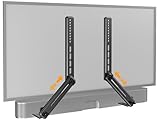
- Top Pick: ELETIUO Soundbar Wall Mount Bracket for Samsung, LG, Sony, JBL, Vizio, Sonos and More, Depth Adjustable 3.5”-6.1”, Soundbar Shelf Under TV, Black
- Best Value: Perlegear Soundbar Mount with Adjustable Height, Sound bar Mount up to 15 lbs, Soundbar Mount Under or Above TV, Soundbar tv Mount Bracket with Detachable Long Extension Plates PGSM04B
- Premium Choice: LENRUE Computer Speakers for PC and Laptop, Under Monitor Sound Bar, Black
There is no single best soundbar “under” a price, because “under” has no number attached — and the honest answer is that the ceiling you pick decides which features you can buy. The three breakpoints that actually change what you get are roughly $250 (a bar that clearly beats built-in TV speakers), $500 (a dedicated center channel, a real wireless subwoofer, and HDMI eARC), and $900–$1,200 (up-firing height drivers, wireless rear surrounds, and automatic room correction). Pick the ceiling first, then spend it on channels and connectivity rather than on advertised wattage.
- Find your ceiling before you compare anything
- Quick comparison: what each budget tier actually buys
- Best budget: under $250
- Best value: $300–$500
- Best for movies: $650–$1,100
- Best for large rooms: $1,200+
- The number that matters more than wattage: required level at your seat
- ARC vs eARC: what your TV can pass through
- Matching a bar to your room in five minutes
- Frequently Asked Questions
As an Amazon Associate we earn from qualifying purchases at no extra cost to you.



Find your ceiling before you compare anything
A search that ends in “under” is really a question about the top of your budget, not the bottom. Two shoppers typing the same phrase can end up with completely different products: at $200 the sensible buy is a compact 2.0 or 2.1 bar for a bedroom or a small apartment; at $2,000 the sensible buy is a 7.1.4 system with a subwoofer the size of a small suitcase. Comparing those two against each other is a waste of time.
So set the number using these questions, in this order:
- Room and seating distance. Under about 2.5 m from the bar, a compact bar with small drivers is fine. Past 3.5 m in an open-plan room, small drivers run out of excursion long before the amplifier runs out of watts.
- Do you want bass you can feel? If yes, budget for a separate subwoofer. A passive radiator in a slim bar cannot move the air a 8–10 inch sub driver moves.
- What plays your content? A streaming app, a game console, or a Blu-ray player. This determines whether you need eARC or whether ARC will do (see the table below).
- Is the TV the weak link? Many mid-range TVs pass Dolby Atmos through eARC but strip it back to stereo over optical. If your TV lacks eARC, spend the money on driver quality rather than on height channels you can’t feed.
Quick comparison: what each budget tier actually buys
| Pick | Best for | Key specs to expect | Typical price |
|---|---|---|---|
| Compact 2.0 / 2.1 bar | Bedrooms, small TVs, clear dialogue | 4–6 small drivers, HDMI ARC + optical, Bluetooth, no up-firing drivers | usually $130–$250 |
| 3.1 bar with wireless sub | Living rooms under ~3 m, mixed TV and music | Dedicated center channel, 6.5–8″ wireless sub, HDMI eARC, Dolby Atmos over DD+ | usually $300–$500 |
| 5.1.2 / 7.1.4 with surrounds | Movies, Atmos and DTS:X discs and streaming | Up-firing height drivers, wireless rear speakers, 8–10″ sub, auto room calibration | usually $650–$1,100 |
| Flagship 7.1.4+ bar | Large rooms, near-reference listening levels | 11+ drivers, 300 W+ total, HDMI 2.1 passthrough, multi-point room EQ | usually $1,200–$2,000 |
Note that these are spec classes rather than fixed model numbers, because soundbar lines are refreshed roughly every 12 months — the model family that sits at $450 this year may sit at $380 next year as it ages out. The feature list in each row is the stable part.
Best budget: under $250
At this ceiling you are buying clarity, not immersion. The goal is a bar with a proper center channel or at least a well-tuned 2.0 array, HDMI ARC, and a dialogue-enhancement mode that actually works. Model families such as the Roku Streambar line, Vizio’s entry V- and M-series, and TCL’s Alto series have occupied this tier for years.
Who it suits: a bedroom, a secondary TV, or anyone whose main complaint is that voices disappear under the soundtrack. Main trade-off: no meaningful sub-bass and no height channels. A 2.1 bar in this range adds a small subwoofer, but expect output that fills a small room only — per manufacturer spec sheets, these subs typically use a 5–6.5 inch driver in a ported box, which rolls off steeply below roughly 45–50 Hz.
Best value: $300–$500
This is where the money starts doing real work. You get a discrete center channel (the single biggest upgrade for dialogue), a wireless subwoofer with an 8-inch driver, HDMI eARC, and decoding for Dolby Atmos delivered over Dolby Digital Plus — which is what every major streaming service uses. The Sonos Beam (Gen 2) defined this class, and Bose’s Smart Soundbar 600 and Samsung’s HW-Q-series mid-tier bars sit alongside it.
Who it suits: the majority of living rooms where the TV is 2–3.5 m from the sofa. Main trade-off: Atmos is “virtual” or height-limited — a 3.1.2 bar with small up-firing drivers creates a sense of height but not the discrete overhead objects a 4-speaker height array produces. If you can stretch to the next tier, that’s the upgrade that matters most for movies.
Best for movies: $650–$1,100
Here you get a genuine 5.1.2 or 7.1.4 configuration: up-firing drivers in the bar, a pair of wireless rear speakers, and a 10-inch subwoofer. Flagship-adjacent families such as Samsung’s HW-Q9-series, LG’s S-series, JBL’s Bar series, and Sony’s Bravia Theatre Bar models have held this band. Automatic room calibration — a microphone sweep that sets distance, level, and EQ per speaker — is the feature to insist on, because it compensates for the fact that your left rear speaker is almost never the same distance from your head as the right one.
Who it suits: anyone who watches films with real dynamic range and wants the height and rear channels that Atmos mixes actually contain. Main trade-off: clutter and setup. Rear speakers need power outlets, and the subwoofer needs a corner or wall nearby to work with.
Best for large rooms: $1,200+
Flagship bars — Sonos’s Arc line, Sennheiser’s Ambeo Soundbar Plus, and the top Samsung and LG models — bring 11 or more drivers, 300 W or more of total rated amplification, and multi-point room correction. At this price you are paying for output capability and headroom, not for extra channels.
Who it suits: rooms over roughly 4 m deep, or anyone who listens at high levels and wants the bar to stay clean during peaks. Main trade-off: diminishing returns. A $700 5.1.2 system and a $1,500 flagship will sound far more similar than their price tags suggest in a small room.
The number that matters more than wattage: required level at your seat
Movie mixes are mastered to a reference level of about 85 dB SPL average at the listening position, with peaks around 105 dB per channel and up to 115 dB for the LFE channel. Sound level falls with the square of distance — roughly 6 dB per doubling — so the bar has to produce far more than 105 dB at one meter to hit 105 dB at your sofa.
| Seating distance from bar | Level loss vs. 1 m | Peak SPL the bar must produce at 1 m for 105 dB at the seat |
|---|---|---|
| 1 m | 0 dB | 105 dB |
| 2 m | −6 dB | 111 dB |
| 3 m | −9.5 dB | 114.5 dB |
| 4 m | −12 dB | 117 dB |
Published measurements of compact bars with 2–2.5 inch drivers typically show peak output in the mid-90s dB at one meter — well short of the 114.5 dB a 3 m seat demands at full reference. That gap is why almost everyone listens 10–15 dB below reference, and why a subwoofer matters more than extra channels: the loudest, most excursion-hungry content lives below about 120 Hz, exactly where small bar drivers struggle most. On the amplifier side, doubling power buys only 3 dB, so a 200 W bar is just 6 dB louder than a 50 W bar in theory — and in practice most bars hit driver excursion limits before they hit their rated wattage. Treat wattage as a rough sizing hint, not a quality score.
ARC vs eARC: what your TV can pass through
HDMI ARC was built on the same link as optical S/PDIF and carries roughly 1 Mbps of usable audio. eARC raises that ceiling to about 37 Mbps and adds object-audio support. This determines whether your bar can play the format your source is sending.
| Audio format | Typical bitrate | Over ARC? | Over eARC? |
|---|---|---|---|
| Dolby Digital Plus 5.1 (streaming) | ~0.4–1.5 Mbps (max 6.1 Mbps) | Yes, compressed | Yes |
| Dolby Atmos delivered over DD+ | Same as DD+ | Usually yes | Yes |
| Dolby TrueHD / Atmos on Blu-ray | ~4–18 Mbps | No | Yes |
| Uncompressed PCM 5.1, 24-bit/48 kHz | 6 × 24 × 48,000 = 6.9 Mbps | No | Yes |
| Uncompressed PCM 7.1, 24-bit/48 kHz | 8 × 24 × 48,000 = 9.2 Mbps | No | Yes |
Practical consequence: if you only stream, ARC is usually enough and a premium eARC bar is not strictly necessary. If you play Blu-ray discs, remuxes, or want multichannel PCM from a PC or console, eARC is mandatory — without it the TV downmixes to stereo and the bar’s center and height channels sit idle.
Matching a bar to your room in five minutes
- Small room, budget under $250: buy the best 2.0 or 2.1 bar with HDMI ARC and a clear dialogue mode. Skip Atmos entirely.
- Medium room, $300–$500: prioritize a 3.1 layout with a wireless 8-inch sub and eARC. Virtual height effects are a bonus, not the reason to buy.
- Dedicated movie room, $650–$1,100: require 5.1.2 or better with real up-firing drivers, wireless surrounds, and auto calibration. Check that the bar has at least one free HDMI input for a console.
- Large open-plan space, $1,200+: look for 300 W+ total, an 10-inch sub, and multi-point room EQ. Verify HDMI 2.1 passthrough if a current console connects through the bar.
- Old TV with optical only: spend the entire budget on driver quality. You cannot pass Atmos through optical, so height channels are wasted money.
Frequently Asked Questions
Is a soundbar with a subwoofer worth the extra money?
For most people, yes — a subwoofer is a bigger upgrade than adding height channels. Small bar drivers struggle most below roughly 120 Hz, which is where film soundtracks carry their impact and where peak SPL demands are highest. A wireless 8-inch sub takes that load off the bar and lets the mid-range drivers play cleaner at the same volume. Only skip the sub if you’re in an apartment with neighbours directly below and you genuinely can’t use low frequencies.
Do I need eARC to get Dolby Atmos?
Not necessarily. Atmos delivered by streaming services rides on Dolby Digital Plus, which fits inside the roughly 1 Mbps ceiling of standard ARC, so an ARC-equipped TV can pass it. What ARC cannot carry is Dolby TrueHD, the lossless Atmos format used on Blu-ray discs, or uncompressed multichannel PCM. If your sources are streaming apps only, ARC is fine; if you play discs or want multichannel PCM from a PC or console, you need eARC.
How many watts do I need for a large living room?
Wattage is a weak guide because most bars are limited by driver excursion, not amplifier output. A more useful calculation is level at the seat: a 3 m listening distance costs about 9.5 dB versus one meter, so near-reference peaks would require roughly 114.5 dB at the bar. Since compact bars typically measure in the mid-90s dB at one meter, the realistic strategy in a large room is a bar with larger drivers plus a subwoofer, listened to well below reference level.
Can I add rear speakers to a soundbar later?
Only if the model was designed to accept them. Some bars sell optional wireless surround kits that pair to the main unit, but many do not, and there’s no universal add-on that works across brands. If rear channels matter to you, buy a system that includes them from the start — it’s usually cheaper than replacing the bar later. Check the manufacturer’s spec sheet for an explicitly listed optional surround kit before assuming support.
Is a cheap 5.1 bar better than a good 2.0 bar?
Usually not. A low-priced 5.1 system spreads a small budget across five speakers plus a subwoofer, which means tiny drivers, thin cabinet walls, and often a sub that rolls off above 50 Hz. A well-tuned 2.0 or 3.1 bar at the same price typically sounds cleaner and clearer, especially for dialogue. Channel count only wins when the per-channel quality is at least adequate.
Does a soundbar work with a projector or a TV without HDMI ARC?
Yes, via optical or analogue input, with limits. Optical carries Dolby Digital 5.1 and stereo PCM but cannot pass Atmos, TrueHD, or multichannel PCM, so the bar’s height and rear channels will stay silent on most content. In that setup, put your budget into driver quality and a good subwoofer rather than into channel count. If your projector has no audio output at all, you’ll need a source device that can send audio to the bar directly.
Ready to decide? Our #1 pick for 2026 is the Compact 2.0 / 2.1 bar.
Live price & availability on Amazon.











Write Your Review
No reviews yet. Be the first to share your experience!