
Quick Answer: Which Heavy Duty Machine Fits Your Workload
The best heavy duty sewing machines in 2026 pair a motor of at least 0.7 amps (roughly 85–105W) with a presser foot lift of 6mm or more and a metal internal frame — the Singer Heavy Duty 4452 covers most denim and canvas work at the budget end (usually $180–$250), the Janome HD3000 is the pick for mixed leather and upholstery (typically $400–$500), and the Brother ST150HDH suits sewists who want more stitch variety without losing piercing power (around $300–$380).
Below is the shortlist by use case:
As an Amazon Associate we earn from qualifying purchases at no extra cost to you.
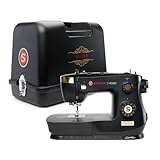


- Best overall value: Singer Heavy Duty 4452 — 32 stitches, 1,100 spm, extra-high foot lift
- Best for leather and vinyl: Janome HD3000 — all-metal body, 18 stitches, 1.0 amp motor
- Best stitch variety: Brother ST150HDH — 50 stitches, 9mm lift, sewing font included
- Best mechanical simplicity: Singer 4432 — 32 stitches, one of the strongest feed systems in its class
- Best semi-industrial step-up: Juki TL-2010Q — straight-stitch only, but 1,500 spm and a true workhorse build for heavy quilt and canvas runs (usually $900–$1,100)
The Three Specs That Actually Predict Durability
Marketing calls anything “heavy duty.” Three measurable specs separate the real thing:
1. Motor Power (Amps or Watts)
Motor output determines piercing force — how cleanly the needle punches through 8+ layers of denim or a leather seam. Domestic machines rated below ~0.6 amps stall or skip stitches on heavy stacks. A useful rule of thumb:
Required torque ≈ layers × fabric density factor. For a practical estimate, treat one layer of 12oz denim as “1 unit.” Hemming jeans at the flat-felled inseam means piercing roughly 6 units; a leather strap fold can hit 8–10 units. Machines under 0.7 amps handle ~4 units cleanly; the Janome HD3000’s 1.0 amp motor and the Singer 4452’s enhanced motor handle 7–8 units with the right needle; beyond that you want a walking-foot industrial.
2. Presser Foot Lift Height
Standard domestic lifts are 5.5–6mm. Heavy duty machines push this to 6–9mm, which is what lets you slide a doubled canvas seam under the foot without forcing it — forcing throws off the feed dog timing and causes the birds-nesting beginners blame on tension.
3. Stitch Options (Fewer Is Often Better)
For heavy fabrics you realistically use straight, zigzag, triple-stretch (for stress seams), and a buttonhole. A machine advertising 200 decorative stitches often diverted budget away from the motor and frame. The Juki TL-2010Q proves the point: one stitch, outstanding build quality.
Head-to-Head Spec Comparison
| Model | Motor | Max Speed | Foot Lift | Stitches | Frame | Typical Price |
|---|---|---|---|---|---|---|
| Singer HD 4452 | ~0.7A (enhanced) | 1,100 spm | ~6mm + extra-lift | 32 | Metal interior | $180–$250 |
| Singer 4432 | ~0.7A | 1,100 spm | ~6mm | 32 | Metal interior | $160–$220 |
| Janome HD3000 | 1.0A | 860 spm | ~6.5mm | 18 | All-metal body | $400–$500 |
| Brother ST150HDH | ~0.6A | 850 spm | ~7mm (9mm w/ lever) | 50 | Metal chassis | $300–$380 |
| Juki TL-2010Q | Industrial-grade DC | 1,500 spm | ~9mm knee lift | 1 (straight) | Aluminum die-cast | $900–$1,100 |
Note the trade-off in the table: speed and piercing power pull in opposite directions at this price. The Janome’s 860 spm is slower but its 1.0 amp motor delivers more low-RPM torque — exactly what leather needs, since you often sew it slowly and deliberately.
Decision Matrix: Match Your Project to a Machine
| Your main work | Key requirement | Recommended pick |
|---|---|---|
| Jeans hemming, denim repairs | Pierce 6+ layers, 16/100 denim needle | Singer HD 4452 or 4432 |
| Garment leather, belts, bags | High torque at low speed, Teflon/roller foot | Janome HD3000 |
| Canvas totes, light upholstery | Tall foot lift, walking foot option | Brother ST150HDH |
| Quilting heavy blankets, production runs | Sustained speed, large throat space | Juki TL-2010Q |
| Mixed household sewing + occasional denim | Versatility over raw power | Brother ST150HDH |
Setup Settings That Protect the Machine on Heavy Fabric
Whatever you buy, these settings matter more than brand:
- Needle: 16/100 or 18/110 denim needle for jeans; 14/90 leather needle for hides. A worn universal needle is the #1 cause of “weak motor” complaints.
- Stitch length: 3.0–3.5mm on heavy stacks. Shorter stitches force the feed dogs to fight compressed fabric and overload the motor.
- Upper tension: Drop ~1 number from your cotton default (e.g., 4 → 3) on thick canvas; dense fabric grips the thread more.
- Speed: If the motor strains audibly, you’re exceeding its torque — use the hand wheel through the thickest inch rather than forcing the pedal.
Frequently Asked Questions
Can a heavy duty home machine sew real leather?
Garment-weight leather (up to ~2–3mm) yes, with a leather needle, longer stitch, and a non-stick foot. Veg-tan belts and saddlery leather need an industrial walking-foot machine — no domestic motor is rated for that.
Is more stitches per minute better?
Not for heavy fabric. Torque at low speed matters more than top speed; high spm mostly helps on long straight runs of lighter material.
Mechanical or computerized for heavy work?
Mechanical machines (Singer 44xx, Janome HD3000) are easier to maintain and tolerate abuse better. Computerized models add convenience but introduce electronics that dust and vibration from heavy sewing can wear faster.

Write Your Review
No reviews yet. Be the first to share your experience!