
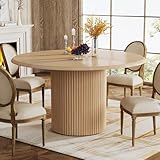
- Top Pick: Alpen 42" Round Dining Table for 4-6, Farmhouse Kitchen Table with Storage Shelf, Wood Circle Table with Pedestal Metal Frame, Small Space Table for Apartment, Dining Room, Vintage Brown
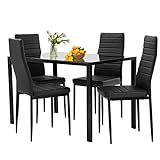
- Best Value: FDW | 5-Piece Dining Table Set | Black | Glass Kitchen Table
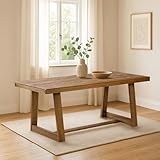
- Premium Choice: Plank+Beam Classic 72 Inch Dining Table, Rectangular, Pecan Wirebrush
The best dining table is the one that fits your room with chairs pulled out—not just the space occupied by the tabletop—and suits how many people you seat most days. Measure the usable floor area first, allow roughly 36 inches around the table for chair movement, then choose a shape and capacity that leave a clear route through the room. For tight spaces, consider a round pedestal or a compact rectangular table; for a room that hosts occasional guests, an extendable table can provide extra seats without taking up more space every day.
As an Amazon Associate we earn from qualifying purchases at no extra cost to you.

Start with the room, not the seat count
Measure the room and mark any doorways, cabinets, radiators, or walkways that need to stay accessible. The 36-inch clearance is a practical planning allowance, not a universal building rule: a passage used as a main route may need more, while a rarely used side can sometimes tolerate less. If chairs will be pushed against a wall, check their depth in that position too.
A quick fit check is to subtract 72 inches from each room dimension to estimate the largest tabletop that preserves about 36 inches of clearance on opposite sides. For example, in a 10-by-12-foot dining area (120 by 144 inches), that leaves a rough maximum of 48 by 72 inches. This is only a starting point: a doorway or traffic lane may make a smaller or differently shaped table more practical.
Match the shape to the layout
- Rectangular: A versatile choice for long, narrow rooms and larger households. It uses space efficiently along a wall, but its corners can obstruct movement in a cramped area.
- Round: Often easier to circulate around in a compact or square room. With no corners to navigate, it can feel less intrusive, though larger round tables require substantial floor width.
- Oval: Combines a long seating edge with softened corners. It can work well in a narrow room where a rectangular table feels too sharp, but needs enough length for its capacity.
- Square: Suits a square room and small group, especially when placed centrally. A large square table can put diners far apart, so it is less suitable for regular groups of six or more.
A pedestal base can improve legroom and make it easier to add a chair, especially at a round table. Check that the base is stable and that diners’ knees will not hit its central support. Four-legged tables are often a dependable fit for rectangular layouts, but corner legs can limit how closely chairs tuck in or where extra seats go.
Use dimensions as a first-pass seating guide
These ranges are planning estimates, not guarantees. Chair width, table legs, place settings, and whether anyone sits at the ends all affect the real capacity. Allow about 24 inches of table edge per person for comfortable everyday dining; people may fit more tightly for a short meal.
| Table shape | Approximate tabletop size | Typical seating | Best suited to |
|---|---|---|---|
| Round | 36–42 inches across | 2–4 | Small kitchens or breakfast areas |
| Round | 48–54 inches across | 4–6 | Square dining areas |
| Rectangular | 48 × 30–36 inches | 4 | Compact rooms and apartments |
| Rectangular | 60 × 36 inches | 4–6 | Everyday family dining |
| Rectangular | 72 × 36 inches | 6–8 | Larger rooms or frequent entertaining |
| Oval | 60–72 × 36 inches | 4–6 | Narrow rooms needing softened corners |
To check a specific setup, measure your chairs at their widest point and mark their positions around a paper or tape outline of the table. Pull each chair out as if someone were getting up. If the chair backs collide or block the main route, reduce the table size or seating count rather than relying on a nominal capacity label.
Choose a material for the way you live
- Solid wood: Often repairable and visually warm, but can scratch, dent, or respond to changes in humidity. A protective finish and prompt cleanup help preserve it. Ask whether the tabletop is solid wood throughout or has a veneer.
- Wood veneer: Gives a wood appearance, often at a lower price or weight than solid wood. Avoid sanding through the thin surface layer; use trivets and follow the maker’s cleaning guidance.
- Laminate: Usually a practical choice for tighter budgets and busy households because routine spills are easy to wipe away. Edge damage can be difficult to repair, and heat protection is still sensible.
- Glass: Keeps sightlines open and can make a small room feel less visually crowded. Fingerprints and smudges show readily, and a glass top needs careful handling and a stable base.
- Stone or stone-look surfaces: Can provide a substantial, easy-to-wipe surface, but real stone may be heavy, costly, or vulnerable to staining depending on its type and finish. Confirm floor support and care requirements before buying.
For households with young children, a forgiving finish and easy-to-clean surface may matter more than whether the tabletop is the hardest material available. For a rental or frequent move, weight and disassembly can be just as important as appearance.
Decide whether an extension is worth it
An extendable table makes sense when your usual household is smaller than your occasional guest list. Compare its everyday footprint with the fully extended dimensions, then repeat the clearance check in both configurations. A table that fits six when extended is not a good solution if opening it blocks the doorway or leaves no room to pull out chairs.
- Drop-leaf: One or both sides fold down, making it useful when a table needs to sit against a wall or serve different purposes. Check whether the supports feel secure when a leaf is raised.
- Butterfly leaf: A leaf folds and stores inside the table. This avoids finding separate storage, but the mechanism adds moving parts and can make the table heavier.
- Removable leaf: A separate insert can provide a larger extension. Confirm where the leaf will be stored and whether the table requires two people to move or assemble.
Open and close the mechanism before committing, if possible, and check how the leaves align. Look for a manageable opening action, secure locks or supports, and a seam that sits level. Ask whether the extension leaf is included and how it is stored; those details can change the true cost and convenience.
Match your situation to a sensible starting point
| Your room or routine | Good starting choice | What to verify |
|---|---|---|
| Small square room, 2–4 diners | 36–42-inch round table, preferably with a pedestal base | Chair pull-out space and a clear route past the table |
| Narrow room, 4 diners | Compact rectangular table around 48 × 30–36 inches | Clearance along the long sides and access at the ends |
| Family of 4–6, regular meals | Rectangular table around 60 × 36 inches | Actual chair width and leg placement |
| Small everyday group, occasional guests | Extendable rectangular or oval table | Room dimensions and chair clearance when fully extended |
| Tight budget and frequent cleanup | Laminate or durable veneer in a compact, standard size | Edge quality, finish instructions, and included extension hardware |
As a broad market guide, basic laminate and smaller veneer tables often fall around $100–$400; many mid-range wood or extendable options are roughly $400–$1,200; and larger solid-wood or stone tables can cost $1,200 or more. These are general ranges, not fixed prices: size, construction, finish, and delivery can shift the total considerably. Include chairs, assembly, and any delivery or stair-carry charges in your budget.
Final checks before you buy
- Confirm tabletop dimensions both closed and extended, rather than choosing by the advertised seat count alone.
- Check table height against your chairs. Many dining tables are around 28–30 inches high, but seat height, apron depth, and armrests determine whether the combination feels comfortable.
- Make sure chair arms can slide beneath the tabletop if you plan to tuck them in.
- Measure the delivery route, including the front door, stair turns, and elevator, and check whether the tabletop or legs can be disassembled.
- Read care instructions and warranty terms, especially for finishes, extension hardware, and surfaces sensitive to heat or spills.
The most reliable choice is usually the smallest table that comfortably fits your regular diners and leaves the room usable. Add extension capacity only when you can accommodate the table—and its chairs—when it is fully open.
Ready to decide? Our #1 pick for 2026 is the Round.
Live price & availability on Amazon.









Write Your Review
No reviews yet. Be the first to share your experience!