
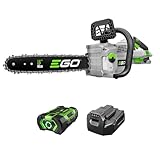
- Top Pick: EGO POWER+ Chain Saw, 16” Battery Powered Chainsaw, Electric Cordless, Includes 56V 2.5Ah Battery and Charger – CS1611
- Best Value: Tietoc Chainsaw 6 Inch Mini Electric Chainsaw Cordless Battery Powered, Hand Held Saw for Wood/Trees Trimming, Tools for Household and Garden, Chain Saw Gift for Men Dad Husband Fathers Gardener 2026
- Premium Choice: SEESII 6 Inch Mini Electric Chainsaw Cordless Battery Powered
Best Battery-Powered Top-Handle Chainsaws
The best battery powered top handle chainsaws for qualified arborists and pruning crews are the STIHL MSA 161 T for low weight, Husqvarna T540i XP for a strong professional 36V platform, ECHO DCS-2500T for higher-voltage performance, and Milwaukee M18 FUEL 2826-20 for users already invested in M18 batteries.
Top-handle chainsaws are specialized climbing and pruning tools, not general-purpose saws. They are designed for trained users who can control a saw one-handed when necessary, work from a stable position, and manage falling branches, ropes, and a second-handhold safely. For ground work, a rear-handle saw is normally the better choice.
As an Amazon Associate we earn from qualifying purchases at no extra cost to you.


Quick comparison
| Model | Typical bar options | Battery system | Approximate bare-tool weight | Best suited to |
|---|---|---|---|---|
| STIHL MSA 161 T | 10–12 in | 36V AP system | About 5.5 lb | Light pruning, climbing, and all-day handling |
| STIHL MSA 220 T | 12–14 in | 36V AP system | About 6.2 lb | More demanding cuts within the STIHL platform |
| Husqvarna T540i XP | 12–14 in | 36V BLi system | About 5.7 lb | Professional pruning with strong chain speed |
| ECHO DCS-2500T | 12 in | 56V eFORCE system | About 6.2 lb | Fast cuts and users wanting a higher-voltage platform |
| Milwaukee M18 FUEL 2826-20 | 12 in | 18V M18 system | About 7.3 lb | Crews already carrying M18 batteries |
| Makita XCU08 | 14 in | Two 18V LXT batteries | About 8 lb before batteries | Longer reach and users committed to LXT |
Weights are approximate tool-only figures and can vary with the chain, bar, guard, and regional configuration. A battery can add roughly 1.5–3 lb, so compare complete working weight rather than the number printed on the tool box.
Head-to-head: which saw is the better fit?
STIHL MSA 161 T: best for minimizing fatigue
The MSA 161 T is a strong choice when the main limitation is weight rather than cutting capacity. Its 10- or 12-inch bar is appropriate for fine pruning, branch removal, and typical climbing cuts where maneuverability matters more than maximum buried-bar capacity. The STIHL AP battery system also provides a broad range of compatible professional tools.
Choose it when you spend long periods aloft, perform many small cuts, or already own AP batteries. A 12-inch bar is the sensible default for general pruning; a shorter bar improves balance in dense crowns but reduces useful reach.
Husqvarna T540i XP: best all-round professional option
The T540i XP combines a compact top-handle design with the performance expected from Husqvarna’s professional 36V system. It is a particularly practical choice for crews that already use BLi batteries and chargers. Its 12-inch configuration is nimble, while a 14-inch setup gives additional reach for larger limbs without moving to a substantially larger saw.
The saw is most convincing when chain speed, throttle response, and battery interchangeability matter as much as minimum weight. Pair it with a high-capacity BLi battery for longer production periods, but remember that the largest battery may make the saw noticeably less comfortable during positional work.
ECHO DCS-2500T: best for a higher-voltage setup
The DCS-2500T uses ECHO’s 56V eFORCE system and is aimed at users who want strong cutting performance from a compact professional top-handle saw. Its 12-inch bar keeps the package maneuverable, while the higher-voltage platform can be attractive to crews already using ECHO’s 56V outdoor equipment.
This is a good match for mixed pruning where cuts are more frequent or larger, but battery mass and platform cost should be considered alongside motor output. Higher voltage does not automatically mean longer runtime: amp-hours, battery size, chain sharpness, and cutting load determine that.
Milwaukee M18 FUEL 2826-20: best for M18 owners
The M18 FUEL top-handle saw makes sense primarily as a platform decision. If a crew already owns several high-output M18 batteries and chargers, the lower entry cost and shared battery inventory can outweigh the advantages of a dedicated 36V or 56V arborist system.
It is heavier than the lightest professional alternatives, especially with a large M18 battery attached. That makes it less attractive for long climbing sessions, but it remains useful for pruning contractors, maintenance teams, and occasional qualified users who already operate M18 equipment.
Makita XCU08: best when a 14-inch bar and LXT compatibility matter
The Makita XCU08 uses two 18V LXT batteries rather than one higher-voltage pack. Its 14-inch bar gives useful reach, but the dual-battery arrangement adds weight and means every job requires two charged packs. It is therefore better suited to users who value bar length and already have a substantial LXT inventory.
For intensive climbing, compare its complete weight carefully against a dedicated 36V saw. For ground-based pruning by a trained operator, the extra reach can be more valuable than the weight penalty.
Bar length: choose for control, not maximum diameter
A longer bar is not automatically safer or faster. It adds weight, increases the chance of contacting hidden wood, and can make the saw awkward in a crown. A shorter bar also reduces the amount of chain engaged in the cut, which can improve control.
- 10 inches: Best for small branches, dense canopies, and maximum maneuverability.
- 12 inches: The most versatile choice for professional pruning and climbing work.
- 14 inches: Useful for larger limbs and additional reach, but only if the saw and battery remain balanced.
Do not select a bar solely by doubling its length to estimate cutting diameter. Safe cutting capacity depends on the saw’s power, chain condition, wood species, cutting position, and the need to leave room for controlled movement. For repeated cuts approaching the bar’s full effective length, a larger rear-handle saw may be the correct tool.
Runtime: a practical battery calculation
Battery voltage and amp-hours provide a useful estimate of energy: watt-hours = nominal volts × amp-hours. For example, a 36V 6Ah battery stores approximately 216Wh. If only 80% is treated as usable working energy and the saw averages 500W while the motor is actually cutting, the theoretical cutting time is:
216Wh × 0.8 ÷ 500W = about 0.35 hours, or 21 minutes of trigger-on cutting.
That is not 21 minutes of elapsed job time. A climber may make a cut for two seconds, reposition for ten seconds, clear a limb, and inspect the next cut. Under that duty cycle, the same battery can support substantially more clock time, often roughly 45–90 minutes of intermittent pruning depending on wood size, chain sharpness, temperature, and operator technique.
Use this calculation to plan batteries rather than relying on marketing runtime. For a full day, carry at least two working batteries per saw, plus a charging plan. A dull chain can increase energy use and heat while reducing the number of cuts per charge.
Decision matrix
| Your situation | Recommended direction | Why |
|---|---|---|
| Many small cuts and long periods aloft | STIHL MSA 161 T, 10–12 in | Low tool weight and compact handling reduce fatigue |
| Mixed professional pruning with 12–14 in needs | Husqvarna T540i XP or STIHL MSA 220 T | Balanced performance and established professional battery systems |
| Existing ECHO 56V equipment | ECHO DCS-2500T | One battery platform and strong cutting performance |
| Existing Milwaukee M18 fleet | Milwaukee 2826-20 | Battery compatibility can lower total ownership cost |
| Existing Makita LXT fleet and need for 14 in | Makita XCU08 | Uses familiar batteries and provides longer bar reach |
Safety features that deserve attention
Look for a chain brake with a clearly reachable hand guard, a trigger lockout, an electronic chain brake, a captive bar nut, and automatic chain lubrication. Tool-less tensioning is convenient, but a conventional captive nut and proper scrench adjustment can hold tension more reliably during professional use.
Some professional battery saws also provide a diagnostic display, selectable operating modes, or Bluetooth-based fleet settings. These features are useful only if they cannot interfere with the fundamentals: a sharp correctly tensioned chain, intact safety controls, secure battery retention, and a clean chain-brake mechanism.
Battery saws are quieter and produce no exhaust at the work position, but they still create severe kickback and cutting hazards. Wear the required chainsaw protective equipment, inspect the tree and escape or lowering plan, and follow the manufacturer’s rules for one-handed operation. Never use a top-handle saw as a substitute for climbing, rigging, or aerial-lift training.
Buying verdict
Choose the STIHL MSA 161 T when low weight and precise pruning are the priority. Choose the Husqvarna T540i XP for a particularly capable all-round professional platform, or the STIHL MSA 220 T when staying within the AP system but needing more cutting reserve. The ECHO DCS-2500T is the logical higher-voltage choice, while Milwaukee and Makita are most compelling when battery compatibility with an existing tool fleet is worth accepting extra weight.
For most qualified arborists, a sharp 12-inch chain, two appropriately sized batteries, and a saw that balances well in the working position are more valuable than the longest bar or the largest battery available.
Ready to decide? Our #1 pick for 2026 is the STIHL MSA 161 T.
Live price & availability on Amazon.






Write Your Review
No reviews yet. Be the first to share your experience!