
The Short Answer
Yes—8GB of VRAM is enough for new games if you play at 1080p and are willing to lower texture quality or ray-tracing settings in the most demanding releases. It is no longer a comfortable “set everything to ultra” capacity, however, and it is a poor choice for a new 1440p gaming build intended to last several years.
VRAM, or video memory, stores textures, lighting data, geometry, shaders, and other assets used by your graphics card. When a game exceeds the available capacity, you may see stuttering, texture pop-in, long asset-loading pauses, or crashes. The GPU’s processing speed still matters, but insufficient VRAM can become the limiting factor even when average frame rates look acceptable.
As an Amazon Associate we earn from qualifying purchases at no extra cost to you. Product prices and availability are accurate as of the date shown and are subject to change.

For 2026, the practical rule is simple: 8GB works best for 1080p, 12GB is a better starting point for 1440p, and 16GB or more is preferable for high-resolution textures, heavy ray tracing, modded games, and longer-term ownership.
What You Actually Get
An 8GB graphics card gives you enough memory for most competitive games and many single-player titles at 1080p. Games such as Fortnite, Counter-Strike 2, Valorant, Overwatch 2, and Rocket League generally fit comfortably within this capacity, assuming the rest of the system is appropriate. At 1080p, you can often use high settings and maintain smooth play without running into a VRAM wall.
The situation changes with modern open-world games. Large environments, high-resolution character models, detailed shadows, and ray-traced effects consume memory quickly. Ultra texture settings can require several gigabytes more than high settings while offering only a modest visual improvement. Dropping textures from ultra to high is often enough to make an 8GB card usable, but that solution depends on the game exposing sensible graphics options.
Resolution has a direct impact. Rendering at 1440p uses more memory than 1080p, and 4K can make an 8GB card feel restrictive very quickly. Upscaling technologies such as DLSS, FSR, and XeSS reduce the internal rendering resolution and can improve performance, but they do not always solve texture-memory limits. A game may still need room for high-resolution assets even when the final image is upscaled.
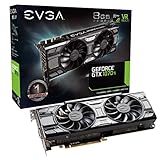
The two older 8GB cards commonly considered at this price point illustrate the problem. The EVGA GeForce GTX 1070 Ti SC Gaming has 8GB of GDDR5, while the MSI GeForce GTX 1080 Gaming X 8G uses faster GDDR5X memory. Both have enough capacity for basic 1080p gaming, but their age limits their value. They lack modern hardware features found on newer cards, including more capable ray tracing support, newer upscaling features, and better efficiency.
Physical fit also matters when buying an older card. A GTX 1070 Ti or GTX 1080 gaming model may be roughly 11 inches long, occupy two expansion slots, and weigh around 2 to 2.5 pounds, though exact dimensions vary by cooler design. The GTX 1080 commonly calls for a power supply around 500 watts, while a GTX 1070 Ti is often paired with a 500- to 550-watt supply. Check the exact model, available case clearance, and PCIe power connectors before buying used hardware.
Pros
- Good 1080p starting capacity: 8GB is sufficient for a large portion of today’s games at high settings, especially when ray tracing is disabled.
- Lower purchase cost: Cards with 8GB can be less expensive than newer 12GB and 16GB models, particularly on the used market.
- Reasonable file and system demands: You do not need a huge power supply or an unusually large case for many midrange 8GB cards.
- Easy settings adjustment: Reducing texture quality, shadow quality, or ray tracing usually lowers memory use without destroying image quality.
- Strong fit for esports: Competitive games typically prioritize frame rate and responsiveness over extremely detailed textures.
Cons
- Limited headroom: Newer releases can exceed 8GB at high or ultra settings, particularly at 1440p.
- Ray tracing is a poor match: Ray-traced lighting can increase both memory use and rendering demands, making older 8GB cards struggle.
- Not very future-proof: A card that is comfortable at 1080p today may require reduced settings sooner than a 12GB or 16GB alternative.
- Older cards can be overpriced: A GTX 1070 Ti listed at $320 or a GTX 1080 listed at $379 is difficult to recommend when newer hardware may offer better efficiency and support.
- Used-card risks: Older graphics cards may have worn fans, dried thermal paste, damaged video outputs, or a history of continuous high-temperature operation.
- Feature limitations: Older models may not support the latest frame-generation, encoding, or ray-tracing features available on current cards.
Who Should Buy It
Buy an 8GB card if you have a 1080p monitor, want to spend as little as possible, and are comfortable adjusting settings. It is also sensible for a secondary gaming PC, a compact budget build, or someone who mainly plays esports, indie games, older releases, and well-optimized multiplayer titles.
An 8GB card can make sense when the price is genuinely low and the seller provides a return period. As a general used-market guideline, an older 8GB card should usually be substantially cheaper than a newer graphics card with 12GB or more. A price range around $100 to $180 may be easier to justify for an older model depending on condition and local availability; $300 to $400 is much harder to defend unless the card is unusually powerful, new, or bundled with meaningful warranty coverage.
Before buying, confirm that your power supply is in good condition, has the required six- or eight-pin connector, and provides adequate capacity. Also check the card’s length against your case. A graphics card that technically fits may still block drive cages or leave too little room for front-mounted fans.
Who Should Skip It
Skip 8GB if you are building specifically for 1440p ultra settings, 4K gaming, extensive ray tracing, virtual reality, or heavily modded games. You should also skip it if you want to keep the same graphics card for five or more years without frequently reducing settings.
Buyers comparing an older GTX 1070 Ti at $320 or GTX 1080 at $379 should be especially cautious. Those prices are reference points, not recommendations. At that level, look for a newer card with at least 12GB, better driver longevity, lower power consumption, and current upscaling support. A newer card may also provide a better warranty and quieter operation, even if its traditional frame rate appears similar on paper.
Cheaper Alternatives
| Option | Cost | Trade-off |
|---|---|---|
| Used 8GB card from the previous generation | $100–$180 | Lowest cost, but limited ray tracing, older features, and greater risk of wear. |
| Used 10GB–12GB card | $180–$280 | More VRAM headroom, though availability, condition, and power efficiency vary. |
| New entry-level 8GB card | $180–$260 | Warranty and newer features, but performance may be modest and 8GB remains the limit. |
| New 12GB card | $250–$400 | Better long-term flexibility, but costs more and may require a stronger power supply. |
| Integrated graphics with a modern processor | $150–$300 for the processor | Lower power use and no separate GPU cost, but demanding games require low settings and reduced resolution. |
Do not choose solely by VRAM number. A slow 16GB card is not automatically better than a fast 8GB card. Compare the GPU’s actual performance, memory bandwidth, cooling, power requirements, software features, and warranty. For a new purchase, though, extra capacity is increasingly valuable because it gives you more room to keep textures high as game requirements rise.
FAQ
Is 8GB VRAM enough for 1080p gaming?
Usually, yes. Eight gigabytes is adequate for most 1080p gaming when you use high rather than ultra textures and avoid demanding ray tracing. Some poorly optimized or particularly graphics-heavy games may still require medium textures or a few additional settings changes.
Is 8GB VRAM enough for 1440p?
It can work, but it is not ideal. At 1440p, you are more likely to encounter texture limits, stuttering, or reduced settings. A 12GB card is a safer minimum for a new 1440p build, while 16GB provides more flexibility for demanding games and long-term use.
Will lowering graphics settings fix an 8GB VRAM limit?
Often, yes. Start with texture quality, ray tracing, shadow resolution, and view distance. Restart the game after making major changes if it does not immediately release allocated memory. If stuttering continues despite low settings, the problem may instead be the GPU’s processing speed, system RAM, storage, or the game’s optimization.
Should I buy an older GTX 1070 Ti or GTX 1080 because it has 8GB?
Only if the price is low, the card is tested, and you specifically need an inexpensive 1080p solution. The GTX 1080’s faster GDDR5X memory does not eliminate its age, and neither card offers the feature set of a modern GPU. At prices near $320 or $379, look for newer hardware with 12GB or more instead.






Write Your Review
No reviews yet. Be the first to share your experience!