
- Top Pick: GIGABYTE GeForce RTX 5070 Ti Gaming OC 16G Graphics Card, 16GB 256-bit GDDR7, PCIe 5.0, WINDFORCE Cooling System, GV-N507TGAMING OC-16GD Video Card
- Best Value: ASUS TUF Gaming GeForce RTX 5070 12GB GDDR7 OC EditionGaming Graphics Card
- Premium Choice: ASUS Prime GeForce RTX 5070 12GB GDDR7 OC Edition Gaming Graphics Card


3070 Vs 5070 represents one of the most anticipated GPU comparisons for midrange PC gamers looking to upgrade in 2026. With NVIDIA releasing its advanced Blackwell architecture, older Ampere graphics cards are showing their age. Let us dive deep into this performance battle to see if it is time to upgrade your system today.
Technical Specifications and Architecture Analysis
Upgrading your graphics card requires a solid understanding of what has changed beneath the metal shroud of your computer. Moving from the older Ampere generation to the modern Blackwell family introduces radical shifts in manufacturing technology, memory design, and processing efficiency. Let us compare the core specifications of these two popular gaming GPUs to see how engineering has evolved over the past several years.
As an Amazon Associate we earn from qualifying purchases at no extra cost to you.


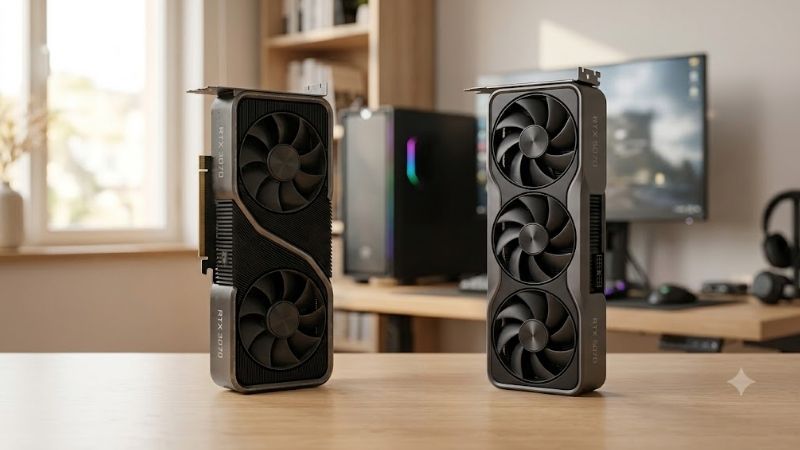
Ampere GA104 vs Blackwell GB205 Efficiency
The historical gap between these two components spans several years of engineering breakthroughs. The older model is built on Samsung’s 8nm process node, which was often criticized for its higher heat output and limited transistor density. In contrast, the modern Blackwell GPU utilizes TSMC’s custom 4N process, bringing a massive reduction in gate width and a huge leap in efficiency. This allows the newer silicon to pack 31.1 billion transistors into a much smaller die area than its predecessor, representing a massive technological leap forward.
Clock speeds tell a story of sheer raw frequency gains. While the older architecture struggles to maintain boost clocks past 1725 MHz under heavy load, the newer counterpart easily exceeds 2512 MHz out of the box. This represents a substantial boost in raw processing cycles, allowing the modern graphics card to execute instructions far quicker than ever before. If you run complex computational tasks, this clock speed multiplier translates directly to snappier overall performance.
Furthermore, the architectural improvements extend to the layout of the compute units. The newer card features 6,144 CUDA cores organized into 48 Streaming Multiprocessors, whereas the older card has 5,888 CUDA cores. When you combine this core increase with a 46% bump in frequency, the theoretical floating-point performance reaches new heights. It is not just about the number of cores anymore; it is about how much more work each core can do per cycle.
Check the latest price on Amazon:
- Rtx Pro 6000 Blackwell Gaming Performance
- Rtx 5060 Vs 5060 Ti 16gb
- Rtx 3070 Vs Rtx 5060 Ti 16gb
- Nvidia Graphics Driver Install
GDDR7 Memory Upgrade Solving VRAM Bottlenecks
One of the biggest pain points for owners of the older graphics card is its limited 8GB memory capacity. Modern AAA titles in 2026 require far more memory to load high-resolution textures without causing system stutter. The newer model directly addresses this bottleneck by offering a much larger 12GB memory buffer, allowing gamers to run demanding titles at maximum settings without running out of space. This represents a critical shift for long-term usability.
Beyond just memory capacity, the type of memory has evolved significantly. The older card utilizes GDDR6 memory, while the newer option features cutting-edge GDDR7 memory. By utilizing advanced PAM3 signaling, the GDDR7 chips transmit more data per clock cycle. To calculate the peak memory bandwidth ($B$), we can use the formula:
$$B = frac{W times S}{8}$$
Where $W$ is the bus interface width in bits and $S$ is the memory clock speed in gigabits per second.
For the older architecture with a 256-bit bus and 14 Gbps speed, the equation gives a bandwidth of $448$ GB/s. For the newer architecture, despite a smaller 192-bit bus, the ultra-fast 28 Gbps speed yields a bandwidth of $672$ GB/s. This represents a 50% increase in memory speed, ensuring that high-resolution assets stream into the frame buffer seamlessly. You can say goodbye to texture pop-in and abrupt frame drops once and for all.
DLSS 4 with Blackwell Frame Generation Breakthroughs
Deep Learning Super Sampling has become a cornerstone of modern PC gaming, transforming how we achieve high frame rates. The older Ampere GPU supports DLSS 2, which offers excellent spatial upscaling but lacks the hardware capability for frame generation. This means that older card owners are entirely locked out of the latest AI-driven performance multipliers that developers are building into modern titles. It is a major limitation as we move further into the decade.
The introduction of the Blackwell architecture brings exclusive access to DLSS 4 technology. Powered by fifth-generation Tensor Cores, DLSS 4 features revolutionary multi-frame generation. This technique uses advanced optical flow vectors to insert entirely synthetic frames between traditionally rendered ones, massively boosting your on-screen frame rates without taxing the main graphics pipeline. It is a true game-changer for high-refresh-rate monitors.
These next-generation Tensor Cores are also highly efficient at handling low-precision AI calculations. Blackwell supports FP4 and FP8 calculations, allowing the card to execute deep learning models with incredible throughput. If you plan to play modern heavy games, having access to DLSS 4 is a massive advantage that the older generation simply cannot replicate. To experience the future of rendering, checking the latest price on Amazon for a Blackwell card is the first step.
| Technical Specification | NVIDIA GeForce RTX 3070 | NVIDIA GeForce RTX 5070 |
|---|---|---|
| Architecture | Ampere (GA104) | Blackwell (GB205) |
| Process Node | Samsung 8nm | TSMC 4N (4nm) |
| CUDA Cores | 5,888 | 6,144 |
| Boost Clock | 1725 MHz | 2512 MHz |
| VRAM Capacity | 8GB GDDR6 | 12GB GDDR7 |
| Memory Bus | 256-bit | 192-bit |
| Memory Bandwidth | 448 GB/s | 672 GB/s |
| TDP (Power Draw) | 220W | 250W |
| DLSS Support | DLSS 2 | DLSS 4 (Multi-Frame Gen) |
Real-World Gaming Benchmarks and Raw Performance
Theoretical specifications are impressive, but real-world gaming performance is what truly matters to enthusiasts and competitive players alike. In this section, we will analyze how these technical advancements translate to actual frames per second. We will look at standard rendering, ray tracing, and how modern software demands impact these devices in everyday scenarios.
1080p and 1440p Rasterization Performance Comparisons
In traditional rasterized games that do not rely on ray tracing, the newer GPU shows a dramatic performance uplift. At 1080p, the older model is still highly capable, but it often becomes limited by modern processor speeds. Even so, the newer graphics card delivers an average performance increase of around 45% in standard rasterized titles, providing incredibly stable frame times that competitive players will appreciate.
The gap widens significantly when you step up to 1440p resolution, which is the sweet spot for these midrange products. In popular multiplayer shooters and open-world games, the older GPU frequently struggles to maintain a stable 1440p gaming experience at maximum settings. The newer card, however, effortlessly pushes past 100 frames per second, offering buttery smooth gameplay even in the most chaotic action scenes.
For those who want to check the latest price on Amazon, upgrading to the newer card allows you to transition your entire gaming library to 1440p high-refresh-rate monitors without compromising on visual fidelity. The rasterization improvement alone makes the newer silicon a highly compelling option for mainstream PC builds. It breathes new life into older games and prepares you for future releases.
Ray Tracing Performance with Next-Gen RT Cores
Ray tracing represents one of the most demanding tasks a graphics processor can undertake, rendering realistic light and shadows. The older Ampere model features second-generation RT Cores, which were revolutionary at launch but suffer from massive frame rate drops when ray-traced shadows and reflections are enabled. Playing heavy ray-traced games on the older card often requires dropping settings to Low or Medium to stay playable.
The newer Blackwell card is equipped with fourth-generation RT Cores, which offer double the ray-triangle intersection throughput. This architectural leap means that ray tracing calculations are handled with minimal impact on overall system performance. In titles like Cyberpunk 2077, the newer card handles path tracing and complex reflections with ease, leaving the older card far behind in visual authenticity.
When you combine the power of these fourth-generation RT Cores with DLSS 4 and ray reconstruction, the newer card can deliver up to a 150% frame rate advantage over the older one. It is a completely different tier of visual quality, making virtual worlds look incredibly lifelike. If you want to experience games exactly as the developers intended, the technological gap here makes the upgrade highly logical.
Modern 2026 AAA Gaming and VRAM Limitations
The gaming landscape of 2026 has changed dramatically, with newer game engines pushing the boundaries of memory consumption. Recent high-profile releases like Kingdom Come: Deliverance II and various Unreal Engine 5 projects have shown that 8GB of VRAM is no longer sufficient for high-quality gaming. The older card suffers from severe stuttering and texture pop-in because it simply lacks the physical memory space to store massive asset files.
The newer model’s 12GB VRAM buffer offers the necessary headroom to handle modern console-quality ports. Games can load massive texture maps and high-detail models directly into the high-speed GDDR7 memory, preventing sudden drops in performance. This extra 4GB of memory makes a night-and-day difference in overall system stability and visual consistency, ensuring a smoother gaming experience.
If you are tired of adjusting game settings downward just to prevent crashes caused by memory limitations, the transition to the newer card is highly recommended. It ensures that your system remains fully compatible with upcoming game releases for years to come. Investing in a card with 12GB of modern VRAM is the smartest way to protect your setup from becoming obsolete.
Value Assessment and Upgrade Verdict for 2026
Choosing between these two graphics cards involves more than just looking at benchmark charts. We must also weigh the financial investment against the features, power requirements, and overall longevity of the hardware. Let us break down the value proposition to help you make an informed purchasing decision for your gaming rig.
Pros and Cons Analysis of the 3070 Vs 5070 Upgrade
Analyzing the strengths and weaknesses of each option is crucial before making a final decision. The main advantages of upgrading to the newer Blackwell GPU include a massive 50% performance improvement in standard gaming, access to exclusive DLSS 4 features, and a much larger 12GB of ultra-fast GDDR7 memory. These benefits ensure that your gaming rig is fully prepared for modern titles.
- Pros of Upgrading to the RTX 5070:
- Massive performance leap of up to 60% in modern rasterized games.
- Generous 12GB GDDR7 memory buffer eliminates VRAM bottlenecks at 1440p.
- Exclusive access to DLSS 4 Multi-Frame Generation and advanced reconstruction.
- Superb power efficiency thanks to TSMC’s advanced 4N process node.
- Next-generation DisplayPort 2.1 support for modern high-refresh monitors.
- Cons of Upgrading to the RTX 5070:
- The launch price of $549 is slightly higher than older launch prices.
- Slightly higher TDP of 250W compared to the older card’s 220W rating.
- Requires a 16-pin 12V-2×6 power connector or adapter.
Despite these minor drawbacks, the pros heavily outweigh the cons for anyone seeking a modern, future-proof gaming experience. You can check the latest price on Amazon to see if there are any deals on these next-generation units. It is an investment that immediately pays off in smoothness and visual fidelity.
Power Consumption and PSU Requirements Compared
Power efficiency is a key consideration when upgrading your system, as a higher power draw can lead to increased heat and noise. The older Ampere GPU has a rated TDP of 220W and typically uses standard 8-pin power connectors. This makes it highly compatible with older power supplies and budget-friendly PC cases, requiring very little modification to install.
The newer Blackwell card features a rated TDP of 250W, which is a 30W increase over its predecessor. It also utilizes the modern 16-pin 12V-2×6 power interface, which is designed to handle power delivery more safely and efficiently. While this interface is highly advanced, it may require you to use an adapter or upgrade to an ATX 3.0 power supply to avoid cable clutter.
For most setups, a high-quality 650W or 700W power supply will be more than sufficient to run either card safely. If your current power supply is aging, upgrading to a modern unit alongside your new graphics card is a smart investment that ensures stable voltage delivery under heavy loads. It also protects your expensive new components from sudden power surges.
Is the RTX 5070 Worth the $549 Investment?
At a starting price of $549, the newer graphics card offers an incredible balance of performance and next-generation features. It bridges the gap between mainstream pricing and high-end capabilities, making it the go-to choice for mid-range builders in 2026. When compared to older options, the price-to-performance ratio of Blackwell is highly competitive.
If you are currently running the older Ampere card, selling your old hardware can help offset the cost of this upgrade. The performance leap is large enough to justify the investment, especially if you find yourself limited by the older card’s 8GB memory capacity or lack of DLSS 4 support. It feels like stepping into a completely different class of performance.
Ultimately, investing in modern hardware guarantees a smoother, more enjoyable gaming experience without the constant headache of performance stutters. Check the latest price on Amazon today to find the best deals on custom partner models from brands like ASUS, MSI, and Gigabyte. Your PC will thank you for the massive injection of modern graphics power.
Conclusion
To wrap things up, our comparison of the 3070 Vs 5070 highlights a massive generational leap in performance, efficiency, and features. The older card remains a decent budget option for entry-level 1080p gaming, but its 8GB memory buffer and older architecture are starting to struggle under the weight of modern 2026 AAA game releases. Upgrading to the newer Blackwell-powered GPU gives you a future-proof 12GB GDDR7 frame buffer, cutting-edge DLSS 4 technology, and the raw power to conquer demanding titles at 1440p and entry-level 4K. If you want to elevate your PC gaming experience and enjoy smooth, stutter-free gameplay with beautiful ray-traced visuals, we highly recommend making the switch. Check the latest price on Amazon to grab your new next-gen graphics card and give your PC build the upgrade it deserves!
Frequently Asked Questions
How big is the performance jump from RTX 3070 to RTX 5070?
Around 50 to 65 percent more rasterized performance at 1440p, with a larger advantage in ray traced titles. Adding DLSS 4 multi frame generation, unavailable on Ampere, makes the practical difference in supported games considerably larger than raw benchmark comparisons suggest.
Does going from 8GB to 12GB solve the VRAM problem?
At 1440p, largely yes. Twelve gigabytes is comfortable for current titles at high textures with ray tracing at that resolution. At 4K it is the new pressure point, so if you plan to move to a 4K display, consider a 16GB card instead.
Will my existing power supply work?
Very likely. The 3070 is a 220W card and the RTX 5070 is 250W, with 650W recommended. You will need the 12V-2×6 connector or the included adapter fed by two separate 8-pin PCIe cables, not a single daisy chained lead, so check your PSU’s cable count.
Is this upgrade worth it at 1080p?
Less so. At 1080p the 3070 already exceeds 60fps in most games and your CPU will absorb much of the 5070’s headroom. The upgrade makes far more sense paired with a move to 1440p or a high refresh display where the extra performance is actually consumed.
What about ray tracing and path tracing?
Blackwell’s RT cores plus DLSS ray reconstruction make path traced modes in games like Cyberpunk and Alan Wake genuinely playable at 1440p with upscaling, which is not realistic on a 3070. If heavy ray tracing appeals to you, that alone can justify the upgrade.
Ready to decide? Our #1 pick for 2026 is the Technical Specification.
Live price & availability on Amazon.









Write Your Review
No reviews yet. Be the first to share your experience!