
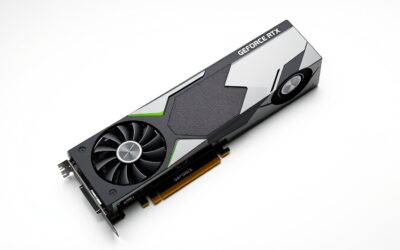
The most recent RTX graphics cards for desktop PCs belong to the RTX 50 series: the 5090, 5080, 5070 Ti, 5070, 5060 Ti, and 5060. That is the lineup NVIDIA built around DLSS 4 and multi frame generation, two features the RTX 40 and older cards cannot run. If you are standing in a store aisle or on a product page trying to work out whether the card in front of you is current, the first thing to check is whether the model name starts with a 50.
Naming is where buyers get tripped up. A laptop “RTX 5070” is a different chip with different memory than a desktop RTX 5070, one model name can hide two memory sizes, and older cards stay on sale for years after their successors arrive. This guide walks through what counts as the newest generation, how to read the labels, and how to avoid buying an older card at the price of a newer one. Because NVIDIA can release refreshed models at any time, treat the list below as the lineup as of this writing in 2026 and check the product’s spec page for anything newer.
As an Amazon Associate we earn from qualifying purchases at no extra cost to you.


The Current Desktop Lineup at a Glance
| Model | VRAM | Board power | Launch MSRP |
|---|---|---|---|
| RTX 5090 | 32GB GDDR7 | 575W | $1,999 |
| RTX 5080 | 16GB | 360W | $999 |
| RTX 5070 Ti | 16GB | 300W | $749 |
| RTX 5070 | 12GB | 250W | $549 |
| RTX 5060 Ti | 16GB or 8GB | 180W | $429 (16GB) / $379 (8GB) |
| RTX 5060 | 8GB | 145W | $299 |
The prices above are launch MSRPs only. Listing prices vary, so check the live page. Also note the 5060 Ti: it exists in two memory sizes under the same name, and the 8GB version is the cheaper one.
Which Newest Card Fits Which Buyer
Newest does not mean best for you. Here is a plain way to map the lineup to a decision.
You game at 1080p and want something compact
The RTX 5060 has 8GB and a 145W rating, so it works in smaller cases and with modest power supplies. The trade-off is memory: 8GB is the point where some recent games start to ask you to turn down textures. For a bit more breathing room, the 5060 Ti 16GB is the one to look at.
You game at 1440p
The 5070 with 12GB and 250W, or the 5070 Ti with 16GB and 300W. The Ti variant gives you extra memory and more speed for a launch price difference of $200.
You game at 4K, or you create and compute
The 5080 and 5090. The 5080 is the sensible high-end gaming option. The 5090 is for those who need 32GB or who want the fastest consumer card available.
How to Tell You Are Looking at the Right Generation
Read the whole model name
A listing that says “RTX 5070” is not necessarily the card you want if it also says “Laptop” or “Mobile”. Laptop chips carry the same numbers but different memory sizes: the 5090 Laptop has 24GB, the 5080 Laptop has 16GB, the 5070 Ti Laptop has 12GB, and the 5070 Laptop and 5060 Laptop have 8GB each. They are not drop-in comparisons to the desktop cards with the same number.
Check the memory size
If a listing for an RTX 5060 Ti does not state the VRAM, assume nothing. Look for 8GB or 16GB in the title or in the specification table. The two cards perform differently in memory-heavy games, and the 16GB version carries a higher launch MSRP.
Watch out for older cards sold as “new”
The RTX 40 series is still around: the 4090, 4080 Super, 4070 Ti Super, 4070 Super, 4060 Ti, and 4060 are all valid purchases, but they do not support multi frame generation. DLSS upscaling and standard frame generation both work on RTX 40, so for many players the difference is smaller than the marketing suggests. It matters mostly if you want to use the highest frame generation modes.
What Is Actually New in the Latest Generation
Three things set the RTX 50 series apart from the generation before. The first is DLSS 4 with multi frame generation, which generates extra frames in supported games. The second is GDDR7 memory, which the 5090 uses and which brings more bandwidth. The third is the 12V-2×6 power connector, which matters when you check your power supply.
What did not change is the need for realistic expectations. Frame generation raises the number you see on the counter, but it does not lower input latency the way a higher native frame rate does. Reviewers at Hardware Unboxed and Gamers Nexus have raised this point repeatedly, and it is worth remembering when a spec sheet advertises a huge frame-rate multiplier.
Is Last Generation Still a Smart Buy?
Often, yes. The RTX 4070 Super has 12GB, a 220W rating, and a $599 launch MSRP. The RTX 4070 Ti Super has 16GB, 285W, and $799. If a previous-generation card is on sale at a meaningful discount against a current-generation equivalent, it can be the better value, as long as you do not need multi frame generation. The reverse also holds: a new RTX 50 card at a price close to its launch MSRP generally beats an older one at the same cost.
What to Check Before You Order
- Power supply wattage and connectors, using the manufacturer’s recommendation on the spec page.
- Card length and thickness against your case clearance.
- PCIe generation: an older PCIe 3.0 board will generally run the card, and resizable BAR support is worth checking in your BIOS.
- CPU pairing: a Ryzen 5 5600X or 10th-gen Intel chip can limit the high-end cards at 1080p and 1440p.
- Return window, because a mistake on model name or memory size is easier to fix early.
Frequently Asked Questions
What is the newest RTX graphics card in 2026?
For desktop PCs it is the RTX 50 series, topped by the 5090. Check NVIDIA’s lineup page for any refreshed models released after this was written.
Do RTX 50 cards work with older PCs?
Yes, generally, as long as the power supply and case fit. A PCIe 3.0 board will run them, possibly with a small performance loss on faster cards.
Is the RTX 5060 Ti 8GB the same as the 16GB version?
The GPU name is the same, but the memory differs, and so does the launch MSRP: $379 for the 8GB model and $429 for the 16GB model.
Can I use DLSS 4 on an RTX 40 card?
RTX 40 cards run DLSS upscaling and standard frame generation, but multi frame generation and the DLSS 4 branding are tied to the RTX 50 series.
Ready to decide? Our #1 pick for 2026 is the RTX 5090.
Live price & availability on Amazon.

Write Your Review
No reviews yet. Be the first to share your experience!