
- Top Pick: Wooden Spoons for Cooking – 10 Pcs Non Toxic Teak Kitchen Utensils Set | Includes spatula, turner, ladle, skimmer, pasta server & salad fork; heat resistant, nonstick safe, easy to clean
- Best Value: Hefild Wooden Spoons for Cooking, 10-Piece Acacia Wood Cooking Utensil Set | Spoons and spatulas stir, mix, flip and serve; balanced handles offer control while staying gentle on nonstick cookware.
- Premium Choice: Wooden Spoons for Cooking, 12 Pcs Teak Utensil Set with Holder & Hooks | Includes Spoon Rest for Storage – Heat Resistant, Durable & Nonstick Safe Kitchen Cookware
For most kitchens, a teak or beechwood utensil set with a spoon, spatula and slotted turner covers daily cooking, olive wood suits buyers who want the hardest and most decorative option, and the real decision is the wood species, the finish and how you will wash the set. Wooden utensils are gentle on nonstick and enameled cookware, stay cooler in the hand than metal and do not melt, which is why a set earns a spot beside a gaming-desk snack station or a full kitchen alike.
As an Amazon Associate we earn from qualifying purchases at no extra cost to you.
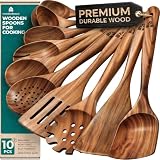


Quick picks by cook
- Everyday all-rounder: a teak set such as the Woodenhouse 10 or 12-piece, the Zulay 6-piece or the Lilly Teak 10-piece, all of which appear in 2026 roundups.
- Nonstick and enameled pans: beechwood sets such as the OXO Good Grips 3-piece or the HANSGO European Beech 3-piece.
- Hardness and looks: olive wood sets such as the Salt & York 5-piece or the Tramanto 5-piece handmade set.
- Starter budget set: a small beech or teak set with only a spoon, spatula and turner.
- Serving as well as cooking: olive wood salad servers, such as the Italian olivewood pieces sold by Quince.
At a glance
| Set | Wood | Best for | Notes from roundups |
|---|---|---|---|
| Woodenhouse 10 or 12-piece | Teak | Complete kitchen starter | Dupe picks the 12-piece for non-toxic kitchen essentials |
| Zulay 6-piece | Teak | Balance of quality and value | Thirsty Bear’s editor’s choice |
| Mooues 9-piece with holder | Teak | Counter-ready set with a holder | Appears in several roundups |
| Lilly Teak 10-piece | Teak | Larger teak collections | Maker-published guide |
| Boxiki 6-piece | Teak | Compact set | Appears in several roundups |
| OXO Good Grips 3-piece | Beech | Nonstick cookware | Solid beechwood construction |
| HANSGO European Beech 3-piece | Beech | Value pick | Woodworking Advisor names it best value |
| Salt & York 5-piece | Olive wood | Hard, durable feel | Woodworking Advisor lists olive at 2,710 lbf Janka hardness |
| Tramanto 5-piece | Olive wood | Handmade look | Each piece varies in grain |
Choosing the wood
Teak
Teak is the most frequently named wood in 2026 roundups because it resists moisture and does not absorb odors easily. It is a natural oil-rich wood, so it holds up to wet kitchens. One source, Woodworking Advisor, disagrees and marks teak “not recommended despite common praise”, citing large pores and silica content that it says can dull or wear. This is a good reminder that expert opinion is not unanimous.
Beech
Beech is a tight-grained, affordable hardwood that Woodworking Advisor calls the clearest underrated pick. It is smooth and less likely to scratch cookware, and it is the material behind familiar sets from OXO, Made In and Our Place. It may take on color from sauces over time, which is cosmetic.
Olive wood
Olive wood is dense and hard, with dramatic swirling grain. The hardness figure of 2,710 lbf cited by Woodworking Advisor is high among the woods it ranks. Pieces are often handmade, so each one looks unique and sizes and shapes can differ from the photo.
Other woods
Maple and cherry are traditional choices, and bamboo is technically a grass. Bamboo tools are often light and inexpensive, though some roundups note they can split if poorly made. Read maker descriptions for finish and glue details.
Finish, safety and care
Look for sets finished with food-safe oil, such as mineral oil or beeswax, and read what the maker states about coatings and glues. Some sets are lacquered or varnished for appearance. A maker that says “non-toxic” or “food-safe” should specify the finish, and you can contact the maker if it does not.
Care instructions are nearly universal: wash by hand with mild soap, rinse, dry upright and never leave a set to soak. A dishwasher can dry out wood and cause cracking and rough splinters. Condition the wood with food-grade mineral oil now and then, and let it absorb. Retire any utensil that cracks deeply, develops splinters or holds an odor after washing, because bacteria can hide in cracks. Wooden tools should not be left in direct contact with a hot burner or placed in an oven.
What to look for in a set
- Piece mix: a spoon, a flat spatula, a slotted turner, a spurtle or flat-edge spoon and a ladle cover most cooking. More pieces are only useful if you will use them.
- Length: longer handles keep your hand away from steam and splatter; shorter ones are easier for small pans.
- Edges: thin, beveled edges scrape pans and flip food; thick tools stir stews.
- Comfort: rounded handles are easier on the hand during long stirring.
- Holder: a holder such as the one with the Mooues set helps on a crowded counter.
- Consistency: wooden pieces vary. Expect slight differences in color and grain.
Decision table: pick X if
| Pick | If you |
|---|---|
| Teak set (Woodenhouse, Zulay, Lilly Teak) | want a full kitchen set and like teak’s water resistance |
| Beech set (OXO, HANSGO) | cook mostly on nonstick or enamel and want a smooth, affordable tool |
| Olive wood set (Salt & York, Tramanto) | want the hardest wood and a decorative grain |
| Small 3-piece set | only need basics and have limited drawer space |
| Set with holder | keep tools on the counter |
Budget tiers
Budget: beech and bamboo sets with three to six pieces. Mid-range: larger teak sets from the names above, often including a holder. Premium: handmade olive wood sets and single hand-carved pieces, which can look like art pieces as much as tools.
Alternatives
- Silicone utensils: heat-tolerant, dishwasher-safe, and the maker states a heat rating that you should respect.
- Stainless steel: durable and sanitary, but it can scratch nonstick.
- Nylon: inexpensive and common, with a lower heat limit than other materials.
Common mistakes
- Putting wood in the dishwasher.
- Leaving tools resting on a hot pan edge.
- Skipping oiling, then wondering why the wood looks dry.
- Buying on piece count rather than usefulness.
- Assuming “non-toxic” means the same everywhere; read the finish details.
Most roundups here are affiliate-style pages rather than lab tests, so use them to find candidate names and then read the maker’s own description.
Frequently Asked Questions
What is the best wood for cooking utensils?
Beech, teak and olive wood are the names that come up. Teak is the most popular, beech is affordable and gentle on pans, and olive wood is the hardest. Opinions differ, with Woodworking Advisor cautioning about teak.
Are wooden utensils safe?
They are widely used and generally considered safe when made from food-safe wood with a food-safe finish. Replace any that crack deeply or develop splinters, and read the maker’s statement about finishes.
Can I put wooden utensils in the dishwasher?
Makers generally advise against it. Heat and long soaks can dry out and crack wood, so hand-wash and dry them.
How often should I oil them?
When the wood looks dry or pale. Many care guides suggest every few weeks to every few months, using food-grade mineral oil or a wood conditioner.
Will wooden spoons scratch nonstick pans?
They are among the gentler options. Smooth, well-finished edges are the key, and a rough or splintered edge can still scuff a surface.
How many pieces do I need?
For many cooks, a spoon, a spatula and a slotted turner are enough. Larger sets add servers and a holder, which are useful if you cook often.



Write Your Review
No reviews yet. Be the first to share your experience!