
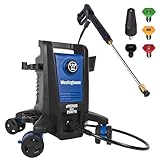
- Top Pick: Westinghouse ePX3500 Electric Pressure Washer, 2500 Max PSI 1.76 Max GPM with Anti-Tipping Technology, Onboard Soap Tank, Pro-Style Steel Wand, 5-Nozzle Set, for Cars/Fences/Driveways/Home/Patios
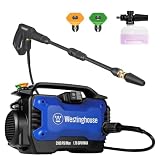
- Best Value: Westinghouse ePX3100s Electric Pressure Washer, 2100 Max PSI 1.76 Max GPM with Foam Cannon and Turbo Nozzle, for Cars/Fences/Driveways/Home/Patios
- Premium Choice: Greenworks 2100 PSI (1.2 GPM) Electric Pressure Washer
For most homeowners, a medium duty electric pressure washer rated at roughly 1,700 to 2,300 PSI with about 1.2 to 1.8 gallons per minute handles cars, patio furniture, siding, fences, decks and driveways, and the best choice depends on whether you value flow rate, portability or a brushless motor. Anything lighter struggles on grime, and anything heavier usually moves into gas-powered territory that needs more storage and upkeep.
As an Amazon Associate we earn from qualifying purchases at no extra cost to you.


At a Glance: Medium Duty Electric Models
| Model family | Best for | Stated specs (approximate, per maker) | Limits |
|---|---|---|---|
| Sun Joe SPX3000 | All-round home use | Maker lists about 2,030 PSI and 1.76 GPM from a corded electric motor | Corded, hose length limited by outlet |
| Greenworks 2000 to 2300 PSI electric | Quiet home cleaning, decks and cars | Maker lists PSI between about 2,000 and 2,300 with GPM near 1.2 to 1.4 depending on model | Specs vary across the Greenworks range |
| Ryobi 2,300 PSI electric | Existing Ryobi owners, mid-range value | Maker lists about 2,300 PSI and roughly 1.2 GPM | Lower flow than higher-GPM rivals |
| Karcher K1700 or K2 class | Compact storage, light-to-medium cleaning | Maker lists PSI at about 1,700 to 1,900 for this class with GPM near 1.2 to 1.3 | Lower pressure, smaller jobs |
| Kranzle or Nilfisk electric | Frequent use, quality motors and pumps | Premium class, makers list robust pumps and hose systems | Premium tier, heavier |
Specs change with model year and regional versions, so confirm the PSI, GPM and amp figures on the maker’s page for the exact variant before buying.
PSI vs GPM: Which Number Matters?
PSI measures pressure, the force behind the spray. GPM measures water volume, the speed at which grime gets rinsed away. Many reviewers point out that cleaning power is a mix of the two, and manufacturers often multiply them to show “cleaning units.” A unit with 2,000 PSI and 1.8 GPM can clean faster on flat surfaces than one with 2,300 PSI and 1.2 GPM, even though the second number looks higher.
Corded Electric vs Cordless vs Gas
| Type | Strengths | Trade-offs |
|---|---|---|
| Corded electric | Light, quiet, no fuel, low maintenance | Needs an outlet and extension-cord care |
| Battery cordless | Portable, no cord | Limited runtime, generally lower pressure |
| Gas | Highest pressure and flow | Loud, heavy, needs fuel and winterizing |
Features That Separate Good From Average
Motor type
Universal motors are common at the entry end, while induction and brushless designs are usually promoted for quieter, longer-lasting operation. Makers who offer these motors list them as a feature, so look for the claim in the spec sheet.
Hose and cord length
A longer high-pressure hose lets you reach corners without moving the unit. Look for a hose of at least 20 feet and a power cord long enough to avoid extension cords, since the maker’s manual often warns about extension cord gauge.
Nozzles and soap delivery
Quick-connect nozzles in several spray angles are standard. Models with a detergent tank or siphon hose make washing vehicles and siding easier, but only use detergents approved by the maker.
Storage and mobility
Wheels, a handle, and on-board nozzle storage keep the setup tidy. Compact designs such as the Karcher K-series favor garage shelf storage over raw power.
Safety and Surface Notes
- Plug into a GFCI-protected outlet and follow the manual’s guidance on extension cords. If you are unsure about your outlet, ask a qualified electrician.
- Never aim the spray at people, pets, or electrical fixtures.
- Test on an inconspicuous spot first. Higher pressure can etch wood, strip paint or damage soft siding.
- Use a wider fan tip, such as a 25 or 40 degree nozzle, on wood, vehicles and windows.
- Do not run the pump dry, and follow the maker’s winterizing guidance to avoid freeze damage.
Pick X If… Decision Table
| Pick this | If you |
|---|---|
| Sun Joe SPX3000 class | Want strong flow and pressure in a widely sold corded design |
| Greenworks 2000 to 2300 PSI | Want a quieter feel and a broad line to choose from |
| Ryobi 2,300 PSI | Already use Ryobi tools or want mid-range value |
| Karcher K1700 or K2 class | Need compact storage and clean mainly cars, bikes and patio furniture |
| Premium Kranzle or Nilfisk | Clean often and want a long-term machine |
Budget Tiers
Budget: Lower-PSI compact units suitable for cars, grills, furniture and light patio work. Mid-range: The 2,000 PSI class with higher flow and better accessories, which suits most homeowners. Premium: Induction or brushless motors, stronger pumps and professional-style hoses, built for frequent use.
Common Mistakes
- Buying on PSI alone and ignoring GPM.
- Using the zero-degree nozzle on wood, car paint or siding.
- Skipping the maker’s guidance on extension cords and GFCI protection.
- Leaving water in the pump over winter.
- Expecting an electric washer to match a gas unit on thick, old concrete stains.
Alternatives to Consider
If you only clean cars and small items, a light-duty compact electric unit is enough and easier to store. If you maintain large decks, long driveways or commercial surfaces, a gas pressure washer or a heavier professional electric model brings more flow. Surface-cleaner attachments, which are offered as add-ons by several makers, can also speed up flat concrete work at any tier.
Frequently Asked Questions
What PSI counts as medium duty?
Medium duty electric washers commonly fall around 1,700 to 2,300 PSI. Light duty sits below that range, and heavy duty is usually gas-powered or professional electric.
Is 2,000 PSI enough for a driveway?
It can clean ordinary dirt and mildew from a driveway, though it will take longer than a higher-flow machine. A surface-cleaner attachment can help, and stubborn oil stains may need a detergent made for concrete.
Can I use an extension cord?
Many makers allow a heavy-gauge outdoor extension cord of limited length, while some advise against it. Follow your model’s manual and use a GFCI-protected outlet.
Will an electric pressure washer damage my car?
It can if the pressure is too tight or the nozzle too close. Use a wide-angle nozzle, keep a safe distance, and avoid directing spray at seals and trim.
Do I need to winterize it?
If you store it where temperatures drop below freezing, the manual usually asks you to drain the pump and hoses. Trapped water can crack the pump.
How long does an electric pressure washer last?
Lifespan depends on the motor, pump and care. Reviewers generally find that induction or brushless motors and brass or metal pump heads suit frequent use better than entry-level universal motors.



Write Your Review
No reviews yet. Be the first to share your experience!