
- Top Pick: MEKOH 20” Heavy-Duty Pressure Washer Surface Cleaner with Wheels, 4500PSI | Dual-Handle Power Washer Attachment for Large Driveway Sidewalk Deck Patio Concrete Streak-free Cleaning, 3/8'' Quick-Connect
- Best Value: Westinghouse PWSC12 12" Pressure Washer Surface Cleaner Attachment – 3000 Max PSI, 1/4” Connector
- Premium Choice: Westinghouse Universal 16.5” Pressure Washer Surface Cleaner Attachment – Stainless Steel – 4400 Max PSI, 1/4” Connector – for Gas and Electric Pressure Washers
A surface cleaner attachment suits anyone washing large flat areas such as driveways, patios and decks, and the right size is decided by your washer’s flow rate and pressure rating rather than by the biggest disc you can buy. Gamers who keep a pressure washer in the garage for the driveway, the patio where the LAN party barbecue happens, or the car pad outside will find the same buying logic applies: match the attachment to the machine, then to the surface.
- What a surface cleaner actually does
- Compatibility checklist before you shop
- At a glance: attachment classes
- Budget tier: bundled and compact cleaners
- Mid-range tier: universal cleaners such as Simpson
- Premium tier: heavy-duty stainless models
- Pick X if you
- Common mistakes
- Alternatives worth considering
- Safety notes
- Bottom line on choosing
- Frequently Asked Questions
As an Amazon Associate we earn from qualifying purchases at no extra cost to you.

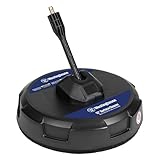


What a surface cleaner actually does
A surface cleaner is a round, shrouded housing with a spinning bar or arm inside. The arm carries two or more nozzles that rotate close to the ground, and the housing keeps water and debris from spraying everywhere. Compared with a bare wand, the rotating nozzles overlap their passes, which is why makers and reviewers point to even results without the “zebra stripes” that wand work tends to leave on concrete.
It is a tool for flat, hard surfaces. It is not meant for vertical walls, vehicles, delicate wood or soft stone, and manufacturers generally warn against using high pressure on anything that can be gouged.
Compatibility checklist before you shop
- Pressure and flow ratings. Each attachment lists a maximum pressure (PSI) and flow (GPM). Your washer’s own ratings must fall within these limits. Electric consumer machines sit at the low end; gas machines reach much higher.
- Connection type. Common inlets are quick-connect plugs or threaded fittings. Many attachments ship with adapters, but confirm that the fitting matches your wand or gun.
- Disc diameter. A wider housing covers more ground per pass but needs more flow to clean well. A small electric washer paired with a very large cleaner will often clean slowly and leave patches.
- Housing material. Plastic shrouds are lighter and gentler on the ground; stainless steel shrouds are sturdier and common on heavier-duty models.
- Wheels or rollers. Some include them to keep the height consistent and reduce the effort of pushing.
At a glance: attachment classes
| Class | Typical diameter range | Best for | Limits |
|---|---|---|---|
| Compact electric-washer cleaners (Greenworks, Sun Joe and similar bundles) | Roughly 11 to 14 inches, as listed by each maker | Patios, small driveways, steps | Lower pressure ratings, so check the maker’s maximum before pairing with a stronger machine |
| Simpson Universal 15 inch (model 80165) | 15 inches, listed by the maker | Mid-sized driveways with a gas or strong electric washer | The maker’s page does not list pressure and flow on its category view; read the product manual |
| Simpson Universal 20 inch Industrial (model 80182) | 20 inches, listed by the maker | Large slabs, long driveways, frequent use | Needs a machine with enough flow; heavier to handle |
| Premium stainless-shroud cleaners (for example Mi-T-M, Karcher and similar) | Commonly 15 to 20 inches | Heavy use and long service life | Higher cost class; often overkill for light-duty washers |
Budget tier: bundled and compact cleaners
Many electric washers from Greenworks, Sun Joe, Ryobi and similar brands either include a small surface cleaner or have a matching accessory. The attraction is that the fittings already match. The trade-off is that these shrouds are mostly plastic and sized for low flow, so they are best for a patio or a small driveway used a few times a year.
If you buy one, keep expectations modest. Reviewers who cover electric washers consistently note that the washer’s pressure, not the attachment, sets the ceiling on how quickly oil stains or mildew come off.
Mid-range tier: universal cleaners such as Simpson
Simpson lists a Universal 15 inch cleaner and a Universal 20 inch industrial model on its site. This tier is for owners of gas washers or stronger electric units who want a standard attachment that works across brands through a universal inlet. The 15 inch size is a sensible all-round choice for a typical residential driveway; the 20 inch is for owners who clean big areas more often and own a washer that can feed it.
Because the maker’s category page lists size but not the ratings, read the product sheet before buying so the attachment’s limits match the washer.
Premium tier: heavy-duty stainless models
Premium cleaners use stainless steel housings, bearings built for continuous rotation and replaceable nozzles. Professional users and serious home owners tend to choose them for durability. For a household that washes a driveway twice a year, the extra durability is rarely used up.
Pick X if you
| Your situation | Pick | Why |
|---|---|---|
| Small patio, electric washer | Compact bundled cleaner | Matching fittings and sensible size for low flow |
| Average driveway, gas washer | 15 inch universal cleaner | Balance of coverage and manageable flow demand |
| Large concrete areas, strong washer | 20 inch cleaner | Fewer passes per area, if flow supports it |
| Frequent or paid work | Stainless premium cleaner | Durability and replaceable parts |
| Mixed surfaces including decking | Wand with a wide fan tip instead | A rotating cleaner can mark soft wood |
Common mistakes
- Ignoring flow. An oversized disc on a small machine cleans slowly and unevenly.
- Using it on soft surfaces. Wood decks, painted concrete and some pavers can be etched. Test a hidden spot with a lower-pressure setup first.
- Skipping the hose. A long, kink-free high-pressure hose matters because the cleaner is pushed back and forth.
- Not holding the housing flat. Tilting lets water escape and leaves streaks.
- Forgetting maintenance. Rinse the housing, check the nozzles and look at the spinner for wear after use.
Alternatives worth considering
- Flat surface cleaner with a vacuum recovery system. Used where wastewater must be captured; more specialised and more costly.
- Turbo or rotary nozzle on a standard wand. Cheaper and flexible, but needs more technique to avoid stripes.
- Hiring a service for a one-off job. Reasonable if you only clean once every few years.
Safety notes
High-pressure water can injure skin and eyes. Wear eye protection and closed footwear, never point the wand at people or pets, and follow your washer’s manual on trigger locks and extension cords. Electric washers should only be used with outdoor-rated cords and a GFCI outlet as the manufacturer directs; contact a qualified electrician if you are unsure of your outdoor wiring.
Bottom line on choosing
Decide the surface and area first, read the washer’s pressure and flow, then pick the diameter that sits comfortably inside those limits. For most households that means a 12 to 15 inch cleaner; larger discs only pay off with matching hardware. The maker’s own manual is the final word on compatibility.
Frequently Asked Questions
What size surface cleaner should I buy?
Match it to your washer’s flow rate first. Many homeowners with electric or modest gas washers are served by a roughly 12 to 15 inch model, while 20 inch units suit stronger machines. When a maker lists a minimum flow for the attachment, treat that as a requirement rather than a suggestion.
Will a surface cleaner work with an electric pressure washer?
Yes, if the attachment’s rated limits cover the washer’s pressure and flow and the connectors fit. Compact cleaners sold alongside electric washers are designed with that in mind. Expect slower progress on stubborn stains than with a gas machine.
Can I use one on a wooden deck?
Usually it is not advised. A spinning high-pressure bar can raise the grain or leave marks on softwood. Check the deck maker’s care guidance and consider a wide-angle wand tip or a dedicated deck cleaner instead.
Do surface cleaners need detergent?
Not always, though some models accept a downstream detergent injector for mildew or algae. Use only cleaners that the washer and attachment maker allow, and keep runoff away from storm drains and plants as local rules direct.
Why does my cleaner leave stripes?
Common causes are uneven overlap between passes, a tilted housing, or too little flow to spin the arm properly. Slow, straight, overlapping passes with the shroud flat on the surface usually help.
How long does a surface cleaner last?
That depends on materials and use. Plastic housings are lighter-duty, while stainless models are built for heavier use. Replacing worn nozzles and keeping the spinner clean extends life regardless of tier.


Write Your Review
No reviews yet. Be the first to share your experience!