
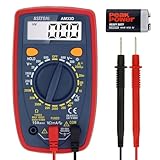
- Top Pick: AstroAI Digital Multimeter Tester 2000 Counts with DC AC Voltmeter and Ohm Volt Amp Meter; Measures Voltage, Current, Resistance, Continuity and Diode, Blue
- Best Value: Klein Tools MM325 Digital Manual-Ranging Multimeter | 600V AC/DC Voltage Tester, Tests Batteries, Current, Resistance, Diodes, and Continuity
- Premium Choice: AstroAI Digital Multimeter, True RMS 6000 Counts Auto-Ranging Volt Meter for Automotive & Home Electrical Troubleshooting, AC/DC Voltage Current Resistance Continuity Capacitance Temperature Tester
The Fluke 117 is the pick for electricians who want a trusted name, the Klein Tools MM700 is the pick for professionals who want strong ratings and a low-impedance mode for less money, and AstroAI-class True RMS meters suit hobbyists and PC builders who only check batteries, fuses and low-voltage circuits. If you will ever test household wiring, buy a meter with a proper CAT rating and follow the maker’s safety guidance, or hire a licensed electrician.
As an Amazon Associate we earn from qualifying purchases at no extra cost to you.


Why Gamers and PC Builders Buy a Multimeter
For a PC builder, a multimeter helps with checking continuity on a cable, confirming a fuse, measuring a CMOS battery or checking whether a wall outlet or adapter is delivering power. It is not a tool for opening a power supply; the inside of a PSU can hold charge even when unplugged and should be left to a technician.
At a Glance
| Model | Best for | Key stated specs | Limits |
|---|---|---|---|
| Fluke 117 | Electricians, facility work | The maker lists True-rms, CAT III 600 V, non-contact voltage detection, AutoVolt, selectable low-impedance mode, 9 V battery with about 400 hours typical runtime | Premium tier; 600 V rating, not 1,000 V |
| Klein Tools MM700 | Professional value pick | Reviewers list True RMS, LoZ, 1,000 V AC/DC; rated CAT IV 600 V and CAT III 1,000 V | Comparisons with Fluke are on paper specs, not long-term durability |
| Klein Tools MM720 | Value-minded professionals | Cited as a value alternative in roundups | Confirm which functions you need |
| Klein Tools MM400 | DIYers | Recommended for home use by reviewers | Fewer professional features |
| Fluke 179 | Professional upgrade | Named as the step-up by reviewers | Premium tier |
| AstroAI True RMS | Beginners, hobbyists | Reviewers call it the cheapest True RMS meter they trust | No low-impedance mode, so it can show phantom voltage; not built for daily trade use |
Features That Matter
CAT Rating
The CAT rating describes how the meter handles transient surges in different parts of an electrical system. CAT III covers distribution wiring such as panels and branch circuits, while CAT IV covers the service entrance. The higher the category and voltage, the safer the meter is around mains. For work on wall outlets, a CAT III rating from a reputable maker is the minimum that safety guidance usually points to.
True RMS
True RMS measures AC waveforms accurately even when they are not clean sine waves, which is common with electronics, dimmers and switching power supplies. A basic average-responding meter can misread these. If you are measuring anything beyond a plain outlet, True RMS is worth having.
Low Impedance Mode
Ghost or phantom voltage can show up on a dead wire that runs next to a live one. A low-impedance (LoZ) mode loads the circuit slightly so false readings drop away. Fluke lists a selectable low-impedance mode on the 117; reviewers note the AstroAI lacks it.
Auto-Ranging and Non-Contact Detection
Auto-ranging picks the measurement range for you, which suits beginners. Non-contact voltage detection, built into the Fluke 117 as VoltAlert, offers a quick preliminary check, but it should never replace a proper measurement and a lock-out procedure.
Leads and Build
Good leads are flexible, shrouded and fit snugly. Reviewers who rank budget meters often point to the leads and housing as the weak point under daily use.
Battery and Backlight
A backlight helps in dark panels and under desks. The Fluke 117 lists a 9 V alkaline battery and roughly 400 hours of typical runtime without the backlight. Keep a spare battery with the meter, because a weak battery causes odd readings.
Pick X If You Want Y
| If you are | Pick | Reason |
|---|---|---|
| A working electrician or technician | Fluke 117 or Klein MM700 | Proper CAT rating and LoZ |
| A homeowner checking outlets and batteries | Klein MM400 or similar | Simple, reasonable ratings |
| A PC builder on a budget | AstroAI True RMS | Handy for low-voltage checks |
| Someone who wants a step up | Fluke 179 | Added features per reviewers |
Budget Tiers
The budget tier holds AstroAI and similar meters that cover the basics. The mid-range holds the Klein Tools line. The premium tier is the Fluke range. Reviewers broadly see the mid-range as the sweet spot for professionals and serious DIYers.
Alternatives
- Clamp meter: Better for measuring current without breaking a circuit; many electricians carry one alongside a multimeter.
- Non-contact voltage tester: A quick screening tool, not a replacement.
- PSU tester: A small device that checks the output rails of a power supply without opening it, useful for PC builds.
Common Mistakes
- Buying a meter without a CAT rating and using it on mains.
- Trusting a non-contact tester alone before touching a wire.
- Leaving the leads in the current jack when measuring voltage.
- Opening a power supply to measure inside it.
- Skipping a battery check when readings look odd.
Safe Habits When Using Any Multimeter
A good meter only protects you if you use it correctly. Inspect the leads for cracks before each use and replace damaged ones. Start with the meter set to the highest range if it is not auto-ranging, and keep fingers behind the probe guards. Never measure resistance or continuity on a live circuit, and move the red lead back to the voltage jack after any current measurement. When checking whether a circuit is dead, test a known live source first, test the circuit, then test the known source again to confirm the meter is working. For PC work, unplug the system, wait for it to power down and stay with low-voltage DC measurements such as a CMOS battery or a fan header. Anything involving the inside of a power supply, a damaged outlet or fixed wiring belongs with a licensed electrician or the device maker’s service team.
Frequently Asked Questions
Do I need True RMS?
For simple DC checks, no. For AC circuits with electronics or dimmers, True RMS gives more reliable readings.
What CAT rating do I need for wall outlets?
Safety guidance usually points to CAT III or higher. Follow the maker’s manual and local rules, or hire a licensed electrician for mains work.
Is the AstroAI good enough for PC work?
Reviewers describe it as a reasonable budget meter for low-voltage hobby work. They note it lacks a low-impedance mode and is not built for daily professional use.
Can I test a PC power supply with a multimeter?
You can check outputs on the connector with a proper procedure or a PSU tester, but never open the power supply. Contact the maker or a technician for faults.
Why does my meter show voltage on a dead wire?
This is ghost voltage from nearby live wiring. A low-impedance mode removes it; confirm with a rated meter before touching anything.



Write Your Review
No reviews yet. Be the first to share your experience!