
The GeForce GTX 980 and GTX 970 suit buyers who want a cheap used card for older games, a spare-parts build or a retro system, while anyone planning a main gaming PC for the next several years is better served by a current RTX 50-series or Radeon RX 9000 card. Both are Maxwell-era cards from September 2014, they are no longer part of NVIDIA’s current lineup, and their regular driver support has ended. That does not make them useless, but it changes who should still consider them.
As an Amazon Associate we earn from qualifying purchases at no extra cost to you.
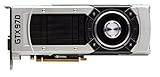

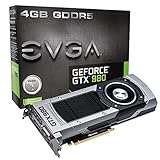

GTX 980 and GTX 970 at a glance
| Item | GeForce GTX 980 | GeForce GTX 970 |
|---|---|---|
| Architecture | Maxwell (GM204) | Maxwell (GM204, cut down) |
| CUDA cores | 2,048 | 1,664 |
| Memory | 4 GB GDDR5 | 4 GB GDDR5, split into a 3.5 GB pool and a 0.5 GB pool |
| Memory bus | 256-bit | Fast segment on 224-bit, slow segment on 32-bit |
| Reference board power | 165 W | 145 W |
| Power connectors | Two 6-pin on the reference design | Varies by partner card, so follow the board maker’s manual |
| Typical outputs (reference) | One DVI, one HDMI 2.0, three DisplayPort 1.2 | Varies by partner card |
| Ray tracing and DLSS | No | No |
| Current status | Legacy, used market only | Legacy, used market only |
The core counts, the 3.5 GB plus 0.5 GB memory layout and the board power figures above match the summaries in the GeForce 900 series references and in NVIDIA’s own explanation of the GTX 970 memory design as reported by PC Perspective. The 980 reference connector and output details come from launch coverage such as Gaming Nexus and Digital Trends.
What the GTX 980 offers
The GTX 980 uses the full GM204 chip with 2,048 CUDA cores and 4 GB of GDDR5 on a 256-bit bus. Reviewers at launch listed the memory at 7 Gbps effective, which works out to 224 GB/s of bandwidth, and a board power of 165 W fed by two 6-pin connectors. It was one of the first cards with HDMI 2.0, which allows 4K at 60 Hz on a compatible TV or monitor, and it supports Direct3D 12 at feature level 12_1.
At release, reviewers positioned it as a strong 1080p card and a capable 1440p card in the games of that period. In 2026 the picture is different. Newer titles are built around 8 GB or more of video memory at high settings, and the 980 only has 4 GB. It also lacks the dedicated ray-tracing and AI hardware that later NVIDIA generations added, so DLSS upscaling and hardware ray tracing are not available.
What the GTX 970 offers, and the 3.5 GB note
The GTX 970 uses a reduced GM204 with 1,664 CUDA cores and a lower board power than the 980. It was priced to undercut the 980 and sold in large numbers, which is why its memory layout became a well-known story.
In January 2015 NVIDIA acknowledged that the card’s 4 GB is not a single uniform pool. PC Perspective reported NVIDIA’s explanation: 3.5 GB is mapped to seven of the memory chips and the final 0.5 GB is mapped to the eighth chip, and the two segments cannot be read at the same time. The slower 0.5 GB segment runs at roughly one seventh of the speed of the main pool according to the same coverage, although it is still faster than reaching out to system memory over PCI Express. The original published specifications for the card, including the number of ROPs and the amount of cache, were also corrected.
NVIDIA’s own testing, as reported at the time, found a performance hit of at most a few percent in cases where a game used more than 3.5 GB. Independent commentators disagreed on how much it mattered, and some argued the card would have been worse without the extra 0.5 GB. For a buyer in 2026 the practical lesson is simple: treat the GTX 970 as a 3.5 GB card for planning purposes, and expect it to run out of memory sooner than the 980 as texture sizes grow.
Driver support status
NVIDIA moved the Maxwell, Pascal and Volta generations to legacy status. Tom’s Hardware and VideoCardz report that Game Ready driver support for these GPUs ended with a final release in October 2025, after which the cards receive quarterly security updates through October 2028. Phoronix reports that the 580 driver branch is the last Linux branch supporting these architectures. Wikipedia’s GeForce 900 series page lists Game Ready support as ended in November 2025.
In practice this means a GTX 980 or GTX 970 will keep working with its existing driver, but new game releases will not get optimization profiles, and new features such as later DLSS versions are not coming to this hardware. Buyers who rely on day-one driver fixes for new releases should weigh this carefully. Sources differ slightly on the last driver build number, so read NVIDIA’s legacy driver notes if the exact version matters to you.
Performance class and the limits that matter in 2026
Reviewers describe both cards as 1080p-class hardware at modest settings in modern games, with older and esports titles still comfortable. Neither card should be treated as a 1440p or 4K option for new releases. The main limits are:
- Video memory: 4 GB (3.5 GB fast on the 970) is below what many recent games ask for at medium and high texture settings.
- No upscaling hardware: There are no Tensor cores, so DLSS is unavailable. Resolution scaling options from the game or from vendor-neutral upscalers may help in supported titles.
- No ray tracing hardware: Games that require ray tracing will not run well or at all.
- Older video engine: Newer codecs such as AV1 are not hardware-decoded on this generation, and HDMI 2.1 features are absent.
- Power draw: A 165 W or 145 W reference rating is high for the performance a modern entry card delivers at much lower consumption.
No frame rate numbers are quoted here because results depend heavily on the game, the settings and the CPU, and independent charts for current titles on these cards are limited.
Who should still consider one
| Pick this if | Choice |
|---|---|
| You play older titles or esports games at 1080p and want a budget used card | GTX 980 first, GTX 970 if the savings are clear |
| You are building a retro or Windows 7/8-era machine with period parts | Either card, with the 980 preferred for its full 4 GB |
| You need a spare card to diagnose another PC | Either card |
| You want to play new releases at high settings | A current RTX 50-series or Radeon RX 9000 card instead |
| You want DLSS, ray tracing or AV1 decode | RTX 40-series or newer |
| You have a small or weak power supply | A modern low-power card, since these draw more for less performance |
Buying used: what to look at
Because both cards are only sold second-hand now, condition matters more than the model name. Ask for photos of the full card and the output ports, and look for signs of heavy dust, corroded contacts or a fan that does not spin freely. Cards from this era are often ten or more years old, and the original thermal paste and thermal pads may have aged. A seller who can describe the card’s history and offers a return window is a safer choice than an unexplained listing.
Check the physical size and power connectors against your case and power supply before buying. Partner cards differ in length, cooler thickness and connector layout, and the reference two 6-pin arrangement is not universal across partner models. Follow the power supply maker’s instructions for connecting PCIe power cables, and do not open a power supply to modify it.
Better alternatives
- Current budget cards: The GeForce RTX 5050 and RTX 5060 and the Radeon RX 9060 series sit in the 1080p-to-1440p entry class and bring modern video engines, newer memory and upscaling support. Compare the maker’s specification pages for each model before choosing.
- Previous-generation used cards: A used GTX 1060 6 GB, GTX 1660 or RTX 2060 can offer more usable memory or ray tracing hardware, but note that Pascal-based cards share the same legacy driver status as Maxwell.
- RTX 30-series and 40-series used cards: These keep active driver support and DLSS. Look at the memory amount first, because 8 GB or more is the more sensible floor today.
Frequently Asked Questions
Is the GTX 980 still sold new?
It is not part of NVIDIA’s current lineup, and the card is mainly found on the used market. Any remaining new-old-stock units would be rare. Treat it as legacy hardware and judge it by condition and seller reputation.
Is the GTX 970 really a 3 GB or 3.5 GB card?
It has 4 GB of physical memory, but NVIDIA explained that 3.5 GB sits on the faster path and the last 0.5 GB sits on a much slower one. The card still uses all 4 GB when needed, but heavy workloads that spill into the slow segment can stutter. For planning, think of it as a 3.5 GB card.
Will new drivers still arrive for these cards?
Reports say Game Ready driver releases for Maxwell ended in late 2025, with quarterly security updates continuing through October 2028. Existing drivers will keep the card working, but you should not expect new game-specific optimizations.
Can a GTX 980 run modern games?
It can run many modern games at reduced settings at 1080p, as long as the game does not demand more than 4 GB of video memory or ray tracing hardware. Results vary by title, so check the game’s stated minimum requirements before buying.
Which is better, a GTX 980 or a GTX 970?
The GTX 980 has more cores and a uniform 4 GB memory pool, so it is the stronger and more predictable card. The 970 is acceptable if it is clearly cheaper and you understand its 3.5 GB behavior. A used 980 in good condition is usually the safer pick.
What should I buy instead for a new build?
A current-generation GeForce RTX 50-series or Radeon RX 9000 card is the sensible choice for a new gaming PC, since it comes with active driver support, modern video decoding and upscaling features. Pick the tier that matches your monitor resolution and budget.








Write Your Review
No reviews yet. Be the first to share your experience!