
Our Short List of 3

- Best for: Feeder, bait-site and close-clearing hog hunting on foot.
- Sensor: 320×240, 12 micron, 60 Hz
- Magnification: 3-9x
- Objective lens: 19 mm
- Field of view: 11.6 x 8.7 degrees

- Best for: Mixed pasture and field-edge hunting where groups must be sorted before shooting.
- Sensor: 384×288, 12 micron VOx, NETD less than 20 mK
- Refresh rate: 50 Hz
- Lens: 35 mm, F/1.0 germanium
- Magnification: 3-24x

- Best for: Hunters who want a traditional tube scope with a 50mm lens for open-field hogs.
- Sensor: 384×288, 17 micron
- Objective lens: 50 mm, F/1.0
- Frame rate: 50 Hz
- Magnification: 3-12x
All 4 Picks at a Glance
| Product | Specs | Action |
|---|---|---|
| ATN ThOR LTV 320 3-9x |
| Check price on Amazon |
| AGM Rattler V2 TS35-384 |
| Check price on Amazon |
| Pulsar Thermion 2 XQ50 Pro |
| Check price on Amazon |
 Pulsar Thermion 2 LRF XP50 Pro |
| Check price on Amazon |
Hog hunting at night turns on one decision: how far away you need to positively identify a hog, not just spot a warm shape, before you shoot. A scope that detects heat across a field can still leave you guessing at the distance where sounders actually feed, and guessing leads to missed chances or worse. Sensor resolution, lens size and base magnification decide that identification distance together.
This guide is for feeder and bait-site hunters shooting at modest range, open-field hunters who scan pasture and crop edges, and landowners clearing hogs from working ground. The four riflescopes below were chosen from their Amazon listing names and specifications, covering a light 320-class option, two 384-class workhorses and a 640-class model with a built-in laser rangefinder.
Quick Picks
As an Amazon Associate we earn from qualifying purchases
| Product | Best for | Key spec from title |
|---|---|---|
| ATN ThOR LTV 320 3-9x | Close feeder and bait sites on foot | 320×240, 12 Micron, 60Hz sensor |
| AGM Rattler V2 TS35-384 | Mixed fields with longer scanning | 384×288 sensor, 1800 yards detection range |
| Pulsar Thermion 2 XQ50 Pro | Traditional 30mm-tube rifle setups | 384×288 sensor, 50mm objective lens |
| Pulsar Thermion 2 LRF XP50 Pro | Open ground where distance must be confirmed | 640×480 sensor, built-in laser rangefinder |
How to Choose
Sensor Resolution and Identification Range
Detection range only tells you a warm object exists. Identification, seeing the body shape, head position and whether smaller animals stand beside a sow, needs far more sensor detail at the same distance. A 320×240 sensor handles feeder distances comfortably, while 384×288 adds usable detail further out and 640×480 holds shape longest across open fields. Judge each scope by the range at which you normally shoot hogs, then choose the sensor class that still shows a clear outline there, rather than chasing the largest detection number printed on the box.
Lens Size and Base Magnification
The objective lens gathers the thermal image, and base magnification decides how much of it fills your view before digital zoom begins enlarging pixels. A 19mm lens with 3x base magnification suits tight bait sites where hogs appear close and move between shadows. A 35mm or 50mm lens with similar or higher base magnification puts more detail on animals across a pasture, but narrows the field of view, so scanning takes longer. Match the lens to your widest typical shot: too much magnification on a close, moving sounder makes tracking harder, not easier.
Rangefinding and Shot Placement
Hogs rarely stand at the exact distance you zeroed for, and at night depth is hard to judge through a thermal image alone. A built-in laser rangefinder, like the one on the Thermion 2 LRF model below, removes that guesswork before the shot. Without one, you rely on known feeder distances, fence lines or a separate handheld rangefinder used before dark. Consider how your ground is set up: marked bait sites reduce the need for built-in ranging, while unfamiliar fields and changing sounder positions make it genuinely valuable rather than a luxury.
Battery System and Mounting Fit
A thermal scope that fades before the sounders move is worse than a simpler one that lasts the sit. Compare how each model powers itself: internal rechargeable batteries are tidy but cannot be swapped in the field, while replaceable rechargeable packs let you carry a charged spare. Mounting matters just as much. Traditional tube designs fit standard rings you may already own, while compact proprietary bodies need their included or specific mount. Confirm ring diameter, rail space and eye relief against your rifle before ordering, especially on short carbines.
The 4 Best Options
ATN ThOR LTV 320 3-9x
- Best for: Feeder, bait-site and close-clearing hog hunting on foot.
- Sensor: 320×240, 12 micron, 60 Hz
- Magnification: 3-9x
- Objective lens: 19 mm
- Field of view: 11.6 x 8.7 degrees
Feeder, bait-site and close-clearing hog hunting on foot.
The 320-class sensor gives up identification detail quickly past bait-site range, so confirm your longest real shot suits it.
This is the straightforward pick for hunters whose hogs come to feeders, bait piles or narrow clearings at close to moderate range. Its 320×240 sensor and wide field of view make finding a moving sounder quick, and the light 1.4 lb body suits rifles carried between stands on foot. Video recording and one-shot zero keep setup and documentation simple, without the extra systems that add weight and menu depth. If your shots stay inside the distances a bait site dictates, this scope covers the job without overspecifying the sensor.
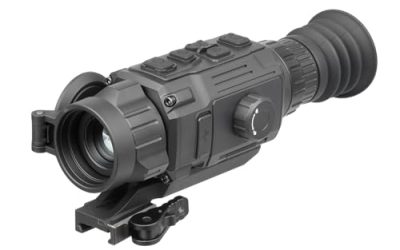
AGM Rattler V2 TS35-384
- Best for: Mixed pasture and field-edge hunting where groups must be sorted before shooting.
- Sensor: 384×288, 12 micron VOx, NETD less than 20 mK
- Refresh rate: 50 Hz
- Lens: 35 mm, F/1.0 germanium
- Magnification: 3-24x
Mixed pasture and field-edge hunting where groups must be sorted before shooting.
The narrower field of view slows scanning at close range, so check it suits your closest bait sites as well as your fields.
The Rattler V2 35-384 steps up to a 384×288 sensor behind a 35mm germanium lens, a combination aimed at hunters who scan field edges and then need enough detail to pick a single animal from a group. Shot-activated recording with sound, picture-in-picture and a stadiametric rangefinder are built in, and the compact body keeps the rifle handy in a blind or on a tripod. Two rechargeable batteries are included in the package, which suits long sits where swapping power beats carrying a power bank and cable.
Pulsar Thermion 2 XQ50 Pro
- Best for: Hunters who want a traditional tube scope with a 50mm lens for open-field hogs.
- Sensor: 384×288, 17 micron
- Objective lens: 50 mm, F/1.0
- Frame rate: 50 Hz
- Magnification: 3-12x
Hunters who want a traditional tube scope with a 50mm lens for open-field hogs.
Confirm your existing rings and rail position give correct eye relief, since this is a full-size tube optic.
The Thermion 2 XQ50 Pro puts a 384×288 sensor in a classic tube form that mounts like a conventional riflescope, which appeals to hunters moving a thermal between rifles already set up with standard rings. The 50mm objective and 3-12x magnification range target field work, while the magnesium alloy body and 50mm eye relief come straight from its listing details. Photo and video recording and multiple reticle options are part of the platform. Choose this one when traditional handling and a larger lens matter more than a built-in rangefinder.
Pulsar Thermion 2 LRF XP50 Pro
- Best for: Open-field and land-clearing work where range must be measured, not guessed.
- Sensor: 640×480, 17 micron, NETD less than 25 mK
- Objective lens: 50 mm, F/1.0
- Frame rate: 50 Hz
- Magnification: 2-16x
Open-field and land-clearing work where range must be measured, not guessed.
At 420 mm long on its data sheet it is a large optic, so confirm rail space and carry weight suit your rifle.
This is the high-detail option for open ground, pairing a 640×480 sensor with a built-in laser rangefinder in the same classic Thermion housing. The rangefinder measures out to 800 metres on its data sheet, so distance stops being an estimate before longer shots across pasture or stubble. An AMOLED display, built-in recording with 16 GB of memory and Stream Vision 2 app support round out the listing specification. It is the scope here for hunters who regularly face sounders at varied, unknown distances and want identification detail held as long as possible.
Which One Fits Your Situation
You Hunt Feeders and Bait at Close Range
Pick the ATN ThOR LTV 320. Its wide field of view finds hogs quickly when they step out close, the light body is easy to carry between stands, and the 320-class sensor is honestly matched to distances a feeder creates. Paying for a larger sensor buys detail you will rarely use at this range, while the simpler controls shorten the time between switching on and being ready.
You Scan Fields and Sort Sounders Before Shooting
Pick the AGM Rattler V2 TS35-384. The 384-class sensor and 35mm lens hold more body detail when a group bunches together, and picture-in-picture helps precise aiming without losing the wider view. The included spare rechargeable battery also fits long evening sits that start with scanning and end well after dark, which is the rhythm most field hog hunting actually follows.
You Want a Thermal That Mounts Like Your Day Scope
Pick the Pulsar Thermion 2 XQ50 Pro. Its classic tube shape works with the standard ring approach used by conventional riflescopes, and the 50mm objective suits rifles that mostly face open ground. This is the natural choice when the rifle, rings and shooting position are already dialled in for a traditional optic and you want the thermal to slot into that same setup.
Your Shots Happen at Unknown Distances
Pick the Pulsar Thermion 2 LRF XP50 Pro. The built-in laser rangefinder answers the one question a thermal image cannot, and the 640-class sensor keeps hogs identifiable while you decide. On unfamiliar leases, large pastures or damage-control work where sounders appear wherever feed remains, that combination removes the two biggest causes of missed night opportunities: misjudged range and unclear targets.
Common Mistakes
- Buying on detection range alone, then discovering the sensor cannot identify a hog clearly at the distance your ground actually demands.
- Choosing high base magnification for close bait sites, which narrows the field of view and makes a moving sounder hard to follow.
- Ignoring the battery system, then facing a flat internal battery with no swappable spare during the busiest part of the night.
- Assuming every thermal mounts like a day scope, without checking tube diameter, proprietary mounts, rail space and eye relief first.
- Skipping local rules: night hunting, thermal optics and hog control methods are regulated differently by state and land type, so verify before hunting.
Frequently Asked Questions
How far can a thermal scope identify a hog?
Far less than its detection range. Detection means a warm shape registers, while identification needs enough sensor pixels on the animal to see body shape and posture. A 320-class scope identifies at close bait-site distances, 384-class models reach further across fields, and 640-class sensors hold detail longest. Judge by your longest realistic shot, not headline figures.
Is a laser rangefinder worth having for hog hunting?
It depends on your ground. At a feeder placed at a known distance, you already know the range and a rangefinder adds little. Across open pasture, stubble or unfamiliar leases, distances deceive at night and a built-in rangefinder confirms them instantly. The Thermion 2 LRF model in this guide exists for that second situation.
Can one thermal scope move between rifles?
Yes, but plan for it. Tube-style scopes using standard rings are the easiest to move, though each rifle still needs its own zero confirmed after remounting. Compact models with proprietary mounts can also move if the mount fits both rails. Keep notes for each rifle and load combination, and always verify zero on paper before hunting again.
Do thermal scopes work in fog, rain or summer heat?
They still form an image, but conditions change contrast. Warm, humid nights reduce the temperature difference between a hog and its background, so detail drops and identification range shortens. Higher-sensitivity sensors cope better in those conditions. In heavy rain or fog, expect a softer picture from any model and shorten your shooting distances accordingly rather than trusting a clear-night estimate.


Write Your Review
No reviews yet. Be the first to share your experience!