
A VR headset is the heaviest display load most GeForce owners will ever buy: even the budget pick below renders about three and a half million pixels per eye, and the Pimax renders more than eight million per eye, twice over, at up to 120Hz. The five picks are judged on published panel data, refresh rate, tracking and how each one connects to a PC, because the connection decides how much of your RTX card’s output actually reaches your eyes.
Every pick is pinned to one exact listing, because VR lineups reuse names across storage tiers and bundle rotations. The Meta Quest 3 512GB is the default pick, the Pimax Crystal Light is the native DisplayPort clarity option, the HTC VIVE Focus Vision is the eye-tracking pick, the VIVE XR Elite is the convertible design, and the Meta Quest 3S 128GB is the budget route.
As an Amazon Associate, we earn from qualifying purchases.
Quick Answer
For most GeForce RTX owners, the Meta Quest 3 512GB is the pick: 2064 x 2208 per eye, pancake lenses and both wired and wireless PC links. The Pimax Crystal Light is the clarity step up for sim rigs, the VIVE Focus Vision adds eye tracking and a DisplayPort mode, the VIVE XR Elite converts for travel, and the Quest 3S 128GB is the budget route.
How to Choose a VR Headset for PC Gaming
Match the pixel load to your GeForce card
Per-eye resolution is the honest spec. The Quest 3S renders about 3.5 million pixels per eye and suits a mid-range RTX card; the Quest 3 and Focus Vision sit in the four-and-a-half to six million range; the Crystal Light’s 2880 x 2880 per eye is 4K-class work per eye and wants a high-end card, ideally with DLSS in supported titles. Buy the panel your GPU can hold at the headset’s native refresh rate, because dropped frames in VR are felt, not just seen.
The connection decides compression and latency
There are two routes to a PC. A native DisplayPort tether, as on the Crystal Light, carries the image uncompressed. Streamed PC VR, wired USB or wireless on the Quest and VIVE picks, compresses the image first, which costs a little sharpness and latency but frees you from a fixed cable path. The Focus Vision straddles both: it streams wirelessly out of the box and adds a DisplayPort mode through HTC’s optional wired streaming kit.
Tracking style decides setup
All five picks track from cameras on the headset, so none needs base stations on the wall. The Crystal Light is the exception that proves the rule: its standard faceplate is inside-out, and an optional Lighthouse faceplate moves it onto SteamVR base stations for buyers who already own that ecosystem. Inside-out tracking is the right default for everyone else.
One recall note, precisely scoped
The category’s one large CPSC recall is old and narrow: in 2021, about four million Oculus Quest 2 removable foam facial interfaces were recalled over skin irritation. No pick in this guide is a Quest 2, and the Quest 3 line uses a different interface design. Check any used older headset against that recall before buying; the five current listings below are outside its scope.
The 5 Best VR Headsets for PC Gaming
1. Meta Quest 3 (512GB)
The Quest 3 is the default pick because it covers both PC routes well: a USB-C Link cable for a wired connection, and Air Link or Steam Link over Wi-Fi for wireless play, on top of a full standalone library. The pancake lenses keep the image sharp edge to edge at 2064 x 2208 per eye, the Snapdragon XR2 Gen 2 is the strongest standalone chip in this group, and 512GB is the only storage tier Meta still sells new. The honest limits are battery life of roughly two hours in play and a stock strap most owners eventually replace.
Specs
– Display: 2064 x 2208 per eye LCD, pancake lenses per Meta
– Refresh rate: 90Hz, up to 120Hz in experimental mode per Meta
– Field of view: 110 degrees horizontal, 96 degrees vertical per Meta
– Chip: Snapdragon XR2 Gen 2 per Meta
– Storage and memory: 512GB, 8GB RAM per Meta
– PC connection: USB-C Link cable, Air Link and Steam Link wireless per Meta
– Weight: 515 g per Meta
– Tier: Mid-range
Choose it for the best all-round PC VR headset that also works away from the PC. Skip it if you want an uncompressed DisplayPort image.
2. Pimax Crystal Light
The Crystal Light is the clarity pick and the only native DisplayPort headset here: 2880 x 2880 per eye on QLED panels with mini-LED local dimming, behind glass aspheric lenses Pimax rates at 35 PPD. That is sim hardware first — it exists so cockpit instruments and distant apexes stay readable — and it is PC-only, with no standalone mode and no battery. Two controllers are in the box, inside-out tracking needs no base stations, and an optional Lighthouse faceplate suits existing SteamVR setups. The costs are size, an 815 g headset, and a GPU bill to match the panels.
Specs
– Display: 2880 x 2880 per eye QLED with local dimming per Pimax
– Lenses: Glass aspheric, 35 PPD per Pimax
– Refresh rate: 72Hz, 90Hz and 120Hz modes per Pimax
– Field of view: 110 degrees horizontal per Pimax
– Tracking: Inside-out, four cameras; optional Lighthouse faceplate per Pimax
– Connection: DisplayPort tether, PC only per Pimax
– IPD: Manual adjustment, 58 to 72 mm per Pimax
– Weight: 815 g per Pimax
– Tier: Premium
Choose it for flight and racing sims where per-eye resolution is the whole point. Skip it if you play room-scale games standing or your card is mid-range.
3. HTC VIVE Focus Vision
The Focus Vision is the premium hybrid: 2448 x 2448 per eye, eye tracking with automatic IPD adjustment, and color passthrough for mixed reality, running standalone or streamed from a PC over Wi-Fi. Its distinguishing extra is the optional wired streaming kit, which adds a DisplayPort mode for an uncompressed PC image, something no Quest offers. The trade-offs are an older Snapdragon XR2 chip behind those panels, Fresnel lenses with a smaller sweet spot than the Quest 3’s pancakes, and a hot-swappable rear battery you will swap on long sessions.
Specs
– Display: 2448 x 2448 per eye LCD, Fresnel lenses per HTC
– Refresh rate: 90Hz per HTC
– Field of view: Up to 120 degrees per HTC
– Eye tracking: Built in, with automatic IPD adjustment per HTC
– Chip: Snapdragon XR2 per HTC
– Storage and memory: 128GB, 12GB RAM per HTC
– PC connection: Wi-Fi streaming; DisplayPort mode via optional wired streaming kit per HTC
– Tier: Premium
Choose it for eye tracking, mixed reality and a DisplayPort upgrade path in one headset. Skip it if standalone performance per price is your priority.
4. HTC VIVE XR Elite
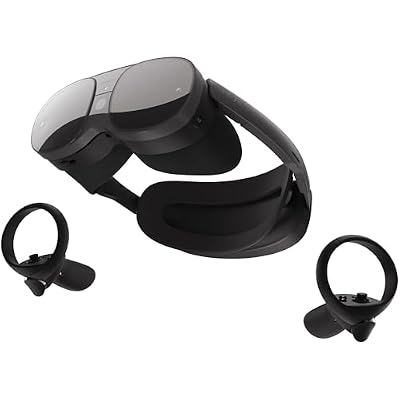
The XR Elite is the convertible pick: the battery cradle detaches and the headset folds into a glasses form for travel or media viewing, a trick nothing else here attempts. On paper it is a step down — 1920 x 1920 per eye and the same XR2 generation as the Focus Vision — but it keeps pancake lenses, full-color passthrough and both standalone and PC streaming over USB or Wi-Fi. Diopter dials adjust focus for many glasses wearers, which is rare at any tier. Buy it for the form factor, not the panels.
Specs
– Display: 1920 x 1920 per eye LCD, pancake lenses per HTC
– Refresh rate: 90Hz per HTC
– Field of view: Up to 110 degrees per HTC
– Chip: Snapdragon XR2 per HTC
– Storage and memory: 128GB, 12GB RAM per HTC
– Design: Convertible glasses mode, hot-swappable battery cradle per HTC
– Focus: Diopter adjustment dials per HTC
– Weight: 625 g with battery cradle per HTC
– Tier: Mid-range
Choose it for travel, media and mixed reality in the smallest bag footprint here. Skip it if panel resolution is your first priority.
5. Meta Quest 3S (128GB)
The Quest 3S is the budget route into the same ecosystem as the Quest 3: the same Snapdragon XR2 Gen 2 chip and the same wired and wireless PC links, wrapped around cheaper optics. The cuts are Fresnel lenses in place of pancakes, 1832 x 1920 per eye, and 128GB of storage, which fills quickly if you also load standalone games. For a buyer whose library lives on Steam, those cuts land exactly where they hurt least, and the PC experience stays close to the flagship’s. Note that Amazon rotates the game bundle attached to this listing, so check what the current listing includes.
Specs
– Display: 1832 x 1920 per eye LCD, Fresnel lenses per Meta
– Refresh rate: 90Hz, up to 120Hz in experimental mode per Meta
– Field of view: 96 degrees horizontal, 90 degrees vertical per Meta
– Chip: Snapdragon XR2 Gen 2 per Meta
– Storage and memory: 128GB, 8GB RAM per Meta
– PC connection: USB-C Link cable, Air Link and Steam Link wireless per Meta
– Weight: 515 g per Meta
– Tier: Budget
Choose it for PC VR on the smallest commitment that still runs the current chip. Skip it if you wear glasses and need the widest sweet spot, or plan a large standalone library.
Who Should Skip VR Headsets for PC Gaming
Skip the whole category if you do not own a gaming PC and do not want one; four of these five headsets run standalone, but this guide judges them as PC displays. Skip the Crystal Light if your play space is a small room or your games are fitness titles. Skip the streamed headsets if your router sits far from your play space and you will not run a cable or a dedicated access point. And skip every pick if your graphics card already struggles at 1440p on a flat screen.
Frequently Asked Questions
Can a mid-range GeForce RTX card run PC VR well?
Yes, at the right panel. The Quest 3S and Quest 3 resolutions are realistic targets for a mid-range RTX card at 90Hz, especially with DLSS in supported games. The Crystal Light and Focus Vision are high-end card territory; on a mid-range card you would lower render resolution and give back the clarity you paid for.
Is DisplayPort better than wireless streaming for PC VR?
For image purity, yes: a DisplayPort tether is uncompressed and avoids streaming latency. For freedom of movement, wireless wins, and modern streaming over a good Wi-Fi 6 router is close enough that most players stop noticing. The Focus Vision is the hedge, since its optional kit adds DisplayPort to a streaming headset.
Do the Quest 3 and Quest 3S play SteamVR games?
Yes. Both connect to a PC over a USB-C Link cable or wirelessly through Air Link or the Steam Link app, and then run SteamVR and PC Rift titles like any PC headset. The games run on your GeForce card; the headset’s own chip only handles standalone titles.
How much room do I need for PC VR?
Seated sim play needs only a chair and arm’s reach, which suits the Crystal Light. Standing and room-scale play wants a clear area of roughly two meters by two meters, more for the wireless headsets you will actually move in. All five picks draw a software boundary in that space before you play.
Final Verdict
Buy on pixel load and connection. Most RTX owners should take the Meta Quest 3 512GB for its pancake lenses and both PC link options. Choose the Pimax Crystal Light for native DisplayPort clarity in sims, the VIVE Focus Vision for eye tracking and mixed reality, the VIVE XR Elite for the convertible travel design, and the Quest 3S 128GB to enter PC VR at the budget tier. Confirm the exact storage tier and bundle on the listing before ordering, since these lineups rotate both.





Write Your Review
No reviews yet. Be the first to share your experience!